Pinanga punicea
Merr.
ArecaceaeShoots

wikimedia · cc0
Wikimedia Commons - Rijksmuseum
Wikimedia Commons - Rijksmuseum

gbif · cc0
President and Fellows of Harvard College
President and Fellows of Harvard College

gbif · cc0
President and Fellows of Harvard College
President and Fellows of Harvard College
What to Eat
Edible parts: Cabbage, Palm heart
The cabbage (palm heart) is edible.
Where to Find It
A tropical plant. It Papua New Guinea it only occurs in the Sandaun and Western Provinces. It grows in lowland rainforest.
Asia, Indonesia, Papua New Guinea, PNG, SE Asia,
Countries: United Arab Emirates, Afghanistan, Armenia, Azerbaijan, Bangladesh, Bahrain, Brunei, Bhutan, China, Georgia, Indonesia, Israel, India, Iraq, Iran, Jordan, Japan, Kyrgyzstan, Cambodia, North Korea, South Korea, Kuwait, Kazakhstan, Laos, Lebanon, Sri Lanka, Myanmar, Mongolia, Maldives, Malaysia, Nepal, Oman, Papua New Guinea, Philippines, Pakistan, Qatar, Saudi Arabia, Singapore, Syria, Thailand, Tajikistan, Timor-Leste, Turkmenistan, Turkey, Taiwan, Uzbekistan, Vietnam, Yemen
How to Identify
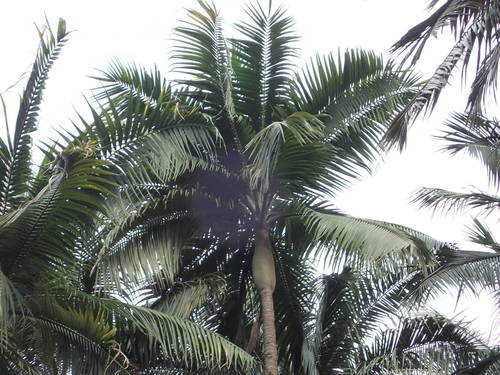
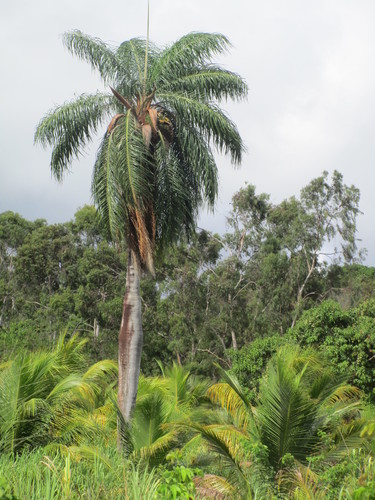
A solitary palm. The sections between the upper nodes are green. The leaf sheath forms a tube shaped crown-shaft. This has rust coloured hairs. The leaflets are along the leaf stalk.
Notes
There are about 120 Pinanga species.
References (2)
- Barfod, A.S., Banka R., and Dowe, J. L., 2001, Field Guide to Palms in Papua New Guinea. AAU Reports 40 Department of Systematic Botany University of Aarhus. Denmark. p 54
- Burkill, I.H., 1966, A Dictionary of the Economic Products of the Malay Peninsula. Ministry of Agriculture and Cooperatives, Kuala Lumpur, Malaysia. Vol 2 (I-Z) p 1759