Gnetum ula
Brongn.
Indian jointfir

iNaturalist · cc-by-sa
(c) Dinesh Valke, some rights reserved (CC BY-SA)
(c) Dinesh Valke, some rights reserved (CC BY-SA)

iNaturalist · cc-by-sa
(c) Dinesh Valke, some rights reserved (CC BY-SA)
(c) Dinesh Valke, some rights reserved (CC BY-SA)

iNaturalist · cc-by-sa
(c) Dinesh Valke, some rights reserved (CC BY-SA)
(c) Dinesh Valke, some rights reserved (CC BY-SA)
What to Eat
Edible parts: Nuts, Fruit, Seeds
The nuts, seeds, and fruit are eaten.
Where to Find It
A tropical plant. It grows in evergreen forests under shade. It occurs in the Western Ghats in India.
Asia, India,
Countries: United Arab Emirates, Afghanistan, Armenia, Azerbaijan, Bangladesh, Bahrain, Brunei, Bhutan, China, Georgia, Indonesia, Israel, India, Iraq, Iran, Jordan, Japan, Kyrgyzstan, Cambodia, North Korea, South Korea, Kuwait, Kazakhstan, Laos, Lebanon, Sri Lanka, Myanmar, Mongolia, Maldives, Malaysia, Nepal, Oman, Philippines, Pakistan, Qatar, Saudi Arabia, Singapore, Syria, Thailand, Tajikistan, Timor-Leste, Turkmenistan, Turkey, Taiwan, Uzbekistan, Vietnam, Yemen
How to Identify
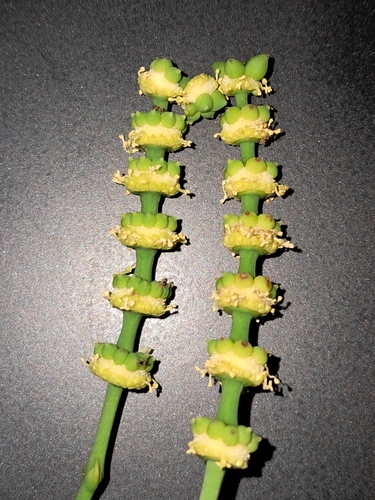
A woody climber. The leaves are opposite and narrowly oval. They are 8-18 cm long and 5-10 cm wide. The flowers are of separate sexes. The male flowers are in rings in spike like cones. These spikes are 3-5 cm long. The female spikes can occur singly or in a group. They are often on the stem. The fruit is fleshy and 8-25 mm long. There is a single hard seed.
Other Information
The oil is only used to a small extent.
Notes
There are about 28 Gnetum species.
Names & Synonyms
Anapendu, Kodkamballi, Kumbal, Lolori, Navurukatte, Nokate, Odal, Peiodal, Tolumbi, Ula, Umbli
Gnetum funiculare B.Smith in part
References (3)
- Ambasta, S.P. (Ed.), 2000, The Useful Plants of India. CSIR India. p 242
- Flora and Livestock in Coastal Karnataka. 2007, Report. EMPRI p 193
- Smith, N., et al, 2007, Amazon River Fruits. Flavors for Conservation. Missouri Botanical Gardens Press. p 134