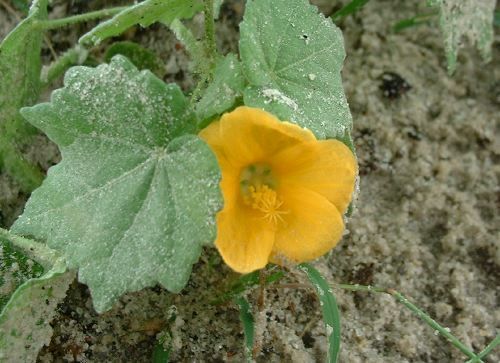
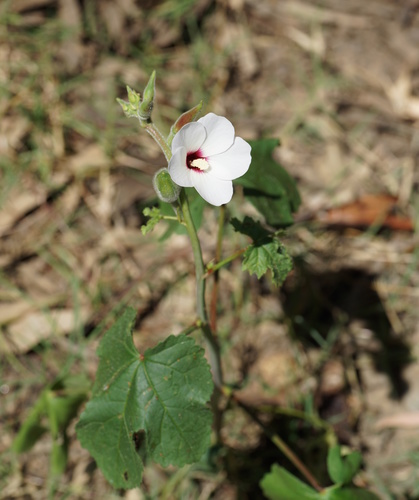
Pachira glabra
Pasq.
Saba nut, Glabrous pachira

(c) João Vitor Oliveira de Souza, some rights reserved (CC BY-NC), uploaded by João Vitor Oliveira de Souza
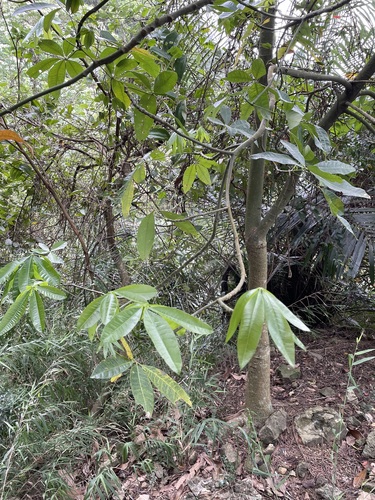
(c) liushengyu, some rights reserved (CC BY-NC), uploaded by liushengyu
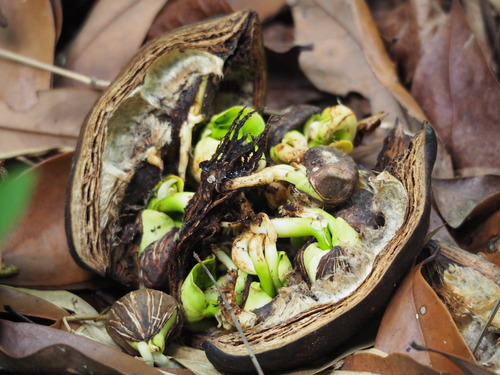
no rights reserved, uploaded by 葉子
What to Eat
Edible parts: Seeds, Nuts, Vegetable, Leaves
The seeds can be eaten raw or cooked — boiled or roasted like chestnuts, they are rich in oil and similar to groundnuts in flavour. This plant is also known as the Pachira nut. The young leaves are also said to be eaten.
Where to Find It
A tropical plant. It is native to Central America. It grows on alluvial plains and lowland rainforests. It suits humid locations. In Townsville BG.
Africa, Amazon, Angola, Australia, Brazil*, Central Africa, Central America, Congo DR, Guianas, Liberia, Mexico, Nigeria, North America, Pacific, Puerto Rico, Sao Tome and Principe, Sierra Leone, Solomon Islands, South America, St Lucia, West Africa, West Indies,
How to Identify
A small tree. It grows 17 m high. The trunk is bright green. The leaves have 5-7 leaflets. The leaves have long leaf stalks. The flowers come out at night. They have light green strap-like petals. The stamen are white and curved. The fruit is a green capsule 12.5 cm long. It contains many large seed. It is like a cocoa pod. There are 10-24 seeds.
Nutrition Score: 29/100
| Part | Moisture | kJ | kcal | Protein | Vit A | Vit C | Iron | Zinc |
|---|---|---|---|---|---|---|---|---|
| Seeds | 66 | — | — | 34.1 | — | — | — | — |
How to Grow
Plants are grown from seed. Cuttings or air-layering can also be used. The seeds are harvested from the fruit once they are open. Seeds are sown when fresh. They germinate in 5-10 days. The rate of germination is high. Seedlings can be transplanted into the field in 4 months.
Propagation: Seed is best sown as soon as it is ripe in a partially shaded position in individual containers. Germination rates of virtually 100% can be expected, with seeds sprouting within 5–10 days. Seedlings develop quickly and should be ready to plant out 3–4 months later. Cuttings root easily. Layering is also possible.
Medicinal Uses
None known.
Other Uses
The plant is easily propagated from cuttings and is widely used as a hedge in coastal regions of Brazil. It is sometimes grown to provide shade in cocoa plantations. The wood is very light, soft, with loose tissue and low natural durability; it is occasionally used to make light objects such as boxes, rulers, and toys.
Wikipedia
Source ↗Pachira glabra (syn. Bombacopsis glabra) is a tropical wetland tree in the mallow family, Malvaceae, native to eastern Brazil, where it grows along waterways. It is generally known by the nonscientific names Guinea peanut, French peanut, Saba nut, money tree, and lucky tree. It shares many of these common names with the similar P. aquatica.
Production
Plants grow quickly. They can be 3.5 m tall in 2 years.
Notes
Also put in the family Bombacaceae. In the subfamily Bombacoideae.
Names & Synonyms
Amendoim-de-arvore, American chestnut, Cacau-do-maranhao, Cacau-selvagem, Castanha-da-praia, Castanha-do-maranhao, Castano de Guinea, Kalanga ya wazungu, Mamorana, Nguba nquela, Nguba mputu, “Pachira nut"
References (24)
- Barwick, M., 2004, Tropical and Subtropical Trees. A Worldwide Encyclopedic Guide. Thames and Hudson p 307
- Bull. Jard. Bot. Etat 33:207. 1963
- Grandtner, M. M. & Chevrette, J., 2013, Dictionary of Trees, Volume 2: South America: Nomenclature, Taxonomy and Ecology. Academic Press p 471
- Grubben, G. J. H. and Denton, O. A. (eds), 2004, Plant Resources of Tropical Africa 2. Vegetables. PROTA, Wageningen, Netherlands. p 563
- Hedrick, U.P., 1919, (Ed.), Sturtevant's edible plants of the world. p 459 (As Pachira grandiflora)
- Jardin, C., 1970, List of Foods Used In Africa, FAO Nutrition Information Document Series No 2.p 95 (As Pochota glabra)
- Karhagomba, I. B., et al, 2013, The cultivation of wild food and medicinal plants for improving community livelihood: The case of the Buhozi site, DR Congo. Nutrition Research and Practice (Nutr Res Pract) 2013;7(6):510-518 (As Bombacopsis glabra)
- Latham, P., 2004, Useful Plants of Bas-Congo province. Salvation Army & DFID p 211
- Lautenschläger, T., et al, 2018, First large-scale ethnobotanical survey in the province of Uíge, northern Angola. Journal of Ethnobiology and Ethnomedicine (2018) 14:51
- Le Bellec, F et V. Renard. 1997. Le grand livre des fruits tropicaux. Orphie ed
- Lorenzi, H., 2002, Brazilian Trees. A Guide to the Identification and Cultivation of Brazilian Native Trees. Vol. 01 Nova Odessa, SP, Instituto Plantarum p 75
- Lorenzi, H., Bacher, L., Lacerda, M. & Sartori, S., 2006, Brazilian Fruits & Cultivated Exotics. Sao Paulo, Instituto Plantarum de Estuados da Flora Ltda. p 160
- Lyle, S., 2006, Discovering fruit and nuts. Land Links. p 306
- Martin, F.W. & Ruberte, R.M., 1979, Edible Leaves of the Tropics. Antillian College Press, Mayaguez, Puerto Rico. p 179 (As Pochota glabra)
- Martin, F. W., et al, 1987, Perennial Edible Fruits of the Tropics. USDA Handbook 642 p 84 (As Pachira grandiflora)
- Menninger, E.A., 1977, Edible Nuts of the World. Horticultural Books. Florida p 65 (As Pachira grandiflora)
- Paz, F. S., et al, 2021, Edible Fruit Plant Species in the Amazon Forest Rely Mostly on Bees and Beetles as Pollinators. Journal of Economic Entomology, XX(XX), 2021, 1–13 (As Bombacopsis glabra)
- Rivero, J. A., y Brunner, B. R., 2007, Arborels frutales exoticas y poco conocidos en Puerto Rico. Universidad de Puerto Rico. p 45 (As Pachira glabra)
- Savill, P. S. & Fox, J. E. D., Trees of Sierra Leone. p 45 (As Pochota glabra)
- Segura, S., et al, 2018, The edible fruit species in Mexico. Genet Resour Crop Evol (2018) 65:1767–1793
- Smith, N., Mori, S.A., et al, 2004, Flowering Plants of the Neotropics. Princeton. p 56 and p 57 (As Pachira grandiflora)
- Voorhoeve, A. G., 1965, Liberian high forest trees. Pudoc p 73 (As Bombacopsis glabra)
- World Checklist of Useful Plant Species 2020. Royal Botanic Gardens, Kew
- www.colecionandofrutas.org