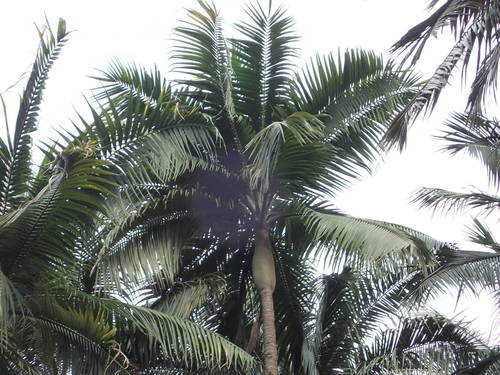
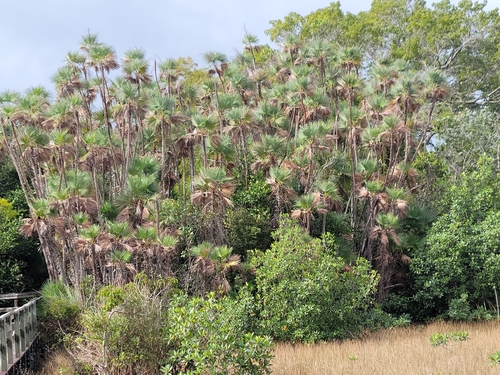
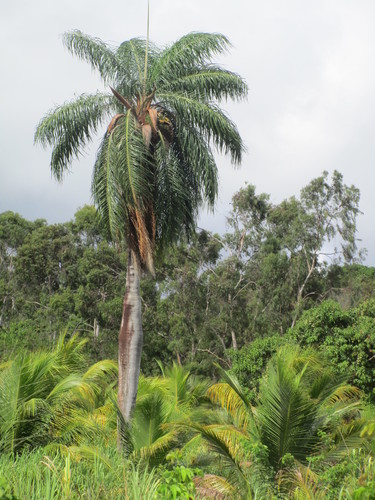
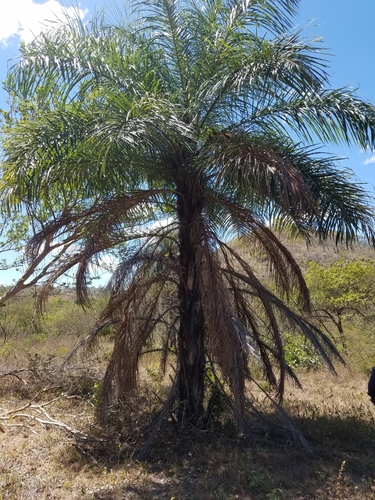
Desmoncus polyacanthos var. prunifer
(Mart.) Henderson
Jacitara
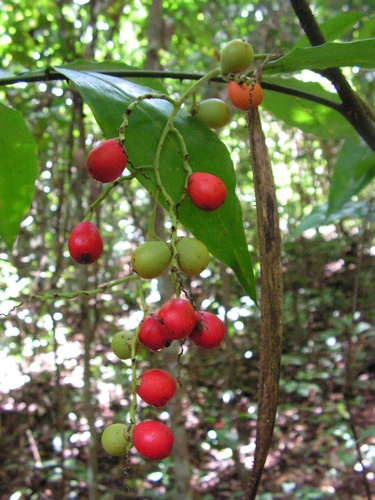
(c) Tarciso Leão, some rights reserved (CC BY-NC)

(c) Guillaume Léotard, some rights reserved (CC BY-NC), uploaded by Guillaume Léotard

(c) Julien Piolain, some rights reserved (CC BY-NC)
What to Eat
Edible parts: Fruit, Nuts, Kernel
The acid-sweet fruits are eaten. The nuts and kernels are also edible portions.
Where to Find It
A tropical plant. They grow along river banks and in open areas. They grow from sea level to 1000 m altitude.
Amazon, Brazil, Colombia, Ecuador, Guianas, Guyana, Peru, South America, Suriname, Venezuela,
How to Identify
A palm with a cluster of stems. They are 2-15 m tall. The stems are 0.5-2 cm across. There are 15-25 leaves. They are in two rows on either side of the stem. The sheath has black or brown spines. These are 2 cm long. The leaf stalk has spines which curve backwards. There are 4-14 leaflets on either side of the leaf. These are arranged irregularly. The flowering stalk has 5-17 branches. The bract has spines which have bulbs near the base. The fruit are oval. They are 1-2.2 cm long by 0.8-1.8 cm wide. They are red or orange.
Wikipedia
Source ↗Desmoncus polyacanthos, the jacitara palm, is a spiny, climbing palm native to the southern Caribbean and tropical South America. Stems grow clustered together, and are 2–12 m long and 0.5–2 cm in diameter. Petioles, rachis, cirrus and peduncular bracts are covered with short, curved spines. Two varieties are recognised: D. polyacanthos var. polyacanthos and D. polyacanthos var. prunifer (Poepp. ex Mart.) A.J.Hend. Desmoncus polyacanthos is found in Colombia, Venezuela, Saint Vincent and the Grenadines, Trinidad and Tobago, Guyana, Suriname, French Guiana, Brazil, Bolivia, Ecuador and Peru. The stems are used for baskets and sieves.
Names & Synonyms
Bambakka, Bejuco alcalde, Espera-ai, Kawawarri, Vara casha, Voladora
References (5)
- Balick, M.J. and Beck, H.T., (Ed.), 1990, Useful palms of the World. A Synoptic Bibliography. Colombia p 596
- Hedrick, U.P., 1919, (Ed.), Sturtevant's edible plants of the world. p 269 (As Desmoncus prunifer)
- Henderson, A., Galeano, G and Bernal, R., 1995, Field Guide to the Palms of the Americas. Princeton. p 200
- Kermath, B. M., et al, 2014, Food Plants in the Americas: A survey of the domesticated, cultivated and wild plants used for Human food in North, Central and South America and the Caribbean. On line draft. p 303
- Macbride, J. F., 1960, Flora of Peru. Vol. 8, Part 1 No. 2 p 417 (As Desmoncus prunifer)