Glaucium flavum
Crantz
Yellow-horned poppy
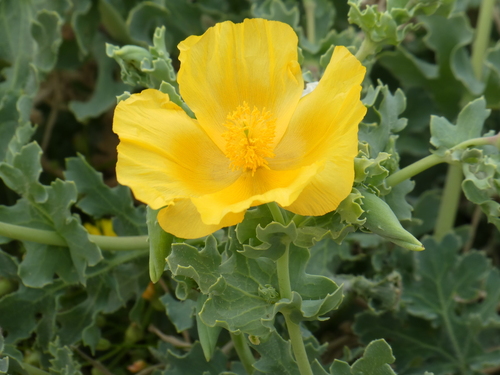
(c) Annika Rüdinger, some rights reserved (CC BY-NC), uploaded by Annika Rüdinger

(c) ton_bal, some rights reserved (CC BY-NC), uploaded by ton_bal

(c) Phil Sellens, some rights reserved (CC BY)
What to Eat
Edible parts: Seeds - oil, Caution
The seed yields a clear yellow edible oil.
Known Hazards
Where to Find It
It is a temperate plant. In Argentina it grows between 500-1,000 m above sea level. It suits hardiness zones 7-10. Tasmania Herbarium.
Africa, Argentina, Australia, Balkans, Britain, Europe, Ireland, Macedonia, Mediterranean, Middle East, Morocco, North Africa, Slovenia, South America, Spain, Tasmania,
How to Identify
A short lived poppy plant. It is a herb. It grows 100 cm high and spreads 40 cm wide. The stems are branching. The leaves are blue-green. They have lobes along the stalk and are finely hairy. There are teeth along the edge. The flowers are yellow or orange and 5 cm wide. The fruit are narrow, curved seed pods. They are 30 cm long.
How to Grow
Easily grown in any good well-drained soil. Requires a very well-drained poor soil. Prefers a hot dry position and dislikes shade. A very ornamental but short-lived perennial, it is hardy to about -10°c. Plants are resentful of root disturbance and should be placed in their final positions as soon as possible. Flowers are produced in the first year from seed.
Propagation: Sow seed in mid-spring or autumn in a cold frame. A period of cold stratification improves germination rates. Prick seedlings into individual pots as soon as they are large enough to handle and grow on under glass for at least the first winter. Plant out into permanent positions in late spring or early summer, after the last expected frosts. Where seed is plentiful, a direct outdoor sowing in situ in mid-spring is worth attempting.
Medicinal Uses
Used as a poultice.
Other Uses
Oil pressed from the seed burns cleanly and is used as a fuel for lighting. It is also used in soap making.
Wikipedia
Source ↗Glaucium flavum, the yellow horned poppy, yellow hornpoppy or sea poppy, is a summer flowering plant in the family Papaveraceae. It is native to Europe, Northern Africa, Macaronesia and temperate zones in Western Asia. The plant grows on the seashore and is never found inland. All parts of the plant, including the seeds, are toxic. It is classed as a noxious weed in some areas of North America, where it is an introduced species. It is grown in gardens as a short-lived perennial but usually grown as a biennial.
Names & Synonyms
Rumena ceduljka
References (10)
- Blamey, M and Grey-Wilson, C., 2005, Wild flowers of the Mediterranean. A & C Black London. p 61
- Cundall, P., (ed.), 2004, Gardening Australia: flora: the gardener's bible. ABC Books. p 639
- Facciola, S., 1998, Cornucopia 2: a Source Book of Edible Plants. Kampong Publications, p 166
- Hedrick, U.P., 1919, (Ed.), Sturtevant's edible plants of the world. p 329
- Heywood, V.H., Brummitt, R.K., Culham, A., and Seberg, O. 2007, Flowering Plant Families of the World. Royal Botanical Gardens, Kew. p 243
- Irving, M., 2009, The Forager Handbook, A Guide to the Edible Plants of Britain. Ebury Press p 250
- Nassif, F., & Tanji, A., 2013, Gathered food plants in Morocco: The long forgotten species in Ethnobotanical Research. Life Science Leaflets 3:17-54
- Stirp. austr. fasc. 2:133. 1763
- Tasmanian Herbarium Vascular Plants list p 43
- Uphof,