Annona sylvatica
A. St-Hil.
Araticu, Sylvan annona
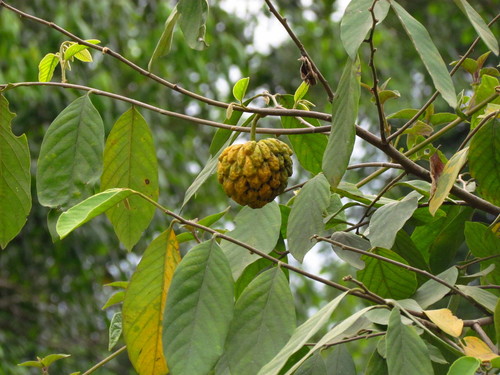
(c) Luís A. Funez, some rights reserved (CC BY-NC), uploaded by Luís A. Funez
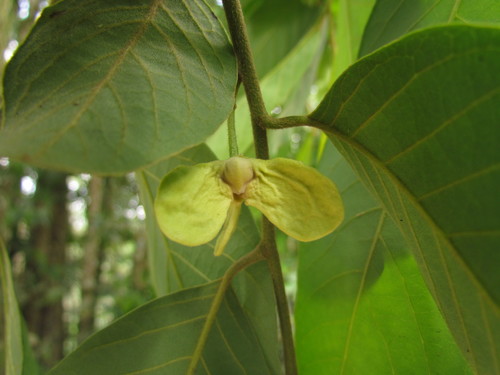
(c) Luís A. Funez, some rights reserved (CC BY-NC), uploaded by Luís A. Funez
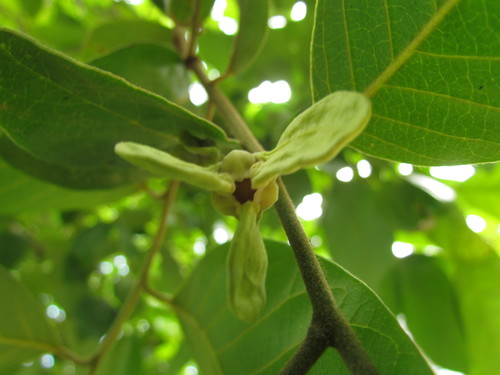
(c) Luís A. Funez, some rights reserved (CC BY-NC), uploaded by Luís A. Funez
What to Eat
Edible parts: Fruit
The fruit is edible, though the large number of seeds limits its appeal. It is occasionally cultivated as a food plant.
Where to Find It
A tropical plant. It grows in Brazil in highland semi-deciduous forest. It grows from sea level up to about 1,000 m altitude.
Argentina, Bolivia, Brazil*, Mexico, South America, Uruguay,
How to Identify
A tree. It grows 6-8 m high. The trunk is 30-40 cm across. The young growth in rusty and hairy coloured. The leaves are thin and simple. They vary in shape. They are 8-12 cm long by 3-6 cm wide. The flowers occur singly or in groups or 2-3. The fruit are compound with fleshy pulp and many seeds.
Nutrition Score: 10/100
| Part | Moisture | kJ | kcal | Protein | Vit A | Vit C | Iron | Zinc |
|---|---|---|---|---|---|---|---|---|
| Fruit | 78.6 | — | — | 1.82 | — | — | — | — |
How to Grow
The seeds are removed from the very ripe fruit by rubbing and washing. Seeds only store fro about 3 months. The seeds are scratched before sowing to improve germination. Seeds germinate in 30-60 days. The seedlings can be transplanted into the field after 6 months.
Propagation: Seed - best sown as soon as it is ripe, germination rates drop when seed is 3 months or more old. The seed germinated better if it is scarified by carefully nicking the seedcoat to allow ingress of moisture, but being careful not to damage the embryo. Sow the seed in light shade in a nursery seedbed or in containers. Germination rates are usually in excess of 60%, with the seed sprouting within 30 - 60 days. Nursery bed seedlings should be potted up into individual pots once they are 4 - 6cm tall. Plant out into permanent positions about 6 months later.
Medicinal Uses
The fruit has anticancer properties.
Other Uses
Fibres in the bark are used for making ropes. The bark can be used as an incense and was traditionally used by native women as an incense if they were having excessive menstruation. The white wood is very light, soft, satin-smooth, solidly compacted and of low natural durability. It is used for building canoes and small boats, internal work, ceiling boards, general carpentry, sculpture, making household objects etc. A fast-growing tree that produces a plentiful supply of fruit for the indigenous species, it is a good species to choose as part of a reforestry project for restoring natural forest.
Wikipedia
Source ↗Annona sylvatica (syn. Rollinia sylvatica) is a species of flowering plant in the family Annonaceae, native to Brazil. Its plentiful fruit is edible and is regularly gathered in the wild by locals, and it is occasionally cultivated. It is considered a good species to use for reforestry projects, as it is very fast growing when young.
Production
Plants grow rapidly. They can be 3.5 m high in 2 years.
Other Information
The large number of seeds limit the attractiveness of the fruit. It is occasionally cultivated as a food plant.
Notes
It has anticancer properties.
Names & Synonyms
Araticum alvadio, Araticum-cagao-macho, Araticum apo, Araticum-da-mata, Araticum-do-mato, Araticum-do-moro, Araticum-grande, Bananinha, Biriba, Corossols, Cortica-amarela, Cortica, Cortica de comer, Embira-de-araticum, Embira, Pasmada-do-mato, Pinha
References (17)
- Barbieri, R. L., et al, 2014, Agricultural Biodiversity in Southern Brazil: Integrating Efforts for Conservation and Use of Neglected and Underutilized Species. Sustainability 6:741-757 (As Rollinia sylvatica)
- Bortolotto, I. M., et al, 2018, Lista preliminar das plantas alimenticias nativas de Mato Grosso do Sul, Brasil. Iheringia, Serie Botanica, Porto Alegre, 73 (supl.):101-116 (As Rollinia sylvatica)
- Brack, P., et al, 2020, Frutas nativas do Rio Grande do Sul, Brasil: riqueza e potencial alimentício. Native fruits of Rio Grande do Sul, Brazil: richness and potential as food. Rodriguésia 71: e03102018.
- Fern, K., 2012, Tropical Species Database http://theferns.info/tropical/
- Fl. bras. 13(1):18. 1841 (As Rollinia sylvatica)
- Grandtner, M. M. & Chevrette, J., 2013, Dictionary of Trees, Volume 2: South America: Nomenclature, Taxonomy and Ecology. Academic Press p 40
- Hedrick, U.P., 1919, (Ed.), Sturtevant's edible plants of the world. p 572 (As Rollinia sylvatica)
- Kermath, B. M., et al, 2014, Food Plants in the Americas: A survey of the domesticated, cultivated and wild plants used for Human food in North, Central and South America and the Caribbean. On line draft. p 752 (As Rollinia sylvatica)
- Kinupp, V. F., 2007, Plantas alimenticias nao-convencionais da regiao metropolitana de Porto Alegre, RS, Brazil p 60 (As Rollinia sylvatica)
- Lorenzi, H., 2002, Brazilian Trees. A Guide to the Identification and Cultivation of Brazilian Native Trees. Vol. 01 Nova Odessa, SP, Instituto Plantarum p 32 (As Rollinia sylvatica)
- Lorenzi, H., Bacher, L., Lacerda, M. & Sartori, S., 2006, Brazilian Fruits & Cultivated Exotics. Sao Paulo, Instituto Plantarum de Estuados da Flora Ltda. p 57 (As Rollinia sylvatica)
- Maas, P. J. M., et al, 1992, Rollinia, Flora Neotropica Vol. 57. p 148 (As Rollinia sylvatica)
- Martin, F. W., et al, 1987, Perennial Edible Fruits of the Tropics. USDA Handbook 642 p 81 (As Rollinia sylvatica and Annona exalbida)
- Oliviera V. B., et al, 2012, Native foods from Brazilian biodiversity as a source of bioactive compounds. Food Research International 48 (2012) 170-179 (As Rollinia sylvatica)
- Pereira, M. C., et al, 2012, Characterisation, bioactive compounds and antioxidant potential of three Brazilian fruits. Journal of Food Composition and Analysis. 29(2013):19-24 (As Rollinia sylvatica)
- Segura, S. et al, 2018, The edible fruit species in Mexico. Genet Resour Crop Evol (2018) 65:1767–1793
- www.colecionandofrutas.org


