Musa uranoscopus
Loureiro
Red-flowering banana, Scarlet banana
MusaceaeFruit

iNaturalist · cc-by-nc
(c) Gabe Sachter-Smith, some rights reserved (CC BY-NC)
(c) Gabe Sachter-Smith, some rights reserved (CC BY-NC)
iNaturalist · cc-by-nc-sa
(c) Nuno Veríssimo P., some rights reserved (CC BY-NC-SA)
(c) Nuno Veríssimo P., some rights reserved (CC BY-NC-SA)

iNaturalist · cc-by-nc
(c) Gabe Sachter-Smith, some rights reserved (CC BY-NC)
(c) Gabe Sachter-Smith, some rights reserved (CC BY-NC)
What to Eat
Edible parts: Fruit
The fruit is edible.
Where to Find It
A tropical plant. It grows in rich, well-drained soils in full sun. It suits hardiness zones 10-12.
Asia, Australia, China*, Hawaii, Indochina, Indonesia, Pacific, Philippines, SE Asia*, USA,
Countries: United Arab Emirates, Afghanistan, Armenia, Australia, Azerbaijan, Bangladesh, Bahrain, Brunei, Bhutan, China, Fiji, Micronesia, Georgia, Indonesia, Israel, India, Iraq, Iran, Jordan, Japan, Kyrgyzstan, Cambodia, Kiribati, North Korea, South Korea, Kuwait, Kazakhstan, Laos, Lebanon, Sri Lanka, Marshall Islands, Myanmar, Mongolia, Maldives, Malaysia, Nepal, Nauru, New Zealand, Oman, Papua New Guinea, Philippines, Pakistan, Palau, Qatar, Saudi Arabia, Solomon Islands, Singapore, Syria, Thailand, Tajikistan, Timor-Leste, Turkmenistan, Tonga, Turkey, Tuvalu, Taiwan, United States, Uzbekistan, Vietnam, Vanuatu, Samoa, Yemen
How to Identify
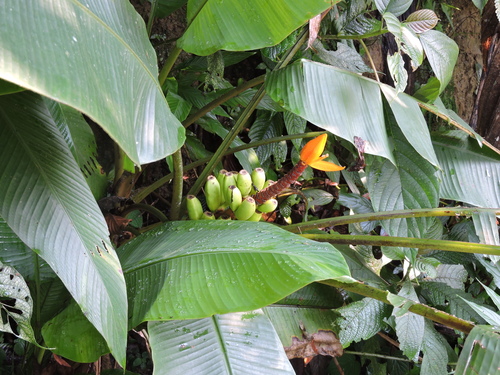
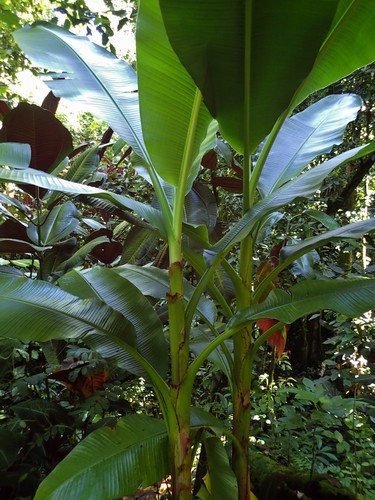
A banana plant with a glossy reddish-green false stem. It grows about 1 m tall. The leaves are glossy and oval. Often they are red at the edges. They are arranged in spirals. The flower heads are erect. The bracts are pink to red. The fruit are oblong and reddish purple. They ripen orange-yellow.
How to Grow
Plants can be grown by dividing the clump.
Names & Synonyms
Pisang skarlet
Musa coccinea H.C. Andrews
References (5)
- Coronel, R.E., 1982, Fruit Collections in the Philippines. IBPGR Newsletter p 10
- Cundall, P., (ed.), 2004, Gardening Australia: flora: the gardener's bible. ABC Books. p 905
- Fl. cochinch. 2:645. 1790
- Staples, G.W. and Herbst, D.R., 2005, A tropical Garden Flora. Bishop Museum Press, Honolulu, Hawaii. p 710
- Sukarya, D. G., (Ed.) 2013, 3,500 Plant Species of the Botanic Gardens of Indonesia. LIPI p 1125