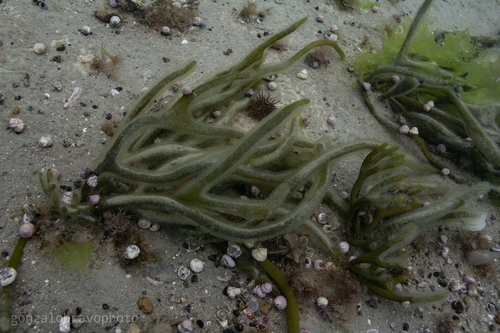
Codium geppiorum
O. C. Schmidt
Sagati
(c) Joachim Louis, some rights reserved (CC BY-NC-ND), uploaded by Joachim Louis

(c) Alastair Potts, some rights reserved (CC BY-NC), uploaded by Alastair Potts
What to Eat
Edible parts: Algae, Fronds, Seaweed
The fronds are edible and can be used fresh in salads, offering a pleasant nutty flavor.
Where to Find It
It is a tropical plant. It grows only in shaded places. It grows in lower tidal zones and in sheltered and partly exposed shores.
Africa, Australia, China, East Africa, Fiji, Hawaii, Indochina, Indonesia, Kenya, Malaysia, Maldives, Mauritius, Micronesia, Middle East, New Zealand, Oman, Pacific, Papua New Guinea, PNG, Philippines, Samoa, SE Asia, Seychelles, Singapore, Solomon Islands, Sri Lanka, Taiwan, Tanzania, Thailand, USA, Vietnam,
How to Identify
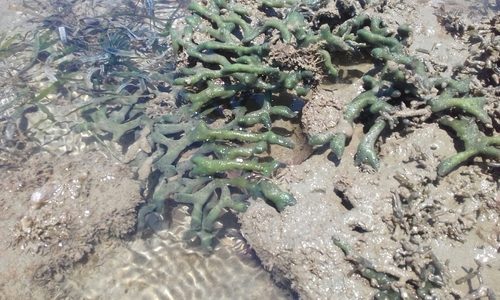
A seaweed. It is made up of filaments or threads. They are clear with an outer layer of green. The branches are club shaped and closely pressed together but not joined. It is slender. The branches lie over.
Wikipedia
Source ↗Codium geppiorum is a species of seaweed in the Codiaceae family. The procumbent and densely branched thallus forms patches that are about 8 centimetres (3.1 in) wide that are attached to sandy substrates with tufts of rhizoids. It epilithic and is found in the intertidal and subtidal zones. In Western Australia is found along the coast in Kimberley and Pilbara regions. It is also widespread throughout the Indian and Pacific Oceans.
Names & Synonyms
Sagati, Totoyava
References (4)
- Cribb, A.B., 1996, Seaweeds of Queensland A Naturalist's Guide. The Queensland Naturalists' Club Handbook No. 2. p 27
- Jansen, A. A. J., et al, (Eds), 1990, Food and Nutrition in Fiji. Volume One. p 55 (As Codium geppii)
- Womersley, H.B. S. & Bailey, A., 1970, Marine algae of the Solomon Islands. Philosophical Transactions of the Royal Society of London. B. Biological Sciences 259:257-352 (As Codium geppii)
- www.algaebase.org