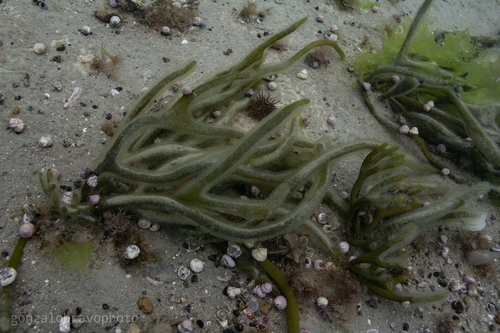
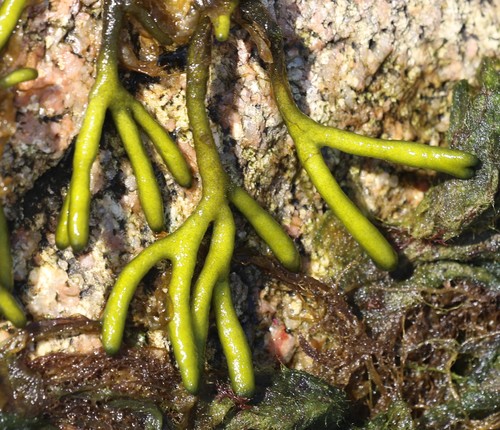
Codium bursa
(Olivi) C. Agardh
CodiaceaeSeaweed

iNaturalist · cc-by-nc
(c) Sylvain Le Bris, some rights reserved (CC BY-NC), uploaded by Sylvain Le Bris
(c) Sylvain Le Bris, some rights reserved (CC BY-NC), uploaded by Sylvain Le Bris

iNaturalist · cc-by-nc
(c) Tomas Cedhagen, some rights reserved (CC BY-NC), uploaded by Tomas Cedhagen
(c) Tomas Cedhagen, some rights reserved (CC BY-NC), uploaded by Tomas Cedhagen

iNaturalist · cc-by-nc
(c) 107120830535687523870, some rights reserved (CC BY-NC), uploaded by 107120830535687523870
(c) 107120830535687523870, some rights reserved (CC BY-NC), uploaded by 107120830535687523870
What to Eat
Edible parts: Seaweed, Algae
The seaweed and algae are edible.
Where to Find It
It is a Mediterranean climate plant.
Atlantic, Europe, Mediterranean, New Zealand, Turkey, Türkiye,
Countries: Andorra, Albania, Austria, Bosnia & Herzegovina, Belgium, Bulgaria, Belarus, Switzerland, Cyprus, Czechia, Germany, Denmark, Algeria, Estonia, Egypt, Spain, Finland, France, United Kingdom, Greece, Croatia, Hungary, Ireland, Israel, Iceland, Italy, Lebanon, Liechtenstein, Lithuania, Luxembourg, Latvia, Libya, Morocco, Monaco, Moldova, Montenegro, North Macedonia, Malta, Netherlands, Norway, Poland, Portugal, Romania, Serbia, Russia, Sweden, Slovenia, Slovakia, San Marino, Syria, Tunisia, Turkey, Ukraine
How to Identify
A medium-sized green marine algae growing to 30 centimeters across, appearing as a spongy dark green sphere with a velvety texture. It is composed of loosely packed filaments with single-celled, bladder-like or club-shaped utricles that form a cortex at the surface, and attaches to rock via a holdfast. It is found in the Atlantic from the Canary Islands to the British Isles and throughout Mediterranean regions.
References (1)
- Pereira, L., Edible Seaweeds of the World.