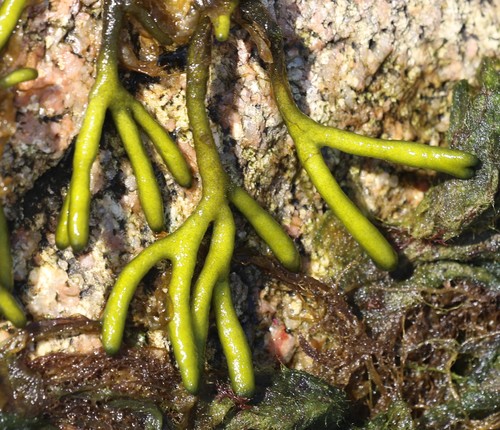
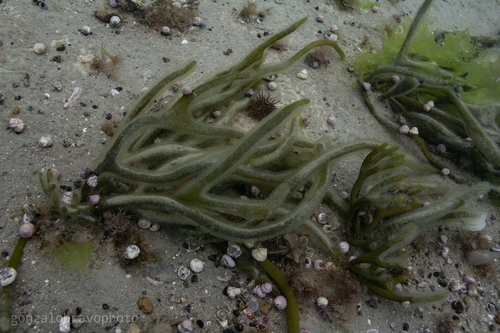
Codium decorticatum
(Woodward) M. A. Howe
CodiaceaeSeaweed
iNaturalist · cc-by-nc
(c) Gonzalo Bravo, some rights reserved (CC BY-NC), uploaded by Gonzalo Bravo
(c) Gonzalo Bravo, some rights reserved (CC BY-NC), uploaded by Gonzalo Bravo

iNaturalist · cc-by-nc
(c) Sarka Martinez, some rights reserved (CC BY-NC), uploaded by Sarka Martinez
(c) Sarka Martinez, some rights reserved (CC BY-NC), uploaded by Sarka Martinez

iNaturalist · cc-by-nc
(c) Sarka Martinez, some rights reserved (CC BY-NC), uploaded by Sarka Martinez
(c) Sarka Martinez, some rights reserved (CC BY-NC), uploaded by Sarka Martinez
What to Eat
Edible parts: Algae, Seaweed
The seaweed/algae is eaten.
Where to Find It
It is a tropical and subtropical plant.
Asia, Australia, Caribbean, China, Hawaii, India, Indonesia, Pacific, Philippines, SE Asia,
Countries: United Arab Emirates, Afghanistan, Armenia, Australia, Azerbaijan, Bangladesh, Bahrain, Brunei, Bhutan, China, Fiji, Micronesia, Georgia, Indonesia, Israel, India, Iraq, Iran, Jordan, Japan, Kyrgyzstan, Cambodia, Kiribati, North Korea, South Korea, Kuwait, Kazakhstan, Laos, Lebanon, Sri Lanka, Marshall Islands, Myanmar, Mongolia, Maldives, Malaysia, Nepal, Nauru, New Zealand, Oman, Papua New Guinea, Philippines, Pakistan, Palau, Qatar, Saudi Arabia, Solomon Islands, Singapore, Syria, Thailand, Tajikistan, Timor-Leste, Turkmenistan, Tonga, Turkey, Tuvalu, Taiwan, United States, Uzbekistan, Vietnam, Vanuatu, Samoa, Yemen
How to Identify
A tropical and subtropical seaweed belonging to the Codiaceae family.
References (1)
- Pereira, L., Edible Seaweeds of the World. CRC Press.