Syagrus macrocarpa
Barb. Rodr.
Maria rosa palm

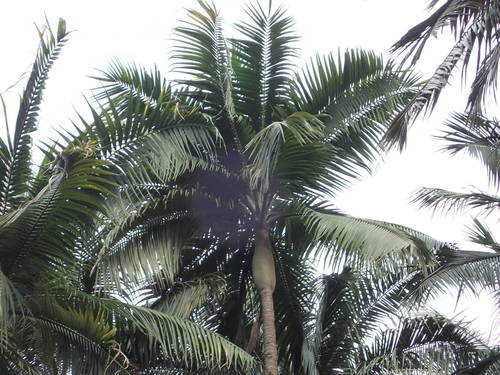
(c) Marcio Santos Ferreira, some rights reserved (CC BY-NC), uploaded by Marcio Santos Ferreira
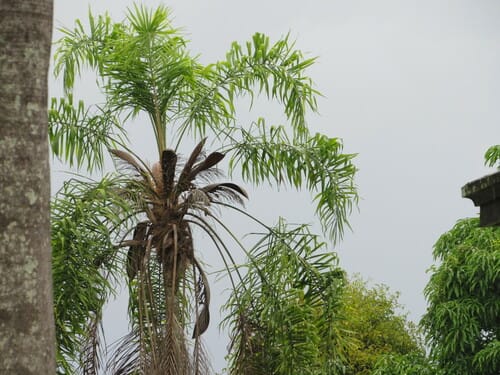
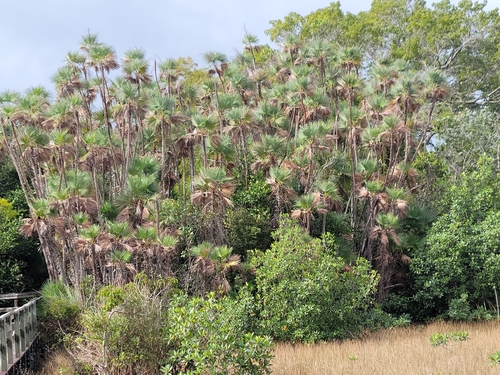
(c) entreespinhoseferroes, some rights reserved (CC BY-NC)

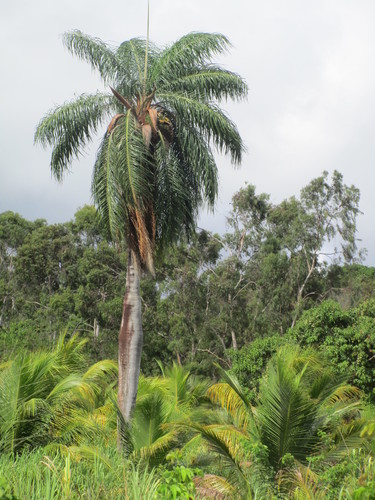
(c) entreespinhoseferroes, some rights reserved (CC BY-NC)
What to Eat
Edible parts: Fruit, Nuts
Fruit - raw. A fibrous, mucilaginous pulp with a slightly sweet flavour. The fruit is about 8cm long and 6cm wide. Seed - raw.
Where to Find It
A tropical plant. It grows on rocky and sandy soils in seasonal forest in Brazil.
Asia, Brazil*, Indonesia, SE Asia, South America,
How to Identify
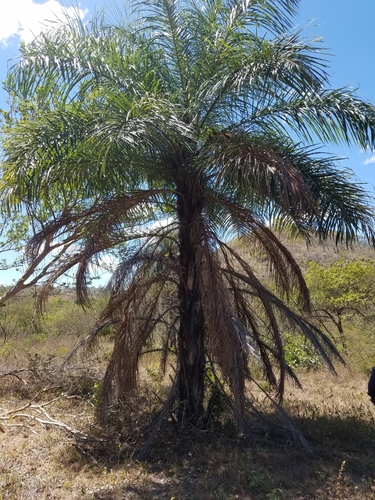
A palm. It has a single stem. It grows 4-8 m tall. The trunk can be 10-20 cm across. There are 15-20 leaves. The dead leaves sometimes hang on the palm. The leaf stalk is 1.2-2.2 m long. The leaflets are arranged with 110-153 on each side. They are stiff and in clusters of 3-5. The flowering stalk is 80 cm long. There are 36-70 flowering branches. The fruit are narrowly oval. They are 6.5-7 cm long and 3-3.2 cm wide. They are green.
How to Grow
Plants are grown from seed.
Propagation: Seed - very difficult to germinate, with rates typically about 5%.
Wikipedia
Source ↗Syagrus macrocarpa is a rare species of palm found only as scattered isolated individuals and small groups in the east of the Brazilian states of Espírito Santo, Minas Gerais and Rio de Janeiro. It grows to 4-10m tall, with 8-20 leaves to 2m long. The leaves are bent at the end, with very hairy margins near the trunk, and consist of 180-320 slightly coiled leaflets irregularly arranged in several planes on the rake. The fruit are oval, greenish-yellow, 6–9 cm long. It is grown in cultivation. Seeds are difficult to germinate, with low rates of germination. Common names for it in Minas Gerais are baba-de-boi-grande and maria-rosa. Unlike most other species of Syagrus, this species started in 1879 as a Syagrus, as João Barbosa Rodrigues classified it along with Karl von Martius' S. cocoides. Three years later Rodrigues synonymised the genus Syagrus with Cocos (it was resurrected in 1916 by Beccari). It is quite similar to Syagrus romanzoffiana, but differs by being smaller, with smaller leaves and inflorescence, but with much larger fruit and female flowers. Unlike the spiral placement of the racemes (branches) of the inflorescence in S. romanzoffiana, S. macrocarpa has its racemes unilaterally arranged. S. cocoides also is similar, but has smaller fruit and spirally placed racemes in the inflorescence. Noblick, writing for the IUCN in 1998, mentions his concern that the scattered nature of the population might harm the species in the long term due to inbreeding.
Names & Synonyms
Arioba, Jurua, Mri-rosa, Palem maria rosa
References (4)
- Balick, M.J. and Beck, H.T., (Ed.), 1990, Useful palms of the World. A Synoptic Bibliography. Colombia p 131 (As Cocos getuliana)
- Lorenzi, H., Bacher, L., Lacerda, M. & Sartori, S., 2006, Brazilian Fruits & Cultivated Exotics. Sao Paulo, Instituto Plantarum de Estuados da Flora Ltda. p 93
- Prot.-app. enum. palm. nov. 46, 48. 1879
- Sukarya, D. G., (Ed.) 2013, 3,500 Plant Species of the Botanic Gardens of Indonesia. LIPI p 820