Syagrus amara
(Jacq.) Mart.
Overtop palm

(c) Forest and Kim Starr, some rights reserved (CC BY)

(c) Javier Alejandro, some rights reserved (CC BY-NC-ND)

(c) Forest and Kim Starr, some rights reserved (CC BY)
What to Eat
Edible parts: Sap, Fruit, Palm heart, Cabbage
The sweet sap from the flowering stalk is tapped and traditionally fermented into wine. The fruits are fermented for beverages. The kernels are eaten, though bitter. The palm heart and sap are also consumed.
Where to Find It
A tropical plant. It grows naturally in the Lesser Antilles below 300 m altitude. In Brisbane Botanical gardens. In XTBG Yunnan. In Townsville palmetum.
Antilles, Asia, Australia, Central America*, China Cuba, Dominica, Guadeloupe, Martinique, St Lucia, West Indies,
How to Identify
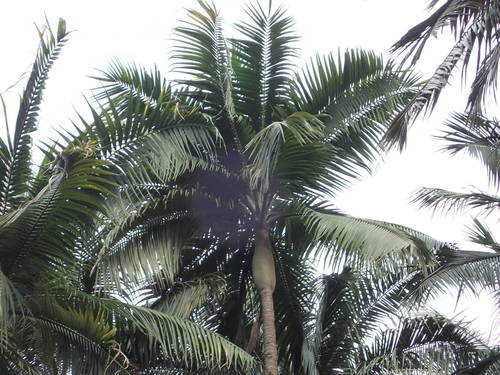
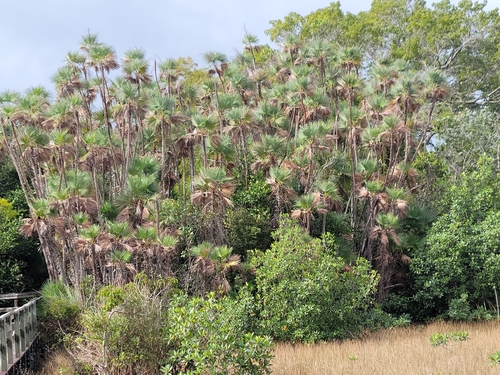
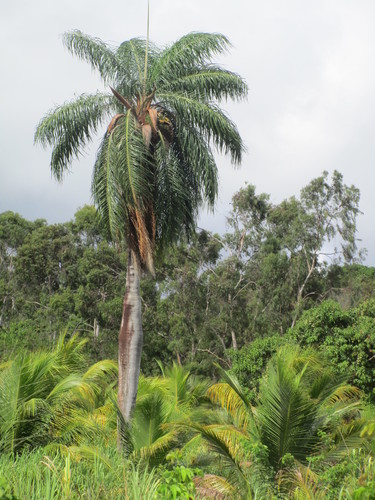
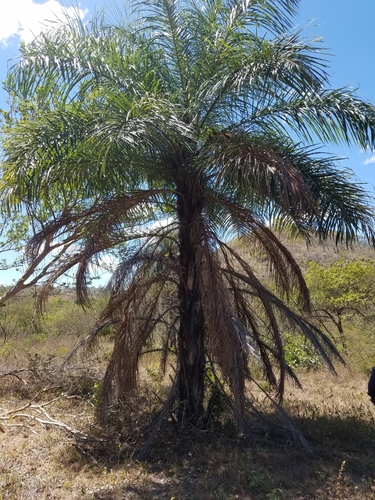
A palm. It has a single stem. It is 15-20 m tall and 10-20 cm across. The trunk is swollen at the base. There are 12-15 leaves and they are 3 m long. There are 102-106 leaflets on each side and these are rigid. They are arranged in irregular clusters of 2-3. They spread out at different planes but are not feathery. The flowering stalk has about 50 flowering branches. The fruit are oval and 5-7 cm long and 3.5 cm wide.
Names & Synonyms
Coco nain, Iataho, Kokoye, Mocho, Petit coco de bois, Yataw, Yattahou
References (6)
- Balick, M.J. and Beck, H.T., (Ed.), 1990, Useful palms of the World. A Synoptic Bibliography. Colombia p 291, 296,
- A. D. d'Orbigny, Voy. Amerique mer. 7(3). Palmiers 132. 1847
- Henderson, A., Galeano, G and Bernal, R., 1995, Field Guide to the Palms of the Americas. Princeton. p 143
- Hodges, W.H., 1957, Rhyticocos amara. Principes 1(5): 176-179
- James, A., 2009, Notes on the Uses of Dominica's Native Palms. Palms, Vol. 53(2): p 65
- Kermath, B. M., et al, 2014, Food Plants in the Americas: A survey of the domesticated, cultivated and wild plants used for Human food in North, Central and South America and the Caribbean. On line draft. p 841