Attalea microcarpa
Mart.
Coco curua palm, Mountain maripa palm
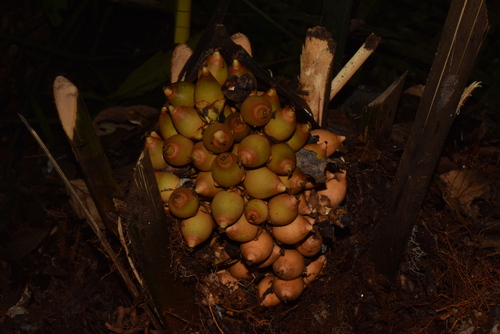
(c) Fred Cristian Ramírez Guerra, some rights reserved (CC BY-NC), uploaded by Fred Cristian Ramírez Guerra
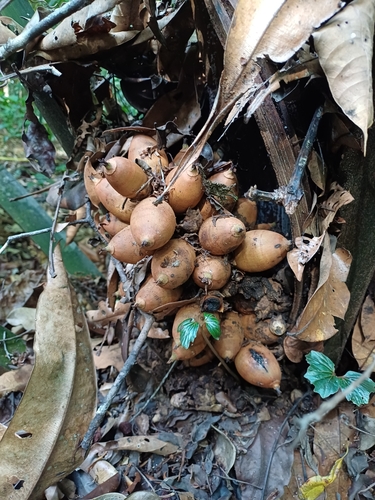
(c) Maël Lemaitre, some rights reserved (CC BY-NC)
What to Eat
Edible parts: Fruit, Seeds, Buds, Sap
The immature endosperm of the fruit and seeds are eaten, the buds are consumed, and the sap is fermented into a drink.
Where to Find It
A tropical plant. It grows in lowland rainforests near the edges of the forest. It is in wet places at low altitudes.
Amazon, Asia, Brazil, Colombia, French Guiana, Guianas, Guyana, Indonesia, Peru, SE Asia, South America*, Suriname, Venezuela,
How to Identify
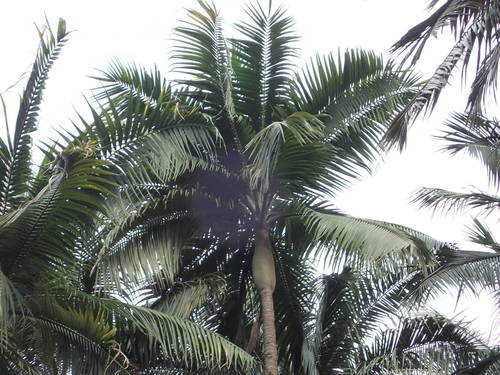
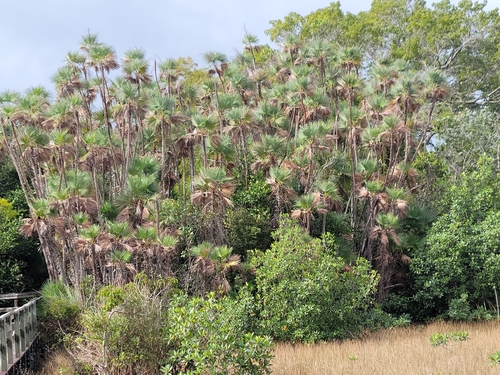
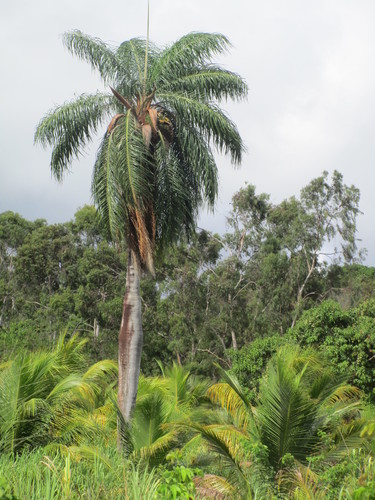
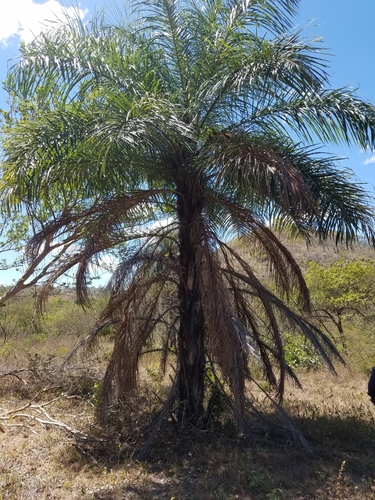
A palm. The stems are short and underground. There are 6-16 leaves. The leaflets are arranged regularly and spread in the same plane. The flowering stalks are erect and borne among the leaves. The male flowers have flattened petals which curve inwards. There are 9-15 tightly coiled and twisted stamens. The fruit have 1-3 seeds. They are oval and 3.5-4 cm long and 2-3 cm wide. They are dark orange.
How to Grow
Plants can be grown from seed.
Notes
There are between (22) 30-71 Attalea species. Some authorities divide them among Attalea, Orbignya, Scheela and Maximiliana.
Names & Synonyms
Catarina, Mabaco, Macoupi, Mavaco, Palem maripa, Shapaja
References (11)
- Balick, M.J. and Beck, H.T., (Ed.), 1990, Useful palms of the World. A Synoptic Bibliography. Colombia p 401 (As Orbignya polysticha),
- Etkin, N.L. (Ed.), 1994, Eating on the Wild Side, Univ. of Arizona. p 122, 140 (As Orbignya polysticha)
- Henderson, A., Galeano, G and Bernal, R., 1995, Field Guide to the Palms of the Americas. Princeton. p 162
- Kermath, B. M., et al, 2014, Food Plants in the Americas: A survey of the domesticated, cultivated and wild plants used for Human food in North, Central and South America and the Caribbean. On line draft. p 109
- Lopez-Diago, D. & Garcia, N., 2021, Wild edible fruits of Colombia. Biota ColomBiana 22 (2) p 31 (As Attalea sagotii)
- Macbride, J. F., 1960, Flora of Peru. Vol. 8, Part 1 No. 2 p 385 (As Orbignya polysticha)
- Marcia, M. J., et al, 2011, Palm Uses in Northwestern South America: A Quantitative Review. Bot. Rev. (2011) 77:462-570
- Roa, J. A. G. & Boada, D. S. G., 2018, Fundación para el Fortalecimiento de la Fruticultura y Plantas Alimenticias no Convencionales en Colombia.
- Sukarya, D. G., (Ed.) 2013, 3,500 Plant Species of the Botanic Gardens of Indonesia. LIPI p 757
- Vasquez, R. and Gentry, A. H., 1989, Use and Misuse of Forest-harvested Fruits in the Iquitos Area. Conservation Biology 3(4): 350f (As Orbignya polysticha)
- World Checklist of Useful Plant Species 2020. Royal Botanic Gardens, Kew