Thrinax radiata
Lodd. ex Schult. & Schult.f.
Florida thatch palm

(c) Drew Avery, some rights reserved (CC BY)
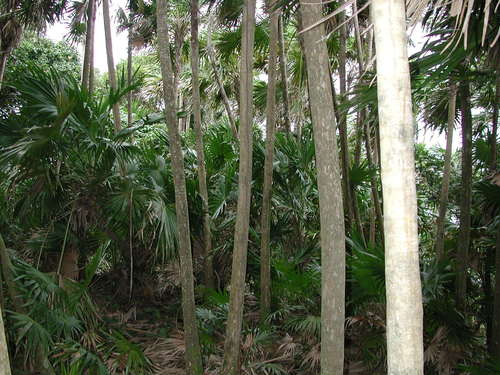
(c) Ryne Rutherford, some rights reserved (CC BY-NC)
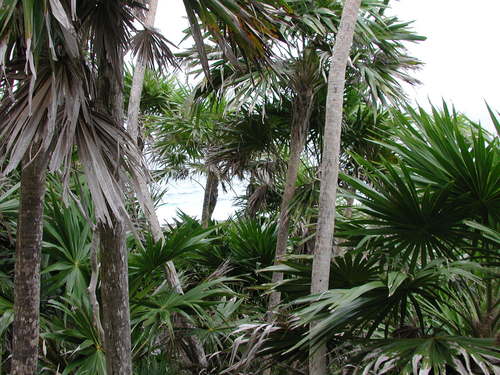
(c) Ryne Rutherford, some rights reserved (CC BY-NC)
What to Eat
Edible parts: Fruit
This species is commonly used as a landscaping tree along roadways and in residential areas in South Florida (zone 10b and 11a). Today, it is being widely planted outside of its natural historic range in South Florida and the Caribbean because of its ability to grow under various conditions. It is used by gardeners and can be grown in containers or in arboretums, which showcase this species' prolific inflorescences and fruit. Its common name derives from the use of its fronds in thatched roofing. Its fronds are the most used part of the palm, being utilized in broom construction, handicrafts, and food wrapping. T. radiata's white fruit are edible. Its trunks have recently been used to construct lobster traps by fishermen in the Yucatán Peninsula.
Where to Find It
A tropical plant. It grows in coastal regions on limestone or sandy soils close to the sea. It is very tolerant to drought. In Townsville Palmetum.
Asia, Australia, Bahamas, Belize, Caribbean*, Central America, Cuba*, Dominican Republic, Haiti*, Hawaii, Honduras, India, Indonesia, Jamaica*, Mexico*, North America, Pacific, SE Asia, USA, West Indies,
How to Identify
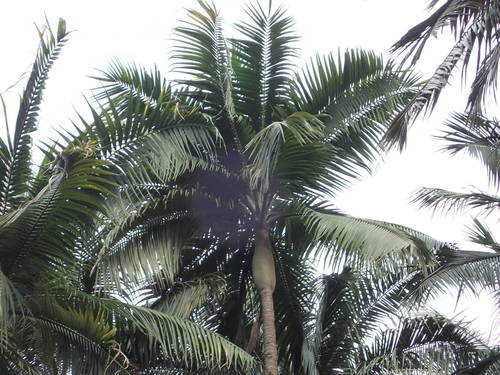
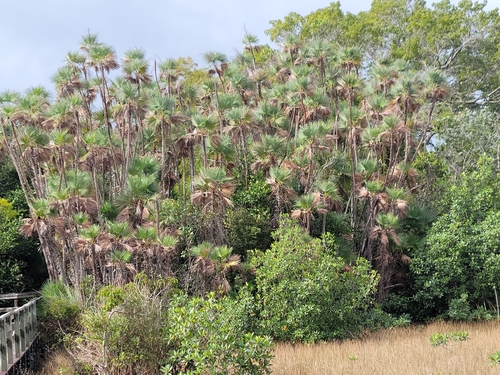
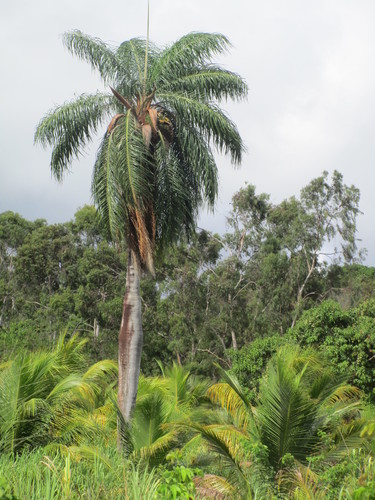
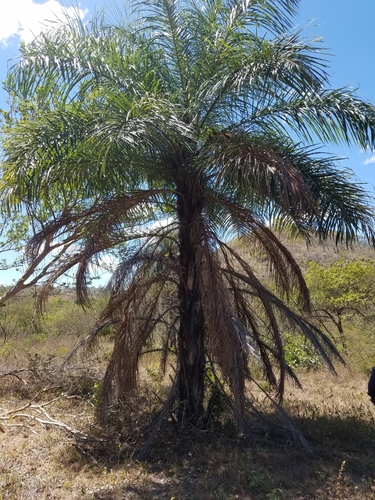
A palm. The stems are 1.5-12 m tall. They are 6-13 cm across. The leaf sheath has fine fibres. The leaf stalk is 36-94 cm long. The leaf blade has 51-63 leaflets. The middle ones are 0.7-1.1 m long. They are lighter green underneath. The flowering stalk does not arch over and is not longer than the leaves. There are 13-21 primary branches. The branches are smooth at flowering time. The fruit are round and 7-8 mm across. They are white.
How to Grow
Plants can be grown from seeds.
Other Uses
The leaves are used to weave hats and other items. The stems are sometimes used as posts.
Wikipedia
Source ↗Thrinax radiata, also known as the Florida thatch palm, is a medium to slow growing palm in the family Arecaceae. It is native to many Caribbean islands, Mexico, Central America, and far southern Florida. Its natural habitat is sandy, calcareous soil in coastal areas.
Production
It is slow growing.
Notes
The leaves are used to weave hats.
Names & Synonyms
Chiit, Guianillo, Guano de costa, Latanier-le-mer, Palem rumbia florida, Palma chit
References (10)
- Balick, M.J. and Beck, H.T., (Ed.), 1990, Useful palms of the World. A Synoptic Bibliography. Colombia p 428
- Grandtner, M. M., 2008, World Dictionary of Trees. Wood and Forest Science Department. Laval University, Quebec, Qc Canada. (Internet database http://www.wdt.qc.ca)
- Henderson, A., Galeano, G and Bernal, R., 1995, Field Guide to the Palms of the Americas. Princeton. p 44
- Kermath, B. M., et al, 2014, Food Plants in the Americas: A survey of the domesticated, cultivated and wild plants used for Human food in North, Central and South America and the Caribbean. On line draft. p 867
- Morton, J.F., 1981, Atlas of Medicinal Plants of Middle America: Bahamas to Yucatan. Springfield, Illinois: Charles C. Thomas
- Plants of Haiti Smithsonian Institute http://botany.si.edu
- Segura, S. et al, 2018, The edible fruit species in Mexico. Genet Resour Crop Evol (2018) 65:1767–1793
- Staples, G.W. and Herbst, D.R., 2005, A tropical Garden Flora. Bishop Museum Press, Honolulu, Hawaii. p 628
- Sukarya, D. G., (Ed.) 2013, 3,500 Plant Species of the Botanic Gardens of Indonesia. LIPI p 821
- Syst. veg. 7(2):1301. 1830