Bactris major
Jacq.
Maraja palm, Cubarro palm
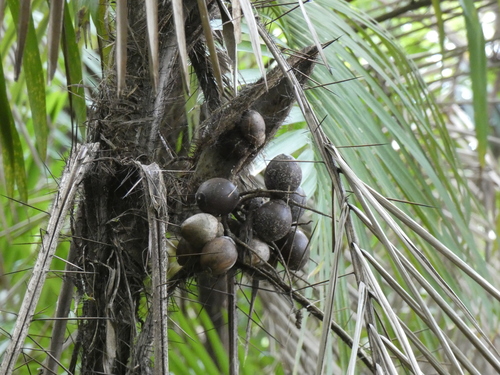
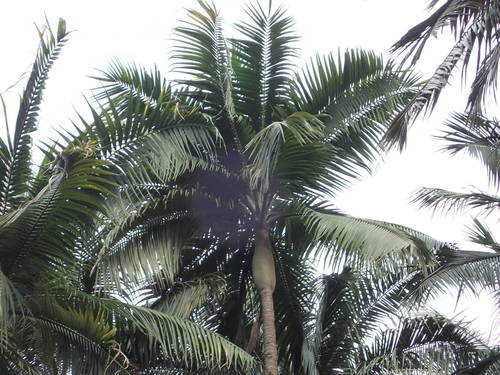
(c) Ricardo Brenes, some rights reserved (CC BY-NC), uploaded by Ricardo Brenes
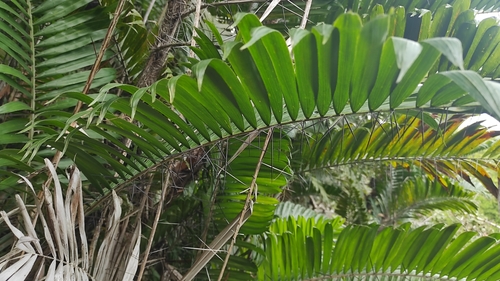
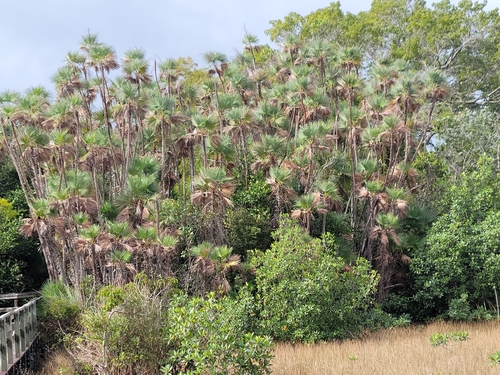
(c) Delgado Fabela Jared Fabián, some rights reserved (CC BY-NC), uploaded by Delgado Fabela Jared Fabián
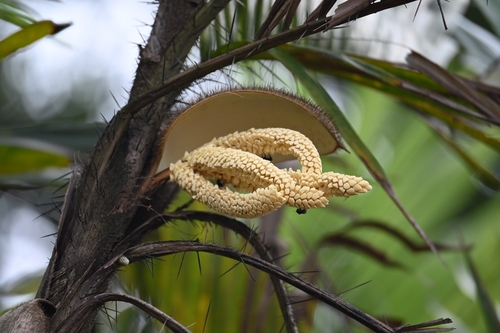
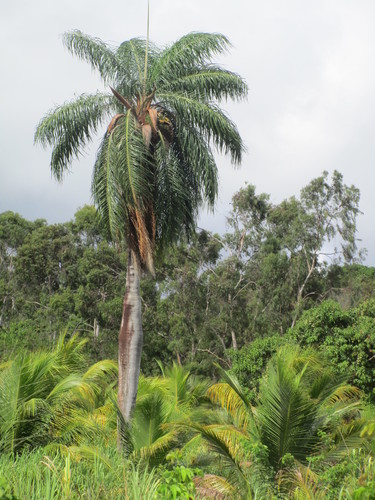
(c) Robin Heymans, some rights reserved (CC BY-NC), uploaded by Robin Heymans
What to Eat
Edible parts: Seeds, Fruit
The fruit flesh is eaten, though it is sour, and can be used to flavor drinks. The grey jelly inside the seeds of unripe fruits is also eaten.
Known Hazards
Where to Find It
A tropical plant. It grows in drier open areas. It is always near groundwater. In Townsville palmetum.
Amazon, Asia, Australia, Belize, Bolivia, Brazil, Central America*, Colombia, Costa Rica, Ecuador, El Salvador, French Guiana, Guatemala, Guianas, Guyana, Honduras, Indonesia, Mexico, Nicaragua, North America, Panama, Peru, SE Asia, South America*, Suriname, Trinidad, Venezuela,
How to Identify
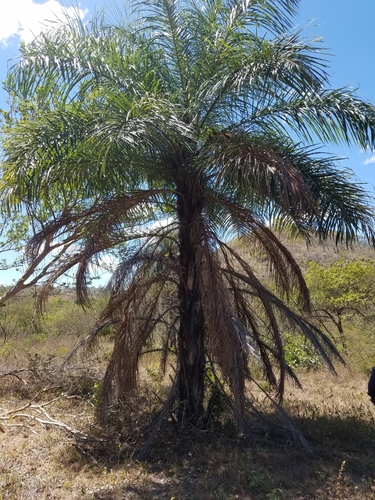
A palm. It has a cluster of stems. They often form large dense clumps. They are spiny. They grow 1-10 m tall and the stems are 2-6 cm across. There are 3-10 leaves on each stem and they have leaflets along the stalks and are spiny. There are short and long black spines. The long spines can be 11 cm long. There are 24-48 leaflets on each side and they are arranged regularly and spread in the same plane. The flowering stalks have 5-17 thick branches. The fruit are oval and 2.4-4.5 cm long by 1.3-3.5 cm wide. The are purplish-black.
How to Grow
Plants can be grown from seeds or suckers.
Other Uses
The stems are made of a rather brittle, easily-split wood that has been used to make partitions between rooms. Longitudinally sectioned, the stems are quite uniform and make an effective wall covering. The shrubs are planted to form impenetrable hedges.
Wikipedia
Source ↗Bactris major is a small to medium-sized (1–10 m tall) spiny palm which ranges from Mexico, through Central America into northern South America and Trinidad. The species is divided into three or four varieties, although the boundaries between varieties is not always clearly defined. The fruits are eaten or used to flavour drinks. Spanish names for the palm species include marayaú.
Notes
There are 239 Bactris species. There are 75 species in tropical America. Most Bactris have fruit that are edible but many are not attractive.
Names & Synonyms
Albarica, Biscoyo, Cana brava, Coyolillo, Cubaro, Cubrarro, Guiscoyol, Hones, Huiscoyol, Jahuacte, Jahuactillo, Kawmaka, Lata, Maraja, Marayau, Mogor, Palem maraja, Samura, Tucum-branco, Tucum-doce, Uvita de tigre, Viscoyol, Yarina, Zagrinette
References (23)
- Balick, M.J. and Beck, H.T., (Ed.), 1990, Useful palms of the World. A Synoptic Bibliography. Colombia p 57 (As Bactris balanoidea), 437 (As Bactris subglobosa), 597 (As Bactris minax), 658 (As Bactris balanoidea),
- Bircher, A. G. & Bircher, W. H., 2000, Encyclopedia of Fruit Trees and Edible Flowering Plants in Egypt and the Subtropics. AUC Press. p 52
- Bortolotto, I. M., et al, 2015, Knowledge and use of wild edible plants in rural communities along Paraguay River, Pantanal, Brazil. Journal or Ethnobiology and Ethnomedicine. 11:46
- Bortolotto, I. M., et al, 2018, Lista preliminar das plantas alimenticias nativas de Mato Grosso do Sul, Brasil. Iheringia, Serie Botanica, Porto Alegre, 73 (supl.):101-116
- Chizmar Fernandez, C., et al, 2009, Plantas comestibles de Centroamerica. Instituto de Biodiversidad, Costa Rica. p 82
- Condit, R., et al, 2011, Trees of Panama and Costa Rica. PrincetonField Guides. p 80
- D'Ambrosio, U., & Puri, R. K., 2016, Foodways in transition: food plants, diet and local perceptions of change in a Costa Rican Ngäbe community. Journal of Ethnobiology and Ethnomedicine (2016) 12:3 p 22
- Etkin, N.L. (Ed.), 1994, Eating on the Wild Side, Univ. of Arizona. p 136 (As Bactris cubaro)
- Grandtner, M. M., 2008, World Dictionary of Trees. Wood and Forest Science Department. Laval University, Quebec, Qc Canada. (Internet database http://www.WDT.QC.ca)
- Grandtner, M. M. & Chevrette, J., 2013, Dictionary of Trees, Volume 2: South America: Nomenclature, Taxonomy and Ecology. Academic Press p 57
- Haynes, J., & McLaughlin, J., 2000, Edible palms and Their Uses. University of Florida Fact sheet MCDE-00-50-1 p 3
- Henderson, A., Galeano, G and Bernal, R., 1995, Field Guide to the Palms of the Americas. Princeton. p 192
- Janick, J. & Paul, R. E. (Eds.), 2008, The Encyclopedia of Fruit & Nuts. CABI p 102
- Lopez-Diago, D. & Garcia, N., 2021, Wild edible fruits of Colombia. Biota ColomBiana 22 (2) p 31
- Marcia, M. J., et al, 2011, Palm Uses in Northwestern South America: A Quantitative Review. Bot. Rev. (2011) 77:462-570
- Piedra-Malagón, E. M. et al, 2022, Edible native plants of the Gulf of Mexico Province. Biodiversity Data Journal 10: e80565 p 11
- Reis, S. V. and Lipp, F. L., 1982, New Plant Sources for Drugs and Foods from the New York Botanical Garden herbarium. Harvard. p 18 (As Bactris balanoidea)
- Roa, J. A. G. & Boada, D. S. G., 2018, Fundación para el Fortalecimiento de la Fruticultura y Plantas Alimenticias no Convencionales en Colombia.
- Segura, S. et al, 2018, The edible fruit species in Mexico. Genet Resour Crop Evol (2018) 65:1767–1793
- Select. stirp. amer. hist. 280. 1763 (ed. 2:134. 1780)
- Sukarya, D. G., (Ed.) 2013, 3,500 Plant Species of the Botanic Gardens of Indonesia. LIPI p 759
- van Andel, T., 2000, Useful plants of Guyana. Non-timber forest products of the North-West District of Guyana. Part 2. A Field Guide. Tropenbos-Guyana Programme. p 298
- van Roosmalen, M.G.M., 1985, Fruits of the Guianan Flora. Utrecht Univ. & Wageningen Univ. p 346