Sabal etonia
Swingle ex Nash
Scrub palmetto, Scrub cabbage

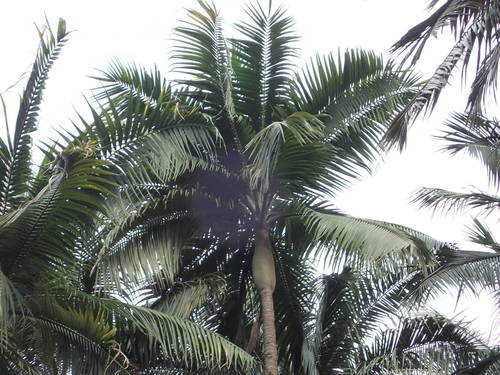
(c) Judy Gallagher, some rights reserved (CC BY-SA), uploaded by Judy Gallagher

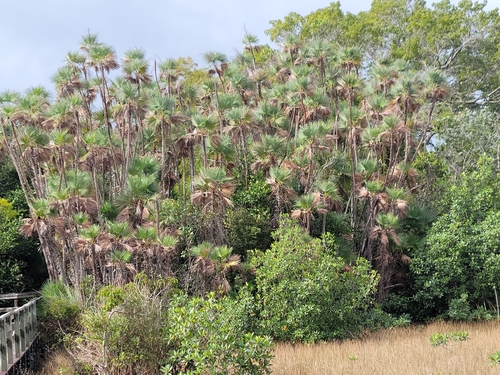
(c) Douglas Goldman, some rights reserved (CC BY-SA)
What to Eat
Edible parts: Fruit, Palm Heart, Cabbage
The fruit is a small dry berry up to 13mm long and 15mm wide, containing a thin sweet flesh, with a seed up to 6.7mm long and 10mm wide. No edibility records have been found specifically for this species, but the following uses recorded for the related S. palmetto very probably apply here. The fruit can be eaten raw or cooked — it is sweet and pleasant, a nourishing food, though said to be an acquired taste; the fruit of S. palmetto is up to 12mm long and 3mm wide. Young leaves can be eaten raw or cooked and are considered an excellent food. The sap is sweet.
Where to Find It
It is a subtropical plant. It grows in the understory or oak-pine forest on sandy soils.
Africa, East Africa, North America, Southern Africa, USA*, Zimbabwe,
How to Identify
A palm. The stems occur singly and are short and underground. They can be erect up to 2 m tall. There are 4-7 leaves. They are yellow-green with a prominent mid-vein. There are 25-50 leaflets. They are rigid and joined for a short distance at the base. There are threads along the edges. The flowering stalk is branched to 2 orders. The flowering stalks stick upwards and are shorter than the leaves. The fruit are almost round. They are 0.9-1.5 cm long and 0.8-1.3 cm wide. They are brownish black.
How to Grow
Succeeds in most fertile moist but well-drained soils in a sheltered sunny position. Although it prefers a humid atmosphere, this species is tolerant of arid atmospheres so long as it has plenty of moisture available at the roots. This palm tolerates short-lived freezes down to about -10°c and can be grown outdoors in the very mildest areas of the country. Palms usually have deep penetrating root systems and generally establish best when planted out at a young stage. However, older plants are substantially more cold tolerant than juvenile plants. In areas at the limit of their cold tolerance, therefore, it is prudent to grow the plants in containers for some years, giving them winter protection, and only planting them into their permanent positions when sheer size dictates. This species can also be transplanted even when very large. Although the thick fleshy roots are easily damaged and/or desiccated, new roots are generally freely produced. It is important to stake the plant very firmly to prevent rock, and also to give it plenty of water until re-established - removing many of the leaves can also help. Plants are very slow-growing when young and take a considerable time to establish.
Propagation: Sow seed as soon as ripe in a warm greenhouse at no less than 24°C — stored seed is very slow to germinate. Pre-soaking seed for 24 hours in warm water before sowing may reduce germination time. Plants form a long tap-root before producing a shoot. Fresh seed typically germinates in 3–4 months at 25°C. Prick seedlings out into individual pots once large enough to handle and grow on in the greenhouse for at least their first two winters. Plant out in late spring or early summer after the last expected frosts, and consider providing cold protection through at least the first winter outdoors.
Medicinal Uses
None known.
Other Uses
The following uses are recorded for S. palmetto and very probably apply to this species as well. An excellent fibre is obtained from the leaf stalks — the finest quality comes from young leaf stalks still in the bud, while coarser fibre comes from older leaves or the bases of old leaf stalks surrounding the bud. The fibres are up to 50cm long and are harvested commercially to make brushes, particularly those that must remain stiff in hot water or caustics. The roots contain tannin.
Wikipedia
Source ↗Sabal etonia, commonly known as the scrub palmetto is a species of palm. It is endemic to Florida in the United States, where it is found in Florida sand pine scrub communities.
Names & Synonyms
References (5)
- Balick, M.J. and Beck, H.T., (Ed.), 1990, Useful palms of the World. A Synoptic Bibliography. Colombia p 585
- Bull. Torrey Bot. Club 23:99. 1896
- Facciola, S., 1998, Cornucopia 2: a Source Book of Edible Plants. Kampong Publications, p 31
- Henderson, A., Galeano, G and Bernal, R., 1995, Field Guide to the Palms of the Americas. Princeton. p 65
- Kermath, B. M., et al, 2014, Food Plants in the Americas: A survey of the domesticated, cultivated and wild plants used for Human food in North, Central and South America and the Caribbean. On line draft. p 770