Achillea atrata
L.
Black-edged yarrow

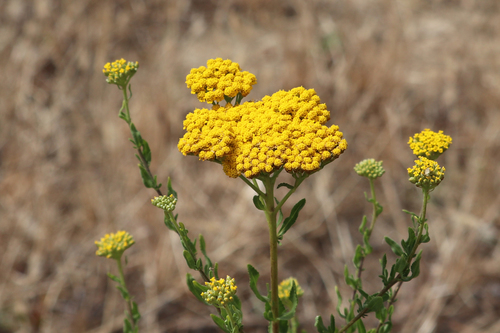
(c) Jakob Fahr, sommige rechten voorbehouden (CC BY-NC), geüpload door Jakob Fahr

(c) Jakob Fahr, sommige rechten voorbehouden (CC BY-NC), geüpload door Jakob Fahr

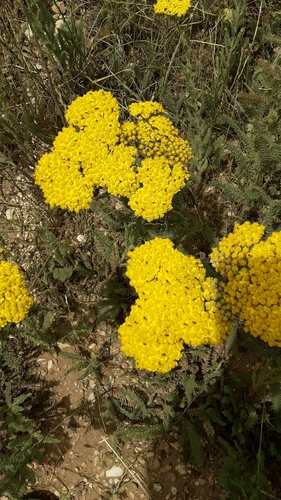
(c) Drepanostoma, sommige rechten voorbehouden (CC BY), geüpload door Drepanostoma
What to Eat
Edible parts: Flowers - wine
The flowers are used in wine production.
Where to Find It
It is a temperate plant.
Alps, Austria, Europe, France, Germany, Italy, Mediterranean, Slovenia, Switzerland,
How to Identify
A shrub or small tree. It grows 5 m tall. There are prickles along the stem. The leaves are twice divided and there are 8-18 pairs of pinnae. There are up to 50 pairs of pinnules on each pinnae. The flowers are yellow. They are in large clusters at the ends of branches. The pods are flattened.
Medicinal Uses
The flowers are used in liqueurs.
Wikipedia
Source ↗Achillea atrata, commonly called black yarrow or dark stemmed sneezewort, is European species of herbaceous perennial flowering plant native to the Alpine regions of Switzerland, France, Italy, Germany, Austria, and Slovenia.
Notes
There are about 85-100 Achillea species. They are temperate in Europe and Asia.
Names & Synonyms
Achillea noire, črnikasti rman
References (4)
- Bircher, A. G. & Bircher, W. H., 2000, Encyclopedia of Fruit Trees and Edible Flowering Plants in Egypt and the Subtropics. AUC Press. p 6
- Facciola, S., 1998, Cornucopia 2: a Source Book of Edible Plants. Kampong Publications, p 32
- Seidemann J., 2005, World Spice Plants. Economic Usage, Botany, Taxonomy. Springer. p 3
- Usher, G., 1974, A Dictionary of Plants Used by Man. Constable. p 16