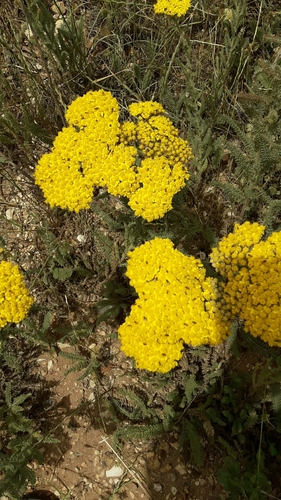
Achillea ageratum
L.
Garden Mace, Nutmeg Thyme
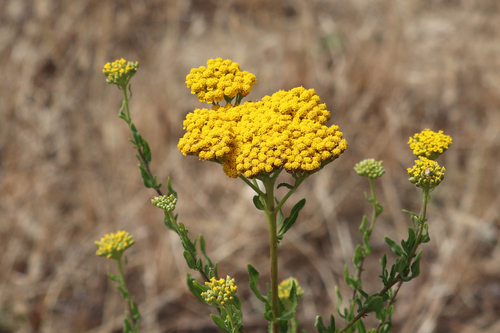
(c) Simão Mateus, some rights reserved (CC BY-NC), uploaded by Simão Mateus
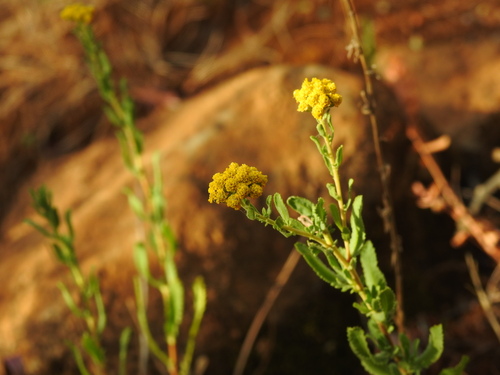
(c) Duarte Frade, some rights reserved (CC BY), uploaded by Duarte Frade

(c) Marina Ribeiro, some rights reserved (CC BY-NC), uploaded by Marina Ribeiro
What to Eat
Edible parts: Leaves
The leaves can be eaten raw or cooked. Their initial flavour is mild and pleasant, becoming more aromatic as they are chewed and leaving a tingly sensation in the mouth. They make an acceptable addition to mixed salads, and though the plant is very productive the leaves are small and fiddly to pick in quantity. They also work well in soups, stews, and as a flavouring in dishes like potato salad. The aromatic leaves can be used as a tea substitute.
Where to Find It
It is a temperate plant. It grows best in well drained soil in a sunny position. They can survive drought. It can withstand temperatures down to -20°C. It can survive in part shade and near the sea.
Africa, Europe, Greece, Mediterranean, North Africa, Spain, Switzerland,
How to Identify
A shrub or small tree. It grows 5 m tall. There are prickles along the stem. The leaves are twice divided and there are 8-18 pairs of pinnae. There are up to 50 pairs of pinnules on each pinnae. The flowers are yellow. They are in large clusters at the ends of branches. The pods are flattened.
How to Grow
Succeeds in most soils but prefers a well-drained soil in a sunny position. It also succeeds in partial shade. Plants live longer in a poor soil. Established plants are very drought tolerant, they can show distress in very severe droughts but usually recover. Plants succeed in maritime gardens. Hardy to about -20°c. An excellent plant to grow in a large pot, the long stems will tend to arch down and continue to flower for a long time. The leaves have a pungent aroma, especially when the plant is grown in a hot sunny position. The plant is intermediate between A. millefolium and A. ptarmica in its characteristics. There is at least one named variety, selected for its ornamental value. Hybridizes freely with other members of the genus.
Propagation: Sow seed in spring or early autumn in a cold frame; it generally germinates within 1–3 months. Prick seedlings out into individual pots once large enough to handle and plant out during summer. If this species is a hybrid it may not breed true from seed. Divide plants in spring or autumn — very straightforward, and divisions can go directly into their permanent positions. Basal cuttings of new shoots can be taken in spring; collect shoots at around 10cm tall, pot individually, and keep in a warm but lightly shaded spot. They should root within 3 weeks and be ready to plant out by summer.
Medicinal Uses
None known
Other Uses
None known
Wikipedia
Source ↗Achillea ageratum, also known as sweet yarrow, sweet-Nancy, English mace, or sweet maudlin, is a flowering plant in the sunflower family. It is native to southern Europe and Morocco. In the United States the plant is cultivated in the state of New York for its pleasant fragrance and sparingly naturalized in a few places outside its native range. In the Middle Ages it was used as a strewing herb to repel insects such as moths, lice and ticks and spread a good smell in private rooms. The leaves can be chopped and used raw as a herb, or added with other herbs to soups and stews. Modern uses of the herb include its use as a flavouring, as a dried flower, and as an ornamental herb. The species was first given a species name by Carl Linnaeus and published in his Species Plantarum 1753. Achillea is a reference to the Greek hero Achilles, who was trained to use herbs by his mentor, the centaur Chiron. The flowers last for a relatively long period, hence the inclusion of ageratum in the species name. The plant grows to a height of 12 to 18 inches (300 to 460 mm). A hardy perennial, it can be identified by its narrow and serrated leaves, and clusters of small flowers.
Notes
There are about 85-100 Achillea species. They are temperate in Europe and Asia.
Names & Synonyms
Ageraton, Arnica, Mace, Mace Yarrow, Maudlin, Milfoil, Sweet Nancy, Sweet Yarrow
References (8)
- Blamey, M and Grey-Wilson, C., 2005, Wild flowers of the Mediterranean. A & C Black London. p 442
- Blanco-Salas, J., et al, 2019, Wild Plants Potentially Used in Human Food in the Protected Area “Sierra Grande de Hornachos” of Extremadura (Spain). Sustainability 2019, 11, 456
- Bremness, L., 1994, Herbs. Collins Eyewitness Handbooks. Harper Collins. p 136
- Plants for a Future database, The Field, Penpol, Lostwithiel, Cornwall, PL22 0NG, UK. http://www.scs.leeds.ac.uk/pfaf/
- Seidemann J., 2005, World Spice Plants. Economic Usage, Botany, Taxonomy. Springer. p 2 (As Achillae)
- Slocum, P.D. & Robinson, P., 1999, Water Gardening. Water Lilies and Lotuses. Timber Press. p 105
- Sp. pl. 2:897. 1753
- Usher, G., 1974, A Dictionary of Plants Used by Man. Constable. p 16