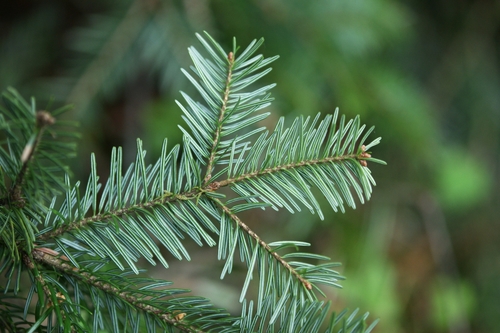
Abies amabilis
(Douglas) J. Forbes
Amabilis fir, Cascades fir, Pacific Silver fir
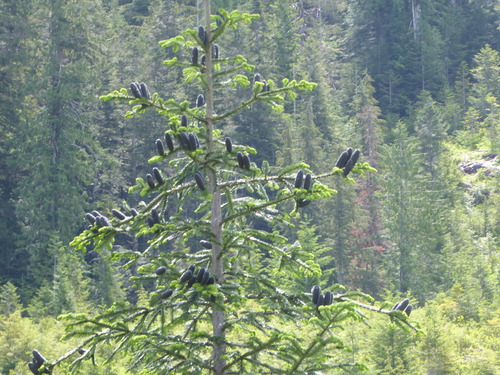
(c) Ian Cruickshank, some rights reserved (CC BY-NC), uploaded by Ian Cruickshank

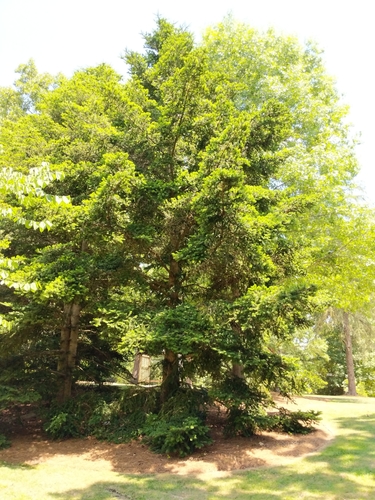
(c) Susan, some rights reserved (CC BY-NC), uploaded by Susan

(c) Pam Borso, some rights reserved (CC BY-NC), uploaded by Pam Borso
What to Eat
Edible parts: Leaves - tea, Bark
Young shoot tips can be brewed as a tea substitute. The pitch from the bark can be hardened — likely by immersing in cold water — and used as a chewing gum. The inner bark is also edible; while no further detail is given, it can be dried, ground into a powder, and combined with grain flours to make bread and similar preparations.
Where to Find It
It is a temperate plant. It will grow on most soils but they need to be deep. It needs a good reliable rainfall. It cannot tolerate drought but is resistant to frost.
Australia, Canada, North America, USA,
How to Identify
A shrub or small tree. It grows 5 m tall. There are prickles along the stem. The leaves are twice divided and there are 8-18 pairs of pinnae. There are up to 50 pairs of pinnules on each pinnae. The flowers are yellow. They are in large clusters at the ends of branches. The pods are flattened.
How to Grow
Requires a good moist but not water-logged soil in a sheltered position. Grows well in heavy clay soils. Plants are very shade tolerant but growth is slower in dense shade. Intolerant of atmospheric pollution. Prefers slightly acid conditions down to a pH of about 5. Prefers growing on a north-facing slope. Trees are somewhat shallow rooted and are therefore susceptible to strong winds. Grows best in the Perthshire valleys of Scotland. It does very well on glacial moraines in Scotland. When grown in an open position, the tree clothes itself to the ground with gracefully drooping branches, though on the whole, this species does not grow well in Britain. Trees have been of variable growth in this country and seem to be short-lived. The best and fastest growing specimens are to be found in the north and far west of the country. Growth in girth can be very quick, 1.8 metres in 35 years has been recorded. Trees should be planted into their permanent positions when they are quite small, between 30 and 90cm in height. Larger trees will check badly and hardly put on any growth for several years. This also badly affects root development and wind resistance. The crushed leaves have an odour like orange peel. Plants are strongly outbreeding, self-fertilized seed usually grows poorly. They hybridize freely with other members of this genus. This species is often confused with A. nordmanniana. A very ornamental plant. Trees are sometimes grown as 'Christmas trees'. Plants are susceptible to injury by aphis.
Propagation: Sow seed in early February in a greenhouse or outdoors in March. Germination is often poor, typically taking 6–8 weeks. Stratification improves germination uniformity, so sowing in a cold frame as soon as seed ripens in autumn is recommended. Seed remains viable for up to 5 years if well stored. Prick seedlings into individual pots once large enough to handle and grow on through at least their first winter under cover. Plant out in late spring or early summer after the last expected frosts. Where sufficient seed is available, outdoor seedbed sowing is also an option. One account recommends growing seedlings on in shade at a density of about 550 plants per square metre; another recommends a sunny position.
Medicinal Uses
Native North American peoples used this plant widely. A bark infusion served as a tonic and was used to treat stomach ailments, TB, haemorrhoids, and various minor complaints. The pitch or resin was used for colds and sore throats. The bark contains blisters filled with a resin called Canadian Balsam, which can almost certainly be used in the same ways as the resin of A. balsamea: it is a highly effective antiseptic and healing agent applied as a protective covering for burns, bruises, wounds, and sores, and also for sore nipples and sore throats. The resin is antiscorbutic, diuretic, stimulant, and tonic, and is used internally in proprietary mixtures to treat coughs and diarrhoea — though taken in excess it is purgative. A warm liquid of the gummy sap was drunk as a treatment for gonorrhoea. A leaf tea is antiscorbutic and used for coughs, colds, and fevers. Leaves and young shoots are best collected in spring and dried for later use.
Other Uses
The fragrant boughs can be hung indoors as an air freshener. The wood is hard, light, close-grained, and not particularly strong or durable; it is used for framing small buildings (but not large ones), crates, and pulp. The tree yields the resin Canadian Balsam, which — based on its use when obtained from A. balsamea — is collected during July and August from bark blisters or by cutting pockets in the wood. It is used medicinally and in dentistry, and in the manufacture of glues, candles, and as a cement for microscope slides due to its high refractive index, which closely resembles that of glass. Average yield is about 8–10 oz per tree. The resin also serves as a fixative in soaps and perfumery.
Wikipedia
Source ↗Abies amabilis, commonly known as the Pacific silver fir, is a fir native to the Pacific Northwest of North America, occurring in the Pacific Coast Ranges and the Cascade Range. It is also commonly referred to in English as the white fir, red fir, lovely fir, amabilis fir, Cascades fir, or silver fir.
Notes
There are about 50 Abies species.
References (7)
- Pinet. woburn. 125, t. 44. 1839
- ecocrop.fao.org
- Facciola, S., 1998, Cornucopia 2: a Source Book of Edible Plants. Kampong Publications, p 169
- MacKinnon, A., et al, 2009, Edible & Medicinal Plants of Canada. Lone Pine. p 37
- Ryan, S., 2008, Dicksonia. Rare Plants Manual. Hyland House. p 61
- Turner, N. J., 1988, Ethnobotany of Coniferous Tress in Thompson and Lillooet Interior Salish of British Colombia. Economic Botany 42(2) :177-194
- Wiersema, J. H. & Leon, B., 2013, World Economic Plants. A Standard Reference CFC Press. 2nd Ed. p 1