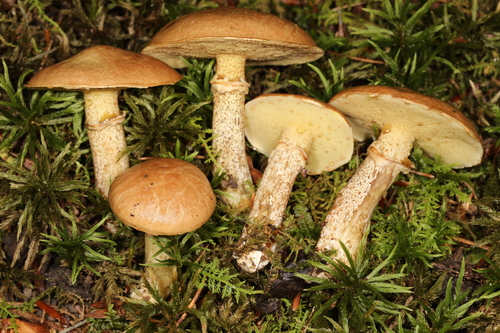
Suillus granulatus
(L.) Roussel
The granular bolete, Pine bolete, Dotted-stalk suillus

(c) Mononymous, some rights reserved (CC BY-NC), uploaded by Mononymous
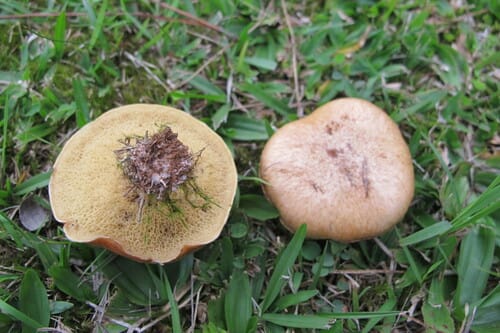
(c) Marcos Mortara, some rights reserved (CC BY-NC)
What to Eat
Edible parts: Fungus, Mushroom, Caution
The mushroom is eaten raw.
Known Hazards
Where to Find It
It grows in temperate and tropical places.
Africa, Armenia, Asia, Australia, Britain, Burundi, Caucasus, Chile, China, Denmark, East Africa, Egypt - Sinai, Europe, Georgia, Himalayas, Hong Kong, Hungary, Indochina, Israel, Italy, Laos, Madagascar, Malawi, Mediterranean, Mexico, Middle East, Nepal, New Zealand, North Africa, North America, Portugal, Russia, Rwanda, Scandinavia, SE Asia, Sicily, Sinai, South America, Spain, Sweden, Tanzania, Turkey, Türkiye, Uruguay, Zambia,
How to Identify
A mushroom in the family Suillaceae that grows in temperate and tropical regions, commonly found in winter and sold in local markets, particularly in Israel where it is the most abundant winter mushroom.
Wikipedia
Source ↗Suillus granulatus is a species of fungus in the genus Suillus. It has been commonly known as the weeping bolete, the butterball bolete, or the granulated bolete. It is a pored mushroom similar to S. luteus, but can be distinguished by its ringless stalk. The species often grows in a symbiosis (mycorrhiza) with pine. It is native to the Northern Hemisphere and has been introduced elsewhere. It is edible.
Other Information
It is the most common winter mushroom in Israel. It is sold in local markets.
Notes
Also put in the family Boletaceae.
Names & Synonyms
Dianbing runiuganjun, Duma soko, Falghanah, Laddeuauu, Yuxhasunk
References (26)
- Bailey, C. and Danin, A., 1981, Bedouin Plant Utilization in Sinai and the Negev. Economic Botany 35(2): 145-162
- Boa, E. R., Wild edible fungi and their importance to people. FAO Non Wood Forest Products Booklet 17
- Bussman, R. W., et al, 2016, A comparative ethnobotany of Khevsureti, Samtskhe-Javakheti, Tusheti, Svaneti, and Racha-Lechkhumi, Republic of Georgia (Sakartvelo), Caucasus. Journal of Ethnobiology and Ethnomedicine.
- Bussman, R. W. et al, 2017, Ethnobotany of Samtskhe-Javakheti, Sakartvelo (Republic of Georgia), Caucasus. Indian Journal of Traditional Knowledge Vol. 16(1) pp 7-24
- Bussman, R. W., et al, 2021, Unity in diversity—food plants and fungi of Sakartvelo (Republic of Georgia), Caucasus. Journal of Ethnobiology and Ethnomedicine (2021) 17:72 p 17
- Buyck, B., 2008, The Edible Mushrooms of Madagascar: An Evolving Enigma. Economic Botany 62(3) pp. 509-520
- Christensen, M., et al, 2008, Collection and Use of Wild Edible Fungi in Nepal. Economic Botany, 62(1), 2008, pp. 12–23
- Cocchi, L. et al, 2006, Heavy metals in edible mushrooms in Italy. Food Chemistry 98: 277-284
- Crowe, A., 1997, A Field Guide to the Native Edible Plants of New Zealand. Penguin. p 125
- Dembitsky, V. M., et al, 2010, Amino and Fatty Acids of Wild Edible Mushrooms of the genus Boletus, Rec. Nat. Prod. 4:4 (2010) 218-223 (As Boletus granulatus)
- Devkota, S., 2008, Distribution and Status of Highland mushrooms: A study from Dolpa, Nepal. J.Nat.Hist.Mus.Vol.23,2008, 51-59
- efta-online.org, Edible Fungi of Tropical Africa, Jardin botanique Meise
- Fuhrer, B., 2005, A field guide to Australian Fungi. Bloomings Books. p 194
- Genccelep, H. et al, 2009, Determination of mineral contents of wild-grown edible mushrooms. Food Chemistry 113: 1033-1036
- Guedes de Piniho, P., et al, 2008, Correlation between the Pattern Volatiles and the Overall Aroma of Wild Edible Mushrooms. Journal of Agricultural and Food Chemistry. 56: 1704-1712
- Kaufmann, B. et al, 1999, The Great Encyclopedia of Mushrooms. Konemann. p 21
- Lentini, F. and Venza, F., 2007, Wild food plants of popular use in Sicily. J Ethnobiol Ethnomedicine. 3: 15
- Li, H., et al, 2020, Reviewing the world’s edible mushroom species: A new evidence-based classification system. Compr Rev Food Sci Food Saf. 2021;20:1982–2014.
- Mabey, R., 1973, Food for Free. A Guide to the edible wild plants of Britain, Collins. p 51 (As Boletus granulatus)
- Mdachi, S. J. et al, 2004, Amino acid composition of some Tanzanian wild mushrooms. Food Chemistry 86: 179-182
- Nanagulyan, S., et al, 2020, Wild plants and fungi sold in the markets of Yerevan (Armenia). Journal of Ethnobiology and Ethnomedicine 16:26
- Pace, G., 1998, Mushrooms of the world. Firefly books. p 192 (As Boletus granulatus)
- Pfister, D. H., 2016, Fungi and Forests. ReVista 16(1) p 14
- Tibuhwa, 2013, Wild Mushroom - an underutilized healthy food resource and income generator: experience from Tanzania rural areas. Journal of Ethnobiology and Ethnomedicine 9:49
- Vetner, J., 2004, Arsenic content of some edible mushroom species. Eur. Food Res. Technol. 219: 71-74
- www.plantnames.unimelb.edu.au