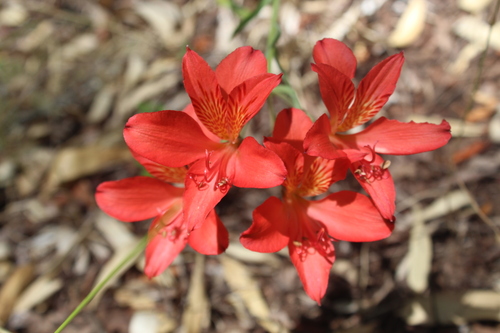
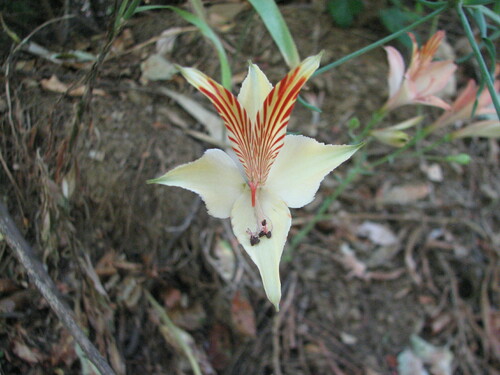
Bomarea salsilla
(L.) Mirb.
Salcilla

(c) maca_sperry, some rights reserved (CC BY-NC)

(c) danielaperezorellana, some rights reserved (CC BY-NC-ND)
What to Eat
Edible parts: Root, Tubers
Edible Parts: Root Edible Uses: Tuber - cooked. Starchy.
Known Hazards
Where to Find It
It is a tropical plant. It grows in woods in the mountains and by the coast in humid areas. It is best in a sunny position with a well-drained and slightly acid soil.
Australia, Chile, South America,
How to Identify
A twining herb. It keeps growing from year to year. The leaves are sword shaped. The flowers are small and pink or red.
How to Grow
Plants can be grown from seeds. It is best to used fresh seed but with stored seed it needs to be put in a warm location then a cold location before planting. Plants can be grown by division.
Propagation: Seed - best sown as soon as it is ripe in a warm greenhouse, it will germinate in a few weeks. Stratify stored seed for 3 weeks at 20°c, then 3 weeks at 5°c. It usually germinates in 1 - 2 months at 20°c. Prick out the seedlings into individual pots when they are large enough to handle and grow them on in the greenhouse for at least their first winter. Plant them out into their permanent positions in early summer. Division in spring, with care since the roots are brittle. Each portion must have some roots and a growth bud. Pot up the divisions, grow them on in the greenhouse until they are well established and then plant them out into their permanent positions in the summer or late spring of the following year.
Medicinal Uses
None known
Other Uses
None known Special Uses
Wikipedia
Source ↗Bomarea salsilla is a species of flowering plant in the family Alstroemeriaceae, native to Chile. It is distributed between the Valparaíso and Araucanía regions. It has gained the Royal Horticultural Society's Award of Garden Merit.
Notes
There are 100-200 Bomarea species. They are climbers in the Andes cloudforest in Central and South America.
Names & Synonyms
Copihuito, Zarcilla
References (7)
- Bircher, A. G. & Bircher, W. H., 2000, Encyclopedia of Fruit Trees and Edible Flowering Plants in Egypt and the Subtropics. AUC Press. p 61
- Fern, K., 2012, Tropical Species Database http://theferns.info/tropical/
- Hedrick, U.P., 1919, (Ed.), Sturtevant's edible plants of the world. p 108
- Hibbert, M., 2002, The Aussie Plant Finder 2002, Florilegium. p 44
- Hist. Nat. Pl. 9:71. 1804
- Kermath, B. M., et al, 2014, Food Plants in the Americas: A survey of the domesticated, cultivated and wild plants used for Human food in North, Central and South America and the Caribbean. On line draft. p 136
- Plants for a Future database, The Field, Penpol, Lostwithiel, Cornwall, PL22 0NG, UK. http://www.scs.leeds.ac.uk/pfaf/