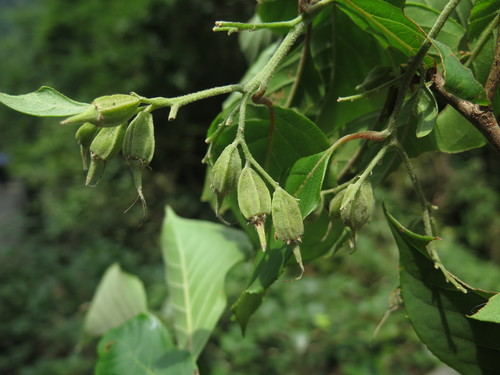
Styrax officinalis
L.
Storax tree
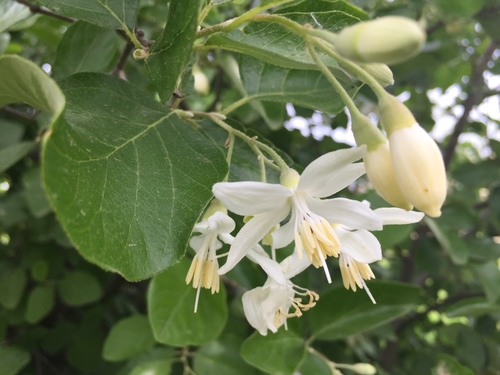
(c) kady_bird, some rights reserved (CC BY-NC), uploaded by kady_bird

(c) Joey Bom, some rights reserved (CC BY-NC)

(c) Ivan Jarolímek, some rights reserved (CC BY-NC)
What to Eat
Edible parts: Gum, Flower - nectar
A highly perfumed balsamic gum obtained from the branches and stems is occasionally used as a condiment. This gum is almost certainly the same resin used for other purposes described below.
Where to Find It
It is a Mediterranean climate plant.
Asia, Europe, Turkey, Türkiye,
How to Identify
A deciduous shrub reaching 5 m tall and 2 m wide, growing at a slow rate. Hardy to UK zone 9 but frost tender. Flowers in June with seeds ripening in October. Hermaphroditic. Tolerates light sandy to medium loamy, well-drained soils with mildly acid to neutral pH. Grows in semi-shade or full sun, prefers moist soil but tolerates drought.
How to Grow
Requires a light lime-free soil in sun or semi-shade. If planted out when young into a planting hole that has been filled with a light lime-free soil the plants will successfully grow into the surrounding soil. Prefers a warm sheltered position with protection from the morning sun. Dislikes wet soils. Established plants are drought tolerant, they grow better in Britain when the summer is dry. This species is not very hardy outdoors in Britain. Dormant plants tolerate temperatures down to about -5°c but the young growth is liable to be damaged by late frosts. Succeeds in the milder parts of the country. Plants were growing and fruiting well on a west-facing wall at Kew in 1992. Plants do not flower freely unless in a warm sunny spot or on a south facing wall. The flowers are very fragrant. Plants in this genus are notably resistant to honey fungus.
Propagation: Seed requires stratification and is best sown in a cold frame as soon as ripe. Stored seed needs 3 months of warm stratification followed by 3 months of cold stratification. Germination is usually good. Prick out seedlings into individual pots once large enough to handle, overwinter in a greenhouse, and plant out in late spring. Half-ripe cuttings can be taken in July or August in a frame. Layering can be done in autumn.
Medicinal Uses
A resin obtained from the stems is both antiseptic and expectorant.
Other Uses
The fragrant resin known as 'storax' is harvested by wounding the stem and is used medicinally, in perfumery, and as incense. The fruits are used as beads in rosaries and similar items.
Wikipedia
Source ↗Styrax officinalis is a species of shrub in the family Styracaceae, commonly called the storax tree, or Snowdrop bush.
Names & Synonyms
Ayifindigi, Gunluk, Yaban ayvasi
References (6)
- Balut, G., 2016, Medicinal and wild food plants of Marmara Island (Balikesir - Turkey). Acta Societatis Botanicorum Poloniae 85 (2): 3501
- Ertug, F, Yenen Bitkiler. Resimli Türkiye Florası -I- Flora of Turkey - Ethnobotany supplement
- Facciola, S., 1998, Cornucopia 2: a Source Book of Edible Plants. Kampong Publications, p 240
- Gunes, S. et al, 2018, Survey of wild food plants for human consumption in Karaisali (Adana-Turkey). Indian Journal of Traditional Knowledge. Vol. 17(2), April 2018, pp 290-298
- Sp. pl. 1:444. 1753
- Uphof,
More from Styracaceae