Styrax tonkinensis
(Pierre) Craib ex Hartwich
Siam benzoin,Lao benzointree
(c) James Ojascastro, some rights reserved (CC BY-NC-SA), uploaded by James Ojascastro

Wikimedia Commons - Gió Đông

Wikimedia Commons - vi:User:Gió Đông
What to Eat
Edible parts: Gum
The gum is used in the food industry for flavoring ice cream, baked goods, chewing gum, and drinks.
Where to Find It
A tropical plant. It grows in mixed forests between 100-2,000 m above sea level. In Yunnan.
Asia, Cambodia, China, Indochina, Laos, SE Asia, Thailand, Vietnam,
How to Identify
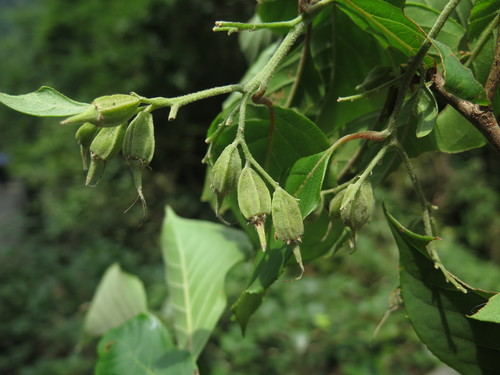
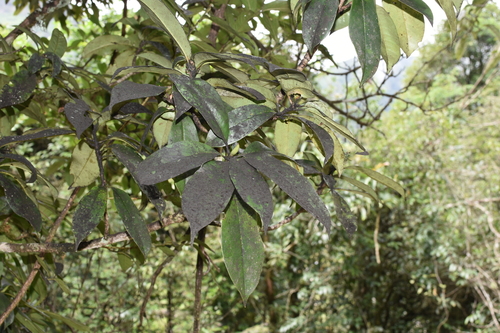
A tree. It grows 6-30 m tall. The trunk is 8-60 cm across. The bark is dark grey and irregularly divided. The leaves are alternate and 8-18 cm long by 4-10 cm wide. The flowers are in groups and are 1-3 cm across. The fruit are flattened and 1 cm across.
How to Grow
A plant of the subtropics to tropics, where it is found at elevations from 30 - 2,400 metres. It is found in areas where the mean annual temperature is in the range 15 - 26°c, though it can survive occasional, short-lived, extreme temperatures as low as -4°c and as high as 45°c. It prefers a mean annual rainfall in the range 1,500 - 2,200mm, though it can tolerate as little as 1,300mm in cultivation. It grows in areas with no distinct dry season, or only a short dry season. Requires a sunny position. Styrax tonkinensis is fast growing and under favourable conditions can attain annual height increments of 3 metres during the first three years pf growth. A mean height of 18 - 25 metres, with stems 20 - 24cm in diameter, are obtainable at 10 years. Such growth would give a wood yield of about 150 cubic metres per hectare based on final stand densities of approximately 600 - 800 stems per hectare. Trees are tapped for their resin from the age of about 6 - 7 years. Tapping continues for 3 - 4 years, or until production declines. Trees have a shallow rooting system.
Propagation: Seed - it soon loses its viability if it is allowed to dry out, but can be stored for at least a year at 20°c if it is kept moist. Fresh seed needs a period of after-ripening or it will take several months to germinate. This is done by placing the fruits in 30 - 40cm deep layers in trays in the shade for 5 - 6 days and turning them over daily to provide aeration. When the pericarp turns yellow or grey, the seeds are extracted and then dried in the shade for 4 - 5 days. Sow the seed in 50% shade and germination should take 2 - 5 weeks. Grown the plants on in 70% light and plant out when 25 - 50cm tall, which usually takes about 3 - 7 months.
Medicinal Uses
There has been little dedicated research into the medical properties of storax resin, but it has been used for long, and apparently with favorable results. It was important in Islamic medicine; Avicenna (Ibn Sina, ابن سینا) discusses S. officinalis it in his Al-Qanun fi al-Tibb (القانون في الطب, The Law of Medicine). He indicates that storax resin mixed with other antibiotic substances and hardening material gives a good dental restorative material. Benzoin resin is a component of the "Theriaca Andromachi Senioris", a Venice treacle recipe in the 1686 d'Amsterdammer Apotheek. Tincture of benzoin is benzoin resin dissolved in alcohol. This and its numerous derived versions like lait virginal and friar's balsam were highly esteemed in 19th-century European cosmetics and other household purposes; they apparently had antibacterial properties. Today tincture of benzoin is most often used in first aid for small injuries, as it acts as a disinfectant and local anesthetic and seems to promote healing. Benzoin resin and its derivatives are also used as additives in cigarettes. The antibiotic activity of benzoin resin seems mostly due to its abundant benzoic acid and benzoic acid esters, which were named after the resin; other less well known secondary compounds such as lignans like pinoresinol are likely significant too.
Other Uses
A benzoin resin is tapped from the trunk. The resin, known commercially as 'Siam benzoin', is of high quality and suitable for use by the perfume industry. It is characterized by its content of benzoic acid (10 - 12%), coniferyl benzoate (65 - 70%) and more than 20 other aromatic esters. Benzoin resin absolute is thick, brownish-yellow oil with a sweet, balsamic odour and a hint of vanilla. Benzoin is used in the manufacture of fragrances which are then compounded and employed in a wide range of end-products which includes personal health care products such as toilet soap, shampoo, body lotion and cream, bath oil, aerosol and talcum powder, and household and other products such as liquid soap, air freshener, fabric softener, washing detergent and other cleaning agents. The resin is also used as an incense. The resin is obtained from incisions made in the bark. It takes about eight weeks before the exuding white-coloured resin becomes firm enough to collect. The wood is light and soft. It is not suitable for construction, but is used to make wooden shoes, pencils, chopsticks, toothpicks and matches. An important pulpwood species in Vietnam, yield and quality of the pulp is comparable with many commercial pulpwood species. The wood is used for fuel. A light-demanding, pioneer species in its native range where it can quickly invade gaps in the forest. If conditions are favourable, it often occurs in the upper storey and can occupy many hectares as almost pure stands. It has been introduced to China, Java and French Guinea in west Africa, where it is used to restore eroded soils and provide green fire belts.
Names & Synonyms
Antuc bacbo, Yue nan an xi xiang
References (6)
- Apotheker Zeitung 28:698. 1913
- Facciola, S., 1998, Cornucopia 2: a Source Book of Edible Plants. Kampong Publications, p 240
- Uphof,
- Wiersema, J. H. & Leon, B., 2013, World Economic Plants. A Standard Reference CRC Press. 2nd Ed. p 666
- World Checklist of Useful Plant Species 2020. Royal Botanic Gardens, Kew
- www.worldagroforestrycentre.org/treedb/
More from Styracaceae