Peganum harmala
L.
Syrian rue, Uzerlik

(c) Ostenfuchs, some rights reserved (CC BY)

(c) José María Escolano, some rights reserved (CC BY-NC-SA)

(c) Giorgio Samorini, some rights reserved (CC BY-NC-SA)
What to Eat
Edible parts: Seeds - spice
The seed is used as a spice and purifying agent, though some caution is advised as it has narcotic properties, inducing euphoria and releasing inhibitions. An edible oil is also obtained from the seed.
Known Hazards
Where to Find It
It is a temperate plant. It grows in slightly salty sands and dry grasslands in desert areas. It grows between 400-3,600 m above sea level.
Afghanistan, Africa, Central Asia, China, Europe, Kazakhstan, Kyrgyzstan, Mediterranean, Middle East, Mongolia, Morocco, North Africa, Pakistan, Russia, Saudi Arabia, Syria, Tajikistan, Turkey, Türkiye, Turkmenistan, Uzbekistan,
How to Identify
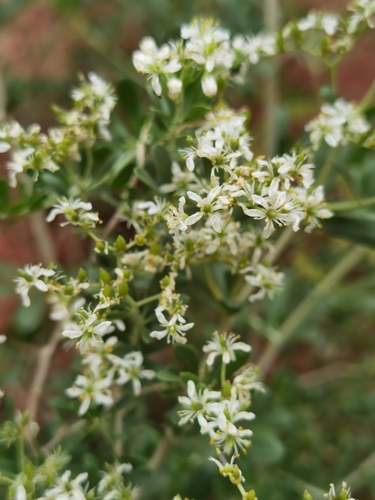
A herb. It keeps growing from year to year. It grows 30-70 cm tall. The leaves are alternate and the blade is divided into 3-5 narrow lobes. The flowers are yellowish white. The fruit is a round capsule. The seeds are dark brown and slightly curved. They are 3 sided.
How to Grow
Prefers a light well-drained but moisture retentive soil and an open position in full sun. Prefers a dry soil and succeeds in poor soils. Although this species comes from dry desert areas, it responds well to cultivation so long as the soil is very well drained. It can tolerate temperatures down to about -20°c if the soil is dry. There is speculation that this plant was the sacred 'Soma' plant, which was used by the ancients of India and Persia as an hallucinogenic aid to understanding the deeper meaning of life.
Propagation: Sow seed in late spring in a greenhouse. Prick seedlings out into individual pots when large enough to handle and grow on in a sunny part of the greenhouse through their first winter, taking care not to overwater, especially during dormancy. Plant out into permanent positions in late spring or early summer. Division can be carried out in late spring.
Medicinal Uses
The plant has alterative properties. The fruit and seed are digestive, diuretic, hallucinogenic, narcotic, and uterine stimulants, used internally for stomach complaints, urinary and sexual disorders, epilepsy, menstrual problems, and mental and nervous illnesses. The seed has been used as an anthelmintic to expel tapeworms, though this should be done cautiously and preferably under qualified guidance, as excessive doses cause vomiting and hallucinations. The seeds contain harmine, a substance under research for mental disease, encephalitis, and brain inflammation. Small quantities stimulate the brain and are considered therapeutic, but excess harmine depresses the central nervous system. A crude seed preparation is more effective than an extract due to the presence of related indoles. Consuming the seed in quantity induces euphoria and releases inhibitions; it has been used historically as a truth drug. The oil from the seed is said to be aphrodisiac, galactogogue, ophthalmic, soporific, and vermifuge. The seed is applied externally for haemorrhoids and baldness. The whole plant is said to be abortifacient, aphrodisiac, emmenagogue, and galactogogue. A decoction of the leaves is used to treat rheumatism. The root has been used as a parasiticide to kill body lice and taken internally for rheumatism and nervous conditions.
Other Uses
A red dye obtained from the seed is widely used in Western Asia, particularly for colouring carpets. The ripe seed contains 3.8–5.8% of the alkaloids harmine, harmaline, harmalol, and peganine. These are ineffective as contact poisons but active in vapour form, where they work against algae, affect water animals at higher concentrations, and are lethal to moulds, bacteria, and intestinal parasites. The seed is also used as an incense.
Wikipedia
Source ↗Peganum harmala, commonly called wild rue, Syrian rue, African rue, esfand or espand, or harmel (among other similar pronunciations and spellings), is a perennial, herbaceous plant, with a woody underground rootstock, of the family Nitrariaceae, usually growing in saline soils in temperate desert and Mediterranean regions. Its common English-language name came about because of a resemblance to rue (to which it is not related). Its seeds contain a high concentration (at least 5.9% by weight) of diverse beta-carboline alkaloids. It has deep roots and a strong smell, finely divided leaves, white flowers rich in alkaloids, and small seed capsules containing numerous dark, oily seeds. It is native to a vast region across North Africa, southern and eastern Europe, the Middle East, Central Asia, and parts of South and East Asia, and has been introduced to countries like South Africa, Mexico, France. It grows in dry, often saline or disturbed habitats, thriving from sea level to high elevations, is pollinated mainly by insects (especially honey bees), disperses seeds mostly by dispersal vectors or human activity, and hosts a specialized beetle (Thamnurgus pegani) proposed for its biological control. Some scholars have associated it with the sacred plant called soma or haoma in ancient Indo-Iranian texts and it has been described under various names by classical and medieval sources, with archaeological evidence suggesting its ritual use dating back to at least the 2nd century BCE. It was first described and illustrated in the 16th century by Rembert Dodoens and later classified by botanists such as Gaspard Bauhin and Carl Linnaeus. It has several recognized varieties distinguished by morphological traits and geographic distribution, with lectotype designations refined over time to clarify its taxonomy. In the United States, it is banned or regulated as a noxious weed in several states requiring eradication, while internationally, possession and sale of the plant or its psychoactive alkaloids are illegal or controlled in several countries, including France, Finland, Canada, and Australia. It is used as a dye, incense, and in traditional medicine. It is also toxic to livestock and difficult to eradicate.
Notes
Also put in the family Zygophyllaceae.
Names & Synonyms
Harmal
References (7)
- Al-Sodany, Y. M., et al, 2013, Medicinal Plants in Saudi Arabia: I. Sarrwat Mountains at Taif, KSA. Academic Journal of Plant Sciences 6 (4): 134-145
- Facciola, S., 1998, Cornucopia 2: a Source Book of Edible Plants. Kampong Publications, p 249
- Ghanimi, R., et al, 2022, Ethnobotanical study on wild edible plants traditionally used by Messiwa people, Morocco. Journal of Ethnobiology and Ethnomedicine. 18:16
- Sp. pl. 1:444. 1753
- Tanaka,
- Urgamal, M., Oyuntsetseg, B., Nyambayar, D. & Dulamsuren, Ch. 2014. Conspectus of the vascular plants of Mongolia. (Editors: Sanchir, Ch. & Jamsran, Ts.). Ulaanbaatar, Mongolia. “Admon“ Press. 334pp. (p. 79-90).
- World Checklist of Useful Plant Species 2020. Royal Botanic Gardens, Kew