Borassus heineanus
Becc.
Palmyra like palm

Wikimedia Commons - The AAU Herbarium Database (License)

Wikimedia Commons - The AAU Herbarium Database (License)

President and Fellows of Harvard College
What to Eat
Edible parts: Fruit
The young fruits are eaten.
Where to Find It
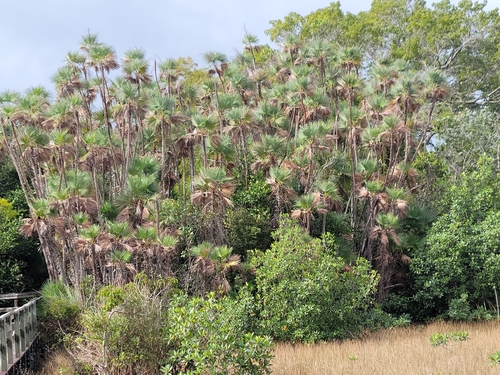
A tropical plant. It occurs in Papua New Guinea in groves in headlands projecting into the Sepik River and also occurs along the Sepik plain. In Cairns Botanical Gardens.
Australia, Indonesia (Papua), Pacific, Papua New Guinea, PNG, SE Asia,
How to Identify
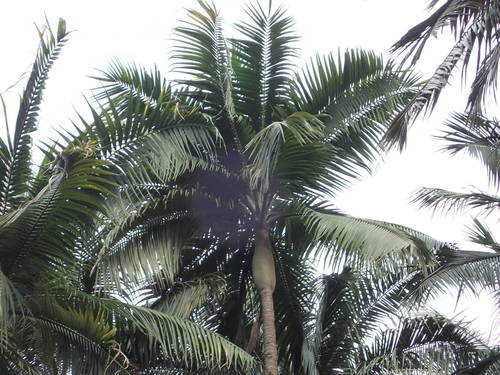
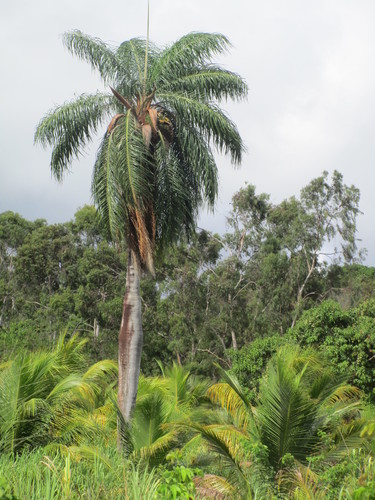
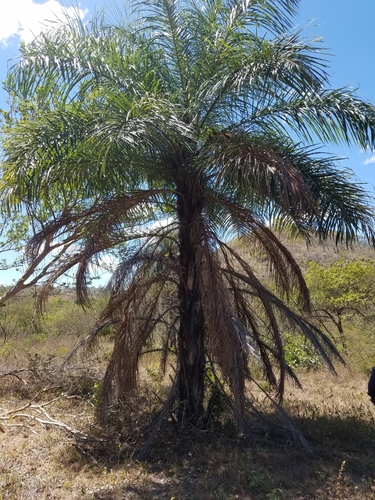
Palmyra like palm. A large palm which has separate male and female trees. It has a single trunk. It can grow 25 m high. The trunk is 35 cm across. The leaflets are spread out like fingers on a hand. The leaf stalks does not have thorns. The leaf sheath is split to the base and there is another split below the leaf stalk. The male and female flowers are very different. The male flowers are in dense clusters in pits in the flower bearing stalk. The fruit are large with a black shiny surface. They are 12-15 cm long by 8-10 cm wide. The fruit is in 3 sections. Each one has a single seed inside.
How to Grow
It grows from seed.
Wikipedia
Source ↗Borassus heineanus is a species of a large solitary fan palm found only in northern New Guinea, in both Papua New Guinea and Indonesia, where it is threatened by habitat loss. Also known as the New Guinea palmyra palm, B. heineanus grows up to 20 m tall with a robust trunk ringed with leaf scars; the old leaves remain attached to the trunk, but eventually fall cleanly. The blueish-green leaves are deeply dissected, up to 3.2 m across and the petioles have very sharp edges, which can give a nasty cut to the unwary. As with all Borassus species, B. heineanus is dioecious with male and female flowers on separate trees. The male flowers are 1.5 cm long and in semi-circular clusters enclosed within leathery bracts, forming massive catkin-like inflorescences. In contrast, the female flowers are golfball-sized, solitary and rest on the surface of the inflorescence axis. After pollination, they develop into green fleshy fruits, each containing 1-3 seeds. Each seed is contained within a woody endocarp and in some cases, woody flanges inside the endocarp penetrate the seed. Borassus heineanus differs from all other Borassus species in that it is found in tropical forests, rather than open savannas, resulting in a leaf anatomy resembling forest palms rather than other Borassus species. This led palm botanist Odoardo Beccari to suggest that B. heineanus might be more akin to the forest palm genus Borassodendron, however DNA evidence and pollen morphology clearly place B. heineanus within the genus Borassus.
Production
Fruit get too dry when old, so are eaten when young.
Notes
There are 7-10 Borassus species.
Names & Synonyms
Beiwof, Lipmemon
References (5)
- Baker, W.J. and Dransfield, J., 2006, Field Guide to Palms of New Guinea. Kew p 28
- Barfod, A.S., Banka R., and Dowe, J. L., 2001, Field Guide to Palms in Papua New Guinea. AAU Reports 40 Department of Systematic Botany University of Aarhus. Denmark. p 27
- Bayton, R. P., 2007, A Revision of Borassus L. (Arecaceae) Kew Bulletin, Vol. 62, No. 4, pp. 561-585
- French, B.R., 1986, Food Plants of Papua New Guinea, A Compendium. Asia Pacific Science Foundation p 320
- World Checklist of Useful Plant Species 2020. Royal Botanic Gardens, Kew