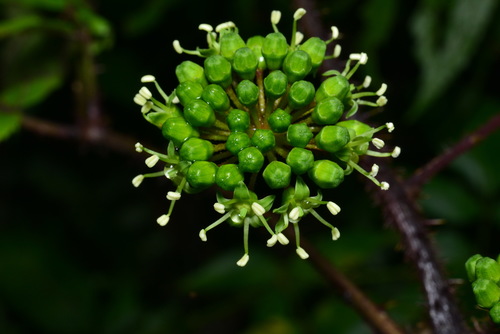
Polyscias multijuga
(A. Gray) Harms.
AraliaceaeLeaves
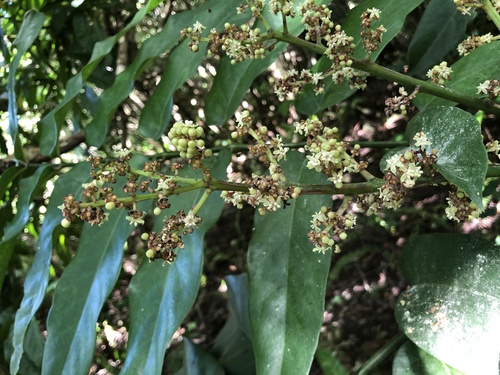
iNaturalist · cc-by-nc
(c) J.R. Kuethe, some rights reserved (CC BY-NC), uploaded by J.R. Kuethe
(c) J.R. Kuethe, some rights reserved (CC BY-NC), uploaded by J.R. Kuethe
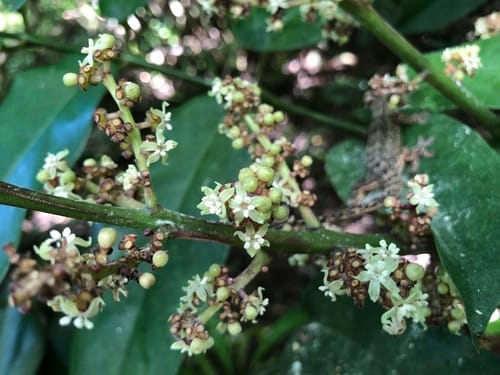
iNaturalist · cc-by-nc
(c) J.R. Kuethe, some rights reserved (CC BY-NC)
(c) J.R. Kuethe, some rights reserved (CC BY-NC)
What to Eat
Edible parts: Leaves
The leaves are eaten.
Where to Find It
A tropical plant. In Fiji it grows from sea level to 1,100 m altitude.
Fiji, Niue, Pacific, Tonga, Vanuatu, Wallis and Futuna,
Countries: Australia, Fiji, Micronesia, Kiribati, Marshall Islands, Nauru, Niue, New Zealand, Papua New Guinea, Palau, Solomon Islands, Tonga, Tuvalu, Vanuatu, Samoa
How to Identify
A tree. It grows 2-15 m high. It is usually slender and with few branches. The trunk is 20 cm across. The flowers are green when young but turn red. The ripe fruit are purple.
Names & Synonyms
Bees
Paratropia multijuga A. GrayNothopanax multijugam Seem.Panax multijugus Benth.Panax multijugum Benth. & Hook.
References (7)
- Barrau, J., 1976, Subsistence Agriculture in Melanesia. Bernice P. Bishop Museu, Bulletin 219 Honolulu Hawaii. Kraus reprint. p 59 (As Tieghemopanax excelsus)
- Cabalion, P. and Morat, P., 1983, Introduction le vegetation, la flore et aux noms vernaculaires de l'ile de Pentcoste (Vanuatu), In: Journal d'agriculture traditionnelle et de botanique appliquee JATBA Vol. 30, 3-4 (As Polyscias excelsa)
- Franklin, J., Keppel, G., & Whistler, W., 2008, The vegetation and flora of Lakeba, Nayau and Aiwa Islands, Central Lau Group, Fiji. Micronesica 40(1/2): 169–225, 2008
- Massal, E. and Barrau, J., 1973, Food Plants of the South Sea Islands. SPC Technical Paper No 94. Noumea, New Caledonia. p 35 (As Tieghemopanax excelsus)
- Smith, A.C., 1985, Flora Vitiensis Nova, Lawaii, Kuai, Hawaii, Volume 3 p 637
- Vanuatu herbarium
- Walter, A. & Lebot, V., 2007, Gardens of Oceania. ACIAR Monograph No. 122. p 171