Hydrangea anomala subsp. petiolaris
(Siebold & Zucc.) E. M. McClint.
Climbing hydrangea
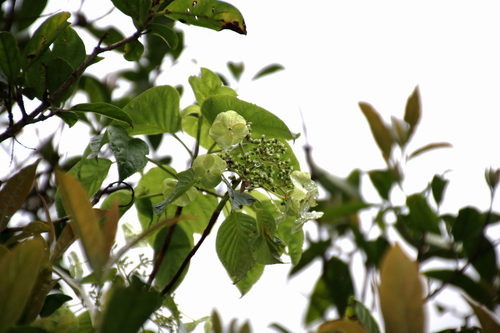
(c) 方伊琳(阿鈣), some rights reserved (CC BY-NC), uploaded by 方伊琳(阿鈣)
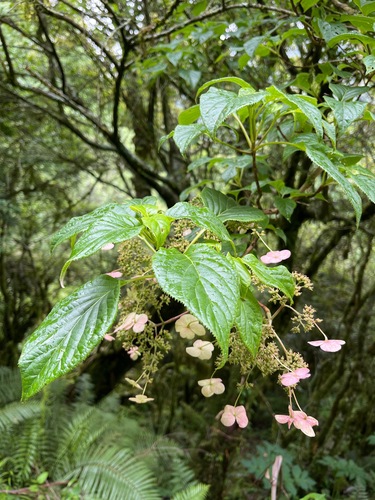
(c) Wolli Huang, some rights reserved (CC BY-NC), uploaded by Wolli Huang

(c) ivanovivan, some rights reserved (CC BY-NC)
What to Eat
Edible parts: Buds
The young spring buds are edible.
Where to Find It
A temperate plant. It suits hardiness zone 5. It grows on rocks and woodlands. It needs well drained moist soil.
Asia, Australia, Japan, Korea, Russia, Taiwan,
How to Identify
A deciduous climbing shrub. It grows 10-20 m high. It often climbs to the top of trees. The leaves are opposite and simple. They are dark green and vary in shape. They are usually oval or heart shaped and 4-10 cm long by 3-10 cm wide. The leaf stalks are 3-8 cm long. The flowers are white. They are in heads.
How to Grow
It can be grown by stem cuttings and layers.
Wikipedia
Source ↗Hydrangea anomala, the Japanese climbing-hydrangea, is a species of flowering plant in the family Hydrangeaceae native to the woodlands of the Himalaya, southern and central China and northern Myanmar. It is a woody climbing plant, growing to 12 m (39 ft) height up trees or rock faces, climbing by means of small aerial roots on the stems. The leaves are deciduous, ovate, 7–13 cm (2.8–5.1 in) long and 4–10 cm (1.6–3.9 in) broad, with a heart-shaped base, coarsely serrated margin and acute apex. The flowers are produced in flat corymbs 5–15 cm (2.0–5.9 in) diameter in mid-summer; each corymb includes a small number of peripheral sterile white flowers 2–3.5 cm (0.8–1.4 in) across, and numerous small, creamy-white fertile flowers 1–2 mm diameter. The fruit is a dry urn-shaped capsule 3–5 mm diameter containing several small winged seeds. The closely related Hydrangea petiolaris from eastern Siberia, Japan, and Korea, is sometimes treated as a subspecies of H. anomala; it differs in growing larger (to 20 m or 66 ft) and flower corymbs up to 25 cm (9.8 in) diameter. The common name Climbing hydrangea is applied to both species.
Names & Synonyms
Goto zuru, Tsuru ajisai, Tsuru demari
References (3)
- J. Arnold Arbor. 37:373. 1956
- Levy-Yamamori, R., & Taaffe, G., 2004, Garden Plants of Japan. Timber Press. p 274
- Ryan, S., 2008, Dicksonia. Rare Plants Manual. Hyland House. p 76


