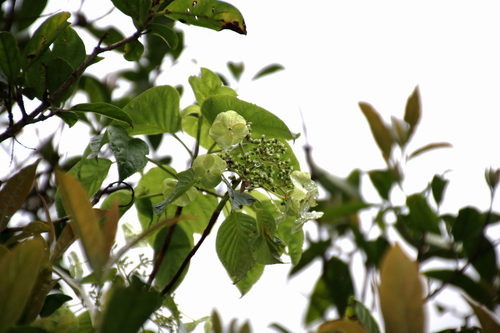
Dichroa febrifuga
Lour.

(c) piyapong, some rights reserved (CC BY-NC)
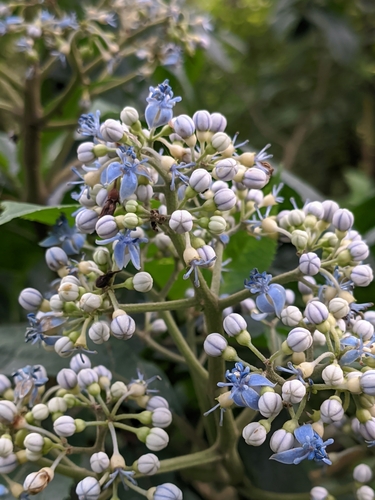
(c) Basu Dev Neupane, some rights reserved (CC BY-NC)
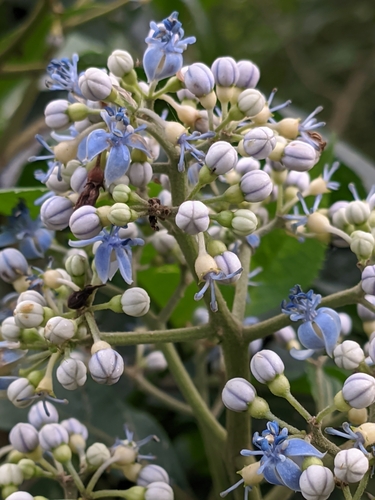
(c) Basu Dev Neupane, some rights reserved (CC BY-NC)
What to Eat
Edible parts: Flower nectar
None known
Known Hazards
Where to Find It
It is a tropical plant. It suits hardiness zone 9. In Hobart Botanical Gardens.
Asia, Australia, China, Myanmar, Nepal, SE Asia, Sikkim, Tasmania,
How to Identify
Dichroa febrifuga is a year-round evergreen shrub reaching 2 m tall, growing at a medium pace. It flowers from June to August with seeds ripening August through October. Hardy to UK zone 9. The plant tolerates light sandy, medium loamy, and heavy clay soils across a wide pH range from very acid to mildly alkaline. It grows in semi-shade or full sun and prefers moist conditions.
How to Grow
An easily grown plant, succeeding in an open loamy soil. The flowers vary in colour according to the type of soil they grow in, the best blue colour is formed when plants are in very acid soils. One report says that this plant is probably not hardy outdoors in Britain whilst another says that some provenances tolerate temperatures down to about -5°c and another report says that the forms in cultivation are only fully hardy in southern Cornwall. This same report goes on to say that those forms probably do not belong to D. febrifuga in the strict sense. This plant is cultivated in Russia as an anti-malarial herb.
Propagation: No specific information is available for this species. It is suggested to sow seed in a greenhouse in spring, barely covering it, and keeping the compost consistently moist. Once seedlings are large enough to handle, prick out into individual pots and grow on under glass for at least the first winter. Plant out in late spring or early summer after the last expected frosts. Cuttings are possible; nearly ripe wood taken in August and placed in a frame is suggested, though no detailed guidance is available.
Medicinal Uses
Commonly used in Chinese herbalism, where it is considered one of the 50 fundamental herbs. The leaves are purgative and used in the treatment of stomach cancer. In Nepal, leaf juice is taken for coughs, colds, and bronchitis. A decoction of the stem bark treats fevers, and a decoction of the leaves is used specifically for malarial fever. The root contains several alkaloids and acts as an emetic, expectorant, febrifuge, and purgative; its juice is used in Nepal to treat fevers and indigestion. The plant is 26 times more powerful than quinine against malaria but causes vomiting. Certain substances within it are 100 times more powerful than quinine, though these are poisonous.
Other Uses
The wood is used as fuel.
Wikipedia
Source ↗Dichroa febrifuga is a year-round evergreen shrub reaching 2 m tall, growing at a medium pace. It flowers from June to August with seeds ripening August through October. Hardy to UK zone 9. The plant tolerates light sandy, medium loamy, and heavy clay soils across a wide pH range from very acid to mildly alkaline. It grows in semi-shade or full sun and prefers moist conditions.
Names & Synonyms
Aseru, Basak, Bashak, Bhaasak, Ganhaaune paat, Shin-htaing-shin
References (1)
- Aryal, K., Moe, A.T., Hein, P.P., Bay, Y.H.S., Htay, T., Aung, H.W., Shakya, B., Xuefei, Y., Shaoliang, Y. , 2020, Wild and non- cultivated edible plants and their contribution to local livelihoods in Putao, Myanmar. ICIMOD.