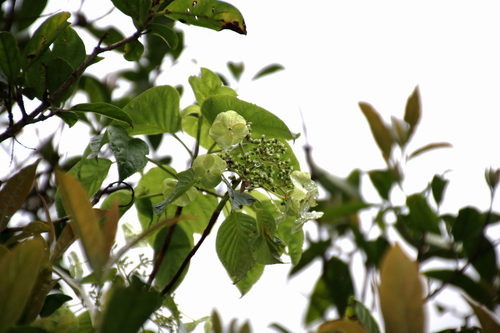
Hydrangea aspera
D.Don.
Hydrangea

no rights reserved, uploaded by 葉子

(c) galanhsnu, some rights reserved (CC BY-NC), uploaded by galanhsnu

no rights reserved, uploaded by 葉子
What to Eat
Tea. The leaves are used as a tea substitute. Some caution is advised, see the notes above on toxicity.
Known Hazards
Where to Find It
E. Asia - China to the Himalayas.
TEMPERATE ASIA: China (Gansu Sheng, Guangxi Zhuangzu Zizhiqu, Guizhou Sheng, Hubei Sheng (southwest), Hunan Sheng (southwest), Jiangsu Sheng, Shaanxi Sheng, Sichuan Sheng, Yunnan Sheng), Taiwan TROPICAL ASIA: Bhutan, India (Sikkim, West Bengal (north)), Nepal, Myanmar (north), Vietnam, Indonesia (Jawa, Sumatera)
How to Identify
Hydrangea aspera is a deciduous Shrub growing to 4 m (13ft) by 4 m (13ft) at a medium rate. See above for USDA hardiness. It is hardy to UK zone 7 and is not frost tender. It is in flower from July to September, and the seeds ripen from September to November. The species is hermaphrodite (has both male and female organs). Suitable for: light (sandy), medium (loamy) and heavy (clay) soils. Suitable pH: mildly acid, neutral and basic (mildly alkaline) soils and can grow in very acid and very alkaline soils. It can grow in semi-shade (light woodland) or no shade. It prefers dry or moist soil.
How to Grow
Succeeds in most good soils, including chalk.This species is one of the most chalk-tolerant members of the genus. Tolerates most soils, thriving in a well-drained loamy soil, but resenting dryness at the roots. Succeeds in full sun or semi-shade, but if it is grown in a low rainfall area then it requires shade at the hottest part of the day. Does well on very acid soils with a pH around 4.5. The colour of the flowers reflects the pH of the soil the plant is growing in, the flowers are pink in a neutral to alkaline soil and blue in an acid soil. Grows well in an open woodland garden. Although fairly tolerant of soil type, this species is not very easy to grow well, it is best given a dryish soil, it resents winter wet. Dormant plants are hardy to about -15°c. They are somewhat tender when young, and the young growth of older plants is also susceptible to damage by late frosts. Plants resent being pruned. This species is notably susceptible to honey fungus.
Propagation: Seed - surface sow in a greenhouse in spring. Cover the pot with paper until the seed germinates. When they are large enough to handle, prick the seedlings out into individual pots and grow them on in the greenhouse for at least their first winter. Plant them out into their permanent positions in late spring or early summer, after the last expected frosts. Cuttings of half-ripe wood, 8cm long, July/August in a frame. Overwinter in a greenhouse and plant out in late spring. Cuttings of mature wood in late autumn in a frame. Mound layering in spring. Takes 12 months. Leaf-bud cuttings of the current seasons growth in a frame.