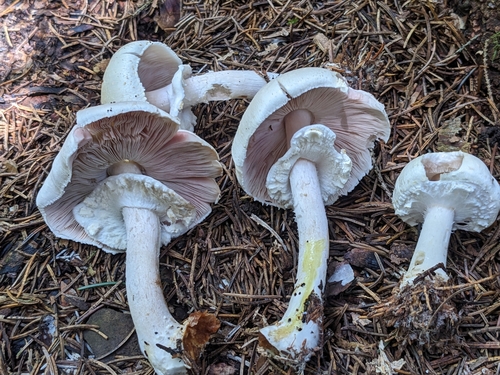
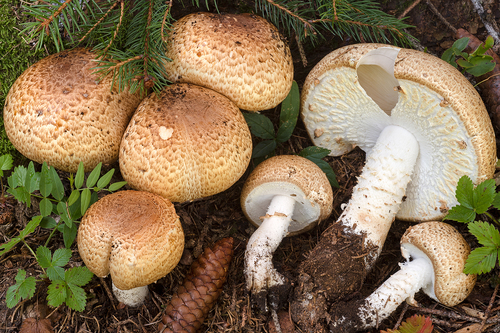
Agaricus subperonatus
(Lange) Sing.
Torn-edged mushroom
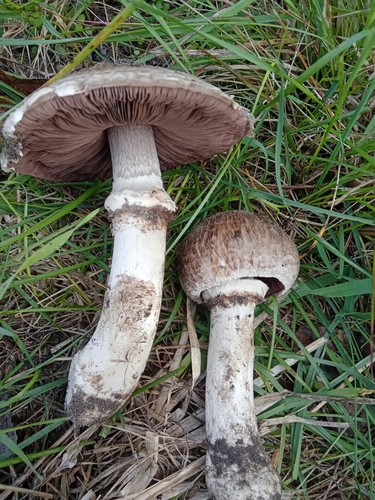
iNaturalist · cc-by-nc
(c) kalmananiko, some rights reserved (CC BY-NC)
(c) kalmananiko, some rights reserved (CC BY-NC)

iNaturalist · cc-by
(c) Enrico Tomschke, some rights reserved (CC BY)
(c) Enrico Tomschke, some rights reserved (CC BY)
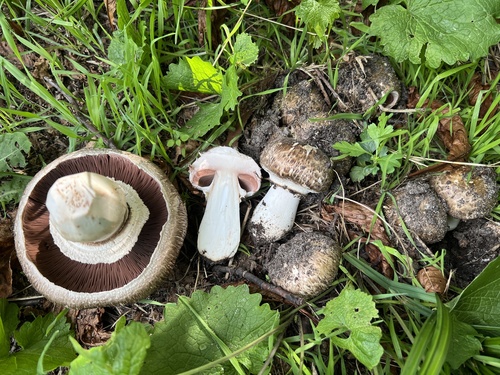
iNaturalist · cc-by-nc
(c) MB, some rights reserved (CC BY-NC)
(c) MB, some rights reserved (CC BY-NC)
What to Eat
Edible parts: Mushroom, Fungus
The genus contains the most widely consumed and best-known mushroom today, A. bisporus. Other well-known and highly regarded species include A. arvensis, A. augustus, and A. campestris. Agaricus porphyrocephalus is a choice edible when young, while A. subrufescens may be edible in some cases. Many other species are of culinary value, especially within sections Agaricus, Arvense, Duploannulatae and Sanguinolenti.
Known Hazards
Where to Find It
It is a temperate plant.
Europe, Mexico, North America, New Zealand*, Turkey, Türkiye,
Countries: Andorra, Antigua & Barbuda, Albania, Austria, Bosnia & Herzegovina, Barbados, Belgium, Bulgaria, Bahamas, Belarus, Belize, Canada, Switzerland, Costa Rica, Cuba, Cyprus, Czechia, Germany, Denmark, Dominica, Dominican Republic, Estonia, Spain, Finland, France, United Kingdom, Grenada, Greece, Guatemala, Honduras, Croatia, Haiti, Hungary, Ireland, Iceland, Italy, Jamaica, St Kitts & Nevis, St Lucia, Liechtenstein, Lithuania, Luxembourg, Latvia, Monaco, Moldova, Montenegro, North Macedonia, Malta, Mexico, Nicaragua, Netherlands, Norway, Panama, Poland, Puerto Rico, Portugal, Romania, Serbia, Russia, Sweden, Slovenia, Slovakia, San Marino, El Salvador, Turkey, Trinidad & Tobago, Ukraine, United States, St Vincent
How to Identify
A temperate mushroom in the Agaricaceae family, one of approximately 300 Agaricus species.
Notes
There are about 300 Agaricus species.
References (4)
- Boa, E. R., 2004, Wild edible fungi and their importance to people. FAO Non Wood Forest Products Booklet 17
- Crowe, A., 1997, A Field Guide to the Native Edible Plants of New Zealand. Penguin. p 129
- Ertug, F., 2000, An Ethnobotanical Study in Central Anatolia (Turkey). Economic Botany Vol. 54. No. 2. pp. 155-182
- Pace, G., 1998, Mushrooms of the world. Firefly books. p 44 (As Psalliota subperonata)