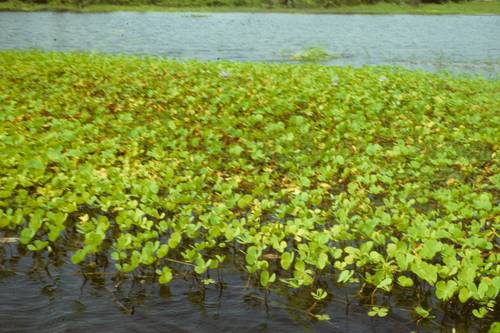
Marsilea macrocarpa
C. Presl.

(c) Ricky Taylor, some rights reserved (CC BY-NC), uploaded by Ricky Taylor

(c) georgfritz, some rights reserved (CC BY-NC)

(c) Ricky Taylor, some rights reserved (CC BY-NC), uploaded by Ricky Taylor
What to Eat
Edible parts: Leaves, Fronds, Stalks
Sporocarps of some Australian species such as Marsilea drummondii are edible and have been eaten by Aborigines and early white settlers, who knew it under the name ngardu or nardoo. Parts of Marsilea drummondii contain an enzyme which destroys thiamine (vitamin B1), leading to brain damage in sheep and horses. During floods in the Gwydir River basin 2,200 sheep died after eating nardoo. Three-quarters of the sheep that were affected did however respond to thiamine injections. Thiamine deficiency from incorrectly prepared nardoo likely resulted in the starvation and death of Burke and Wills. The leaves of Marsilea crenata are part of the East Javanese cuisine of Indonesia, especially in the city of Surabaya. It is called Pecel Semanggi and is served with spicy peanut and sweet potato sauce.
Where to Find It
It is a tropical plant. It grows along streams often floating in running water. It grows between 800-2,000 m above sea level.
Africa, Angola, Asia, Botswana, Central Africa, Congo, East Africa, Indochina, Kenya, Laos, Lesotho, Namibia, SE Asia, South Africa, Southern Africa, Tanzania, Zimbabwe,
How to Identify
A fern. It forms loose clumps. The rhizome can be 0.1-1.8 mm thick. The fronds are 10-25 cm long. The leaflets are grey-green
Names & Synonyms
References (6)
- Fox, F. W. & Young, M. E. N., 1982, Food from the Veld. Delta Books. p 227
- Jacot Guillarmod, 1971
- Peters, C. R., O'Brien, E. M., and Drummond, R.B., 1992, Edible Wild plants of Sub-saharan Africa. Kew. p 5
- Ruiters-Welcome, A. K., 2019, Food plants of southern Africa. Ph.D. thesis. Univ. of Johannesburg p 78
- Setshogo, M. P., 2005, Preliminary checklist of the plants of Botswana. Southern African Botanical Diversity Network Report No. 37. SABONET, Pretoria and Gaborone.
- Welcome, A. K. & Van Wyk, B.-E., 2019, An inventory and analysis of the food plants of southern Africa. South African Journal of Botany 122 (2019) 136–179