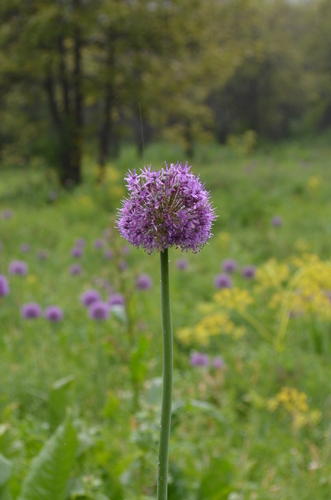
Scadoxus puniceus
(L.) Friis & Nordal
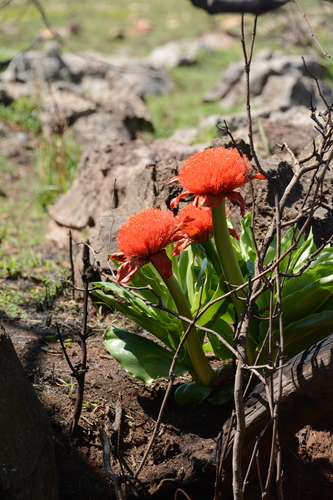
(c) Richard Gill, some rights reserved (CC BY-NC), uploaded by Richard Gill

(c) Frederic Doucet, some rights reserved (CC BY-NC), uploaded by Frederic Doucet

(c) Sunčana Bradley, some rights reserved (CC BY), uploaded by Sunčana Bradley
What to Eat
Edible parts: Fruit
The fruit are eaten raw.
Where to Find It
It is a tropical plant. It is often near streams and near swamps.
Africa, Botswana, East Africa, Eswatini, Ethiopia, Mozambique, South Africa, Southern Africa, Swaziland, Tanzania, Zambia, Zimbabwe,
How to Identify
A herb with a bulb. It grows 75 cm tall. The leaf stalks form a false stem 5-50 cm long. The flowers are in heads on long stalks. There are 30-100 flowers. The flowers are orange. The fruit are berries 5-10 mm across. They are red.
Medicinal Uses
While the bulb is considered poisonous in significant amounts, it is used traditionally to treat "coughs, gastro-intestinal problems, febrile colds, asthma, leprosy, sprains and bruises," and "as an antidote to poisons.'" It is also used as a diuretic. The leaves are applied to sores and ulcers to aid healing and act as an antiseptic. The plant is also traditionally consumed during pregnancy as part of an herbal regime to ensure safe labour. The alkaloids in the plant include haemanthamines, haemanthidine, 6-β-hydroxycrinamine, scapunine, and scadoxucines.
Wikipedia
Source ↗Scadoxus puniceus, commonly known as the paintbrush lily, is a species of bulbous plant. It is native to much of southern and eastern Africa: Ethiopia, Sudan, Tanzania, Malawi, Mozambique, Zambia, Zimbabwe, Botswana, Eswatini (Swaziland), and South Africa (the Cape Provinces, KwaZulu-Natal, the Free State and the Northern Provinces). Scadoxus puniceus can be found in cool, shady habitat such as ravines and forests, where it is often found in moist leaf litter. Other common names include snake lily, royal paintbrush, King-of-Candida, African blood lily (English), rooikwas (Afrikaans), isisphompho, and umgola (Zulu). There are nine species of Scadoxus of which three, S. puniceus, S. multiflorus (with 2 subspecies) and S.membranaceus, occur in South Africa.
Names & Synonyms
References (5)
- Peters, C. R., O'Brien, E. M., and Drummond, R.B., 1992, Edible Wild plants of Sub-saharan Africa. Kew. p 10
- Ruiters-Welcome, A. K., 2019, Food plants of southern Africa. Ph.D. thesis. Univ. of Johannesburg p 13
- Swaziland's Flora Database http://www.sntc.org.sz/flora
- Vinnicombe, 1976,
- Welcome, A. K. & Van Wyk, B.-E., 2019, An inventory and analysis of the food plants of southern Africa. South African Journal of Botany 122 (2019) 136–179