Brahea dulcis
(Kunth) Mart.
Mexican Palm, Sombrero palm

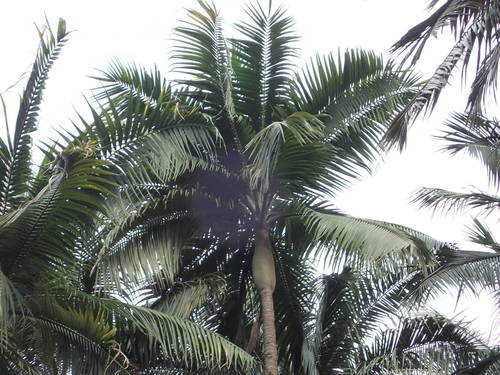
(c) Roberto González, some rights reserved (CC BY-NC), uploaded by Roberto González
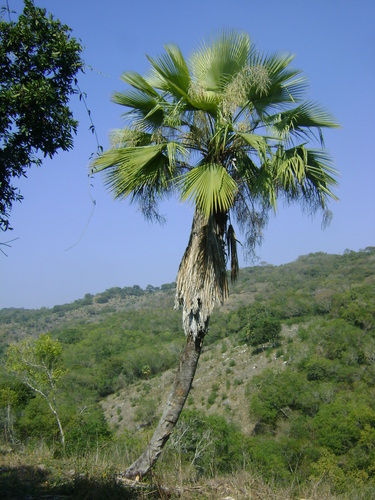
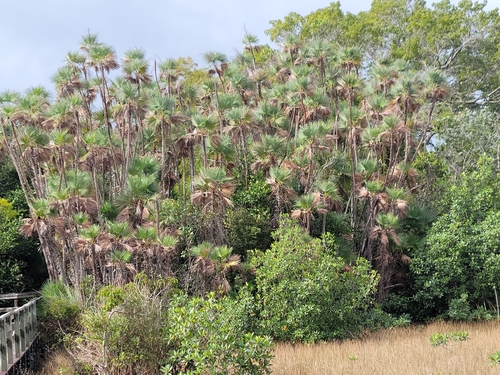
(c) Tereso Hernández Morales, some rights reserved (CC BY), uploaded by Tereso Hernández Morales
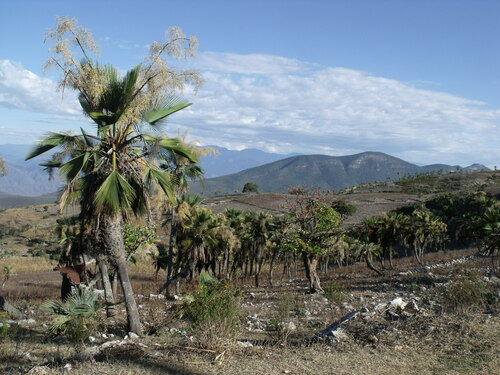
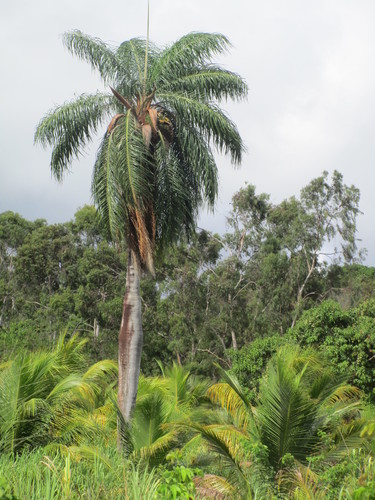
(c) Ángel Méndez, some rights reserved (CC BY-NC), uploaded by Ángel Méndez
What to Eat
Edible parts: Berries, Fruit, Palm heart
Fruit - raw or cooked, A sweet flavour. It is about 2cm in diameter.
Where to Find It
A tropical plant. It can grow in temperate and tropical regions. It does best in rich, sandy soils. It can grow in poor skeletal soils in rocky areas. It needs a protected, sunny position. It is drought resistant and frost tolerant. It grows in semi-arid places. It needs well drained soil. It grows in open woodland between 320 and 1760 m altitude in Central America. It suits hardiness zones 10-12.
Australia, Belize, Central America, El Salvador, Guatemala, Honduras, Mexico, Nicaragua, North America, Peru, South America,
How to Identify
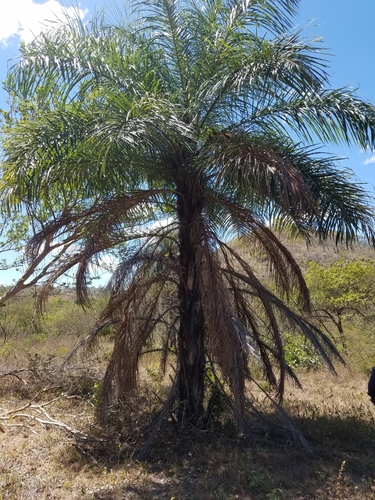
A solitary evergreen palm tree. It grows to 6 m high and spreads to 2 m across. The stem is erect and slender. It can have one or several trunks. They can be thick or thin. The fronds are spread out like fingers on a hand. They are deeply divided into stiff segments and are fanlike. The leaves are covered with a mealy white powder at least when young. The leaf stalks have saw tooth edges. The fruiting talks are 2 m long and hang over. The flowers are very small. The fruit are yellow and oval. They are 1 cm long and juicy. They are edible. They contain one seed. The seed is oval and 1 cm long.
How to Grow
Plants are grown from seed. Seed grow easily. They take 3-6 months to germinate. Seed should be sown fresh after a good soaking.
Propagation: Seed - best sown as soon as it is ripe in a warm greenhouse at not less than 24°c. Germination of fresh seed usually takes place in 3 - 4 months at 25°c. Stored seed is very slow to germinate. Pre-soaking the seed for 24 hours in warm water prior to sowing may shorten the germination time. Plants form a long tap-root some time before forming a shoot so it is best to sow 2 - 3 seeds per deep pot. Grow the seedlings on in the greenhouse for at least their first three winters. Plant them out into their permanent positions in late spring or early summer, after the last expected frosts.
Medicinal Uses
None known
Other Uses
None known Special Uses
Wikipedia
Source ↗Brahea dulcis, the sweet hesper palm or apak palm, is a species of flowering plant in the family Arecaceae. It is native to dry woodlands of Mexico, Guatemala, Belize, El Salvador, and Honduras. A single-trunked palm reaching 7.5 m (25 ft) with edible fruit and green to blue-green leaves, it is occasionally available from commercial suppliers.
Production
It is relatively slow growing.
Other Information
Fruit are sold in markets.
Notes
There are about 12-16 Brahea species. They all grow in Mexico.
Names & Synonyms
Apak palm, Capulin, Miche, Michire, Palma criolla, Palma de abanico, Palma dulce, Palma de sombrero, Rock palm, Suyate
References (27)
- Balick, M.J. and Beck, H.T., (Ed.), 1990, Useful palms of the World. A Synoptic Bibliography. Colombia p 598
- Bircher, A. G. & Bircher, W. H., 2000, Encyclopedia of Fruit Trees and Edible Flowering Plants in Egypt and the Subtropics. AUC Press. p 63
- Bodkin, F., 1991, Encyclopedia Botanica. Cornstalk publishing, p 167
- Casas, A., et al, 1996, Plant Management Among the Nahua and the Mixtec in the Balsas River Basin, Mexico: An Ethnobotanical Approach to the Study of Plant Domestication. Human Ecology, Vol. 24, No. 4 pp. 455-478
- Etherington, K., & Imwold, D., (Eds), 2001, Botanica's Trees & Shrubs. The illustrated A-Z of over 8500 trees and shrubs. Random House, Australia. p 141
- Facciola, S., 1998, Cornucopia 2: a Source Book of Edible Plants. Kampong Publications, p 27
- Gibbons, M., 2003, A pocket guide to Palms. Chartwell Books. p 56
- Grandtner, M. M., 2008, World Dictionary of Trees. Wood and Forest Science Department. Laval University, Quebec, Qc Canada. (Internet database http://www.WDT.QC.ca)
- Haynes, J., & McLaughlin, J., 2000, Edible palms and Their Uses. University of Florida Fact sheet MCDE-00-50-1 p 4
- Hedrick, U.P., 1919, (Ed.), Sturtevant's edible plants of the world. p 112
- Henderson, A., Galeano, G and Bernal, R., 1995, Field Guide to the Palms of the Americas. Princeton. p 56
- Hist. nat. palm. 3:244, t. 137, 162. 1838
- Janick, J. & Paul, R. E. (Eds.), 2008, The Encyclopedia of Fruit & Nuts. CABI p 105
- Johnson, D.V., 1998, Tropical palms. Non-wood Forest products 10. FAO Rome. p 85
- Jones, D.L., 1994, Palms throughout the World. Smithtonian Institution, Washington. p 54, 148
- Jones, D.L., 2000, Palms of Australia 3rd edition. Reed/New Holland. p 126
- Piedra-Malagón, E. M. et al, 2022, Edible native plants of the Gulf of Mexico Province. Biodiversity Data Journal 10: e80565 p 11
- Pulido, M.T. and Coronel-Ortega, M., 2015, Ethnoecology of the palm Brahea dulcis (Kunth) Mart. in central Mexico. Journal or Ethnobiology and Ethnomedicine, 11:1
- Rangel-Landa, S., et al, 2017, Sociocultural and ecological factors influencing management of edible and non-edible plants: the case of Ixcatlan, Mexico. Journal of Ethnobiology and Ethnomedicine. 13:59
- Riffle, R.L. & Craft, P., 2003, An Encyclopedia of Cultivated Palms. Timber Press. p 277
- Schuler, S., (Ed.), 1977, Simon & Schuster's Guide to Trees. Simon & Schuster. No. 48
- Segura, S. et al, 2018, The edible fruit species in Mexico. Genet Resour Crop Evol (2018) 65:1767–1793
- Standley, P. C., 1926, Trees and Shrubs of Mexico. Contributions from the United States National Herbarium Vol. 23 p 75
- Turreira-Garcia, N., et al, 2015, Wild edible plant knowledge, distribution and transmission: a case study of the Achi Mayans of Guatemala. Journal of Ethnobiology and Ethnomedicine. 11:52
- USDA, ARS, National Genetic Resources Program. Germplasm Resources Information Network - (GRIN). [Online Database] National Germplasm Resources Laboratory, Beltsville, Maryland. Available: www.ars-grin.gov/cgi-bin/npgs/html/econ.pl (10 April 2000)
- Wiersema, J. H. & Leon, B., 2013, World Economic Plants. A Standard Reference CRC Press. 2nd Ed. p 111
- www.desert-tropicals.com