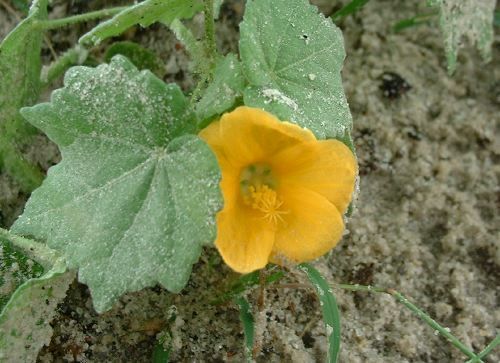
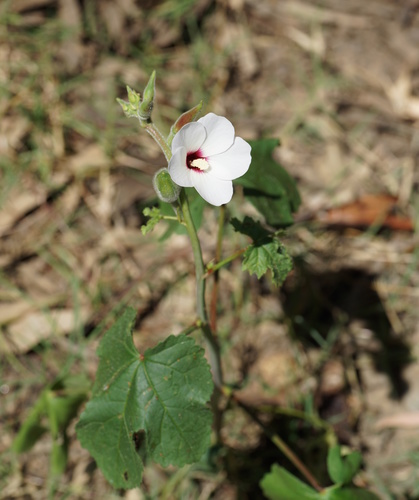
Abutilon hirtum
(Lam.) Sweet
Indian mallow

(c) Lalithamba, some rights reserved (CC BY)
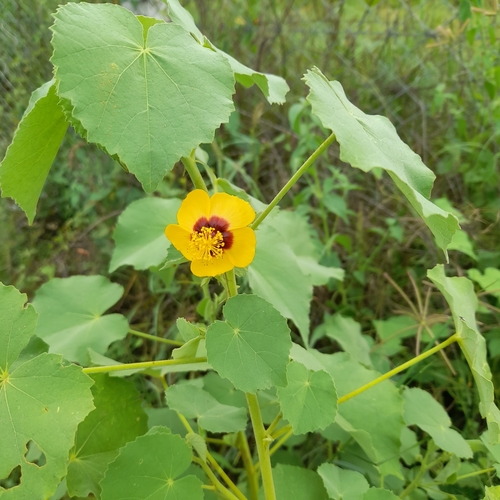
(c) P Jeganathan, some rights reserved (CC BY), uploaded by P Jeganathan
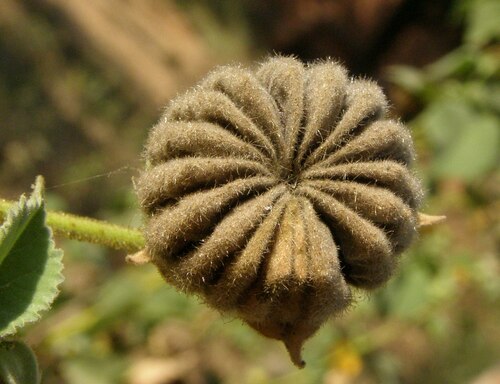
(c) Peter Zika, some rights reserved (CC BY-NC), uploaded by Peter Zika
What to Eat
Edible parts: Seeds, Fruit
The fruit is eaten raw, and both seeds and fruit are edible portions.
Where to Find It
It is a tropical plant. It grows in rocky, stony or sandy soils. It is often over limestone material. It grows between 550-915 m above sea level. It can tolerate shade. It can grow in arid places. In Yunnan.
Afghanistan, Africa, Angola, Australia, Bahamas, Botswana, Burundi, Central Africa, Central America, Chad, China, Colombia, Congo, Costa Rica, Cuba, Dominica, Dominican Republic, East Africa, Ecuador, Ethiopia, Guadeloupe, Haiti, India, Indochina, Indonesia, Iran, Iraq, Israel, Jamaica, Kenya, Marquesas, Mauritius, Mediterranean, Mexico, Middle East, Mozambique, Myanmar, Namibia, New Caledonia, Niger, Nigeria, North America, Pacific, Pakistan, Panama, Philippines, Puerto Rico, Reunion, Rwanda, Sahel, SE Asia, Socotra, Somalia, South Africa, South America, Southern Africa, Sri Lanka, Sudan, Tanzania, Thailand, Trinidad-Tobago, Uganda, USA, Vanuatu, Venezuela, Vietnam, West Africa, West Indies, Yemen, Zimbabwe,
How to Identify
A shrub or small tree. It grows 5 m tall. There are prickles along the stem. The leaves are twice divided and there are 8-18 pairs of pinnae. There are up to 50 pairs of pinnules on each pinnae. The flowers are yellow. They are in large clusters at the ends of branches. The pods are flattened.
How to Grow
A plant of the drier tropics, usually found in areas with a distinct dry season, at elevations up to 1,800 metres. The plant is often found in riverine silty soils in the wild, but more commonly on the more alkaline types of soil.
Medicinal Uses
The plant (part not specified) is used to ease childbirth and to expel the placenta. The plant is used as a poultice to ease the pain of kidney gravel and is often mixed with glutinous rice and applied to ulcers. The roots are antipyretic and also used in the treatment of coughs and toothache. The leaves or flowers are applied to abscesses.
Other Uses
A fibre is obtained from the stem bark. It is used for making string, cordage and cloth. The fibre is long, fine, soft and strong. The plant is a host for okra mosaic virus (Ohm).
Other Information
Probably minor.
Notes
There are about 100-160 Abutilon species.
Names & Synonyms
References (8)
- Copeland, S. R., 2007, Vegetation and plant food reconstruction of lowermost Bed II, Olduvai Gorge, using modern analogs. Journal of Human Evolution 53 (2007) 146-175
- East African Herbarium records, 1981,
- Flora of Pakistan. www.eFloras.org
- Mutie, F. M., et al, 2023, Important Medicinal and Food Taxa (Orders and Families) in Kenya, Based on Three Quantitative Approaches. Plants 2023, 12, 1145
- Plants of Haiti Smithsonian Institute http://botany.si.edu/antilles/West Indies
- Peters, C. R., O'Brien, E. M., and Drummond, R.B., 1992, Edible Wild plants of Sub-saharan Africa. Kew. p 144
- Royal Botanic Gardens, Kew (1999). Survey of Economic Plants for Arid and Semi-Arid Lands (SEPASAL) database. Published on the Internet; http://www.rbgkew.org.uk/ceb/sepasal/internet [Accessed 3rd May 2011]
- World Checklist of Useful Plant Species 2020. Royal Botanic Gardens, Kew