Papaver aculeatum
Thunb.
Orange poppy
no rights reserved
no rights reserved
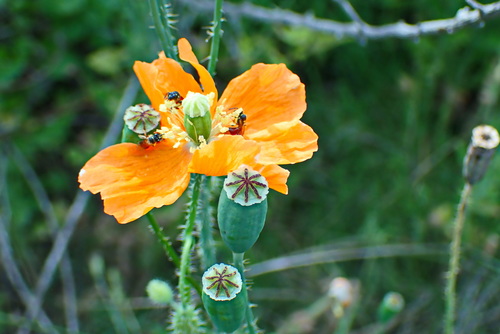
no rights reserved
What to Eat
Edible parts: Leaves
The young leaves are used as a potherb and are eaten in Lesotho.
Known Hazards
Where to Find It
It is a temperate to subtropical plant.
Africa, Australia, Lesotho, South Africa, Southern Africa, Tasmania,
How to Identify
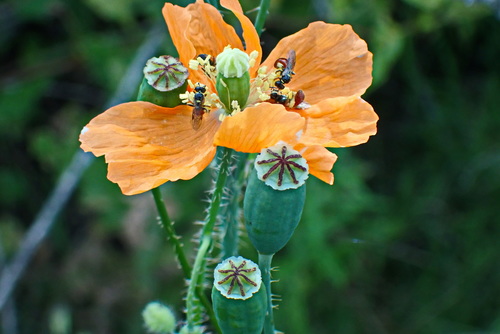
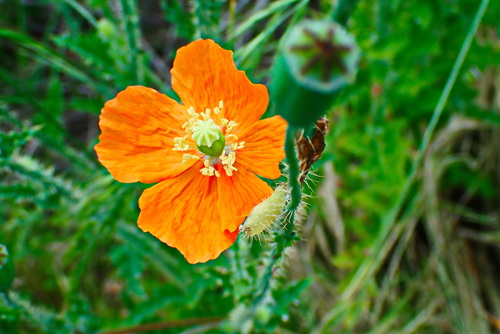
A herb. It grows each year from seed. It grows about 1 m tall. The stems are branched, angled and prickly. The leaves are in a ring at the base. They are divided into lobes along the stalk. The flowers are orange. The fruit is an oval poppy seed head. It has ribs.
How to Grow
Plants grow easily from seed.
Wikipedia
Source ↗Papaver aculeatum, the bristle poppy, orange poppy or South African poppy, is a species of flowering plant in the family Papaveraceae. It is native to Namibia, South Africa, and Lesotho, and has been introduced to eastern and southern Australia. It is the only species of poppy native to the Southern Hemisphere. An upright annual reaching 1.8 m (6 ft), it is found growing in a wide variety of habitats and soil types
Other Information
The young leaves are eaten in Lesotho.
Names & Synonyms
Doring papawer, Sehlahloa, Sehlohlo
References (6)
- Fox, F. W. & Young, M. E. N., 1982, Food from the Veld. Delta Books. p 287
- Guillarmod, J., 1966, 1971,
- Peters, C. R., O'Brien, E. M., and Drummond, R.B., 1992, Edible Wild plants of Sub-saharan Africa. Kew. p 159
- Ruiters-Welcome, A. K., 2019, Food plants of southern Africa. Ph.D. thesis. Univ. of Johannesburg p 84
- Tasmanian Herbarium Vascular Plants list p 42
- Welcome, A. K. & Van Wyk, B.-E., 2019, An inventory and analysis of the food plants of southern Africa. South African Journal of Botany 122 (2019) 136–179