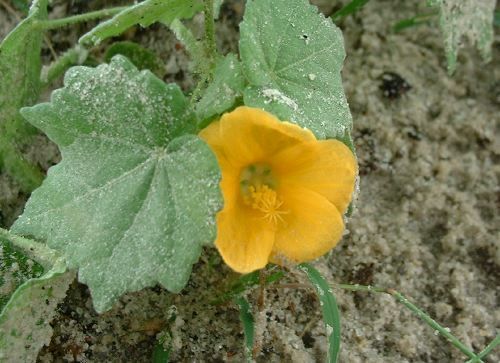
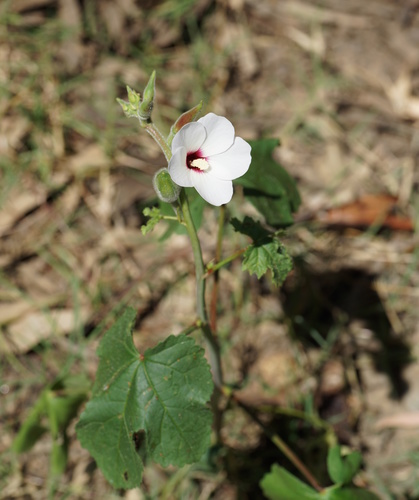
Grewia tembensis
Fresen.

(c) Ali Mohammed Alzahrani, some rights reserved (CC BY-NC)

(c) Jacky Judas, some rights reserved (CC BY)
What to Eat
Edible parts: Fruit, Seeds, Leaves
The sweet ripe fruit are eaten fresh or as juice, and the seeds and leaves are also edible.
Where to Find It
It is a tropical plant. In Kenya it grows between 250-2,200 m altitude. It grows in areas with a rainfall of 500-800 mm. It can grow in arid places.
Africa, Asia, East Africa, Ethiopia, India, Kenya, Somalia, South Sudan, Sri Lanka, Tanzania,
How to Identify
A small shrub. It has several stems. It grows 4 m high. The stems are long and narrow. They are grey and smooth. The leaves are oval and slightly hairy. They are rough above and have teeth along the edge. The flowers are white or pink. The fruit have 4 lobes. They are light green and ripen to red or orange.
How to Grow
Plants can be grown from seeds and also from cuttings.
Other Information
The fruit are popular.
Notes
These were in the Sparrmanniaceae and the Tiliaceae.
Names & Synonyms
Awraris, Deka, Dheekkaa, Hashanli, Ikogom, Iyier, Kituva, Midhayo, Mkone, Mnangu, Mutuva, Nduva, Ogumdi
References (18)
- Asfaw, Z. and Tadesse, M., 2001, Prospects for Sustainable Use and Development of Wild Food Plants in Ethiopia. Economic Botany, Vol. 55, No. 1, pp. 47-62
- Awodoyin, R.O., Olubode, O.S., Ogbu, J.U., Balogun, R.B., Nwawuisi, J.U. and Orji, K.O., 2015, Indigenous Fruit Trees of Tropical Africa: Status, Opportunity for Development and Biodiversity Management. Agricultural Sciences, 6, 31-41
- Bussman, R. W., et al., 2006, Plant Use of the Maasai of Sekenani Valley, Maasai Mara, Kenya. Journal of Ethnobiology and Ethnomedicine. 2:22
- Dale, I. R. and Greenway, P. J., 1961, Kenya Trees and Shrubs. Nairobi. p 569
- East African Herbarium records, 1981,
- Edwards. S., et al, (Eds), 1995, Flora of Ethiopia and Eritrea. Vol.2, Part 2 Canellaceae to Euphorbiaceae. Uppsala, Sweden. p 162
- Gemedo-Dalle, T., et al, 2005, Plant Biodiversity and Ethnobotany of Borana Pastoralists in Southern Oromia, Ethiopia. Economic Botany 59(1) pp. 43-65
- Ichikawa, M., 1980, The Utilization of Wild Food Plants by the Suiei Dorobo in Northern Kenya. J. Anthrop. Soc. Nippon. 88(1): 25-48
- Kuhnlein, H. V., et al, 2009, Indigenous Peoples' food systems. FAO Rome p 239
- Maundu, P. et al, 1999, Traditional Food Plants of Kenya. National Museum of Kenya. 288p
- Morgan, W. T. W., 1981, Ethnobotany of the Turkana: Use of plants by a Pastoral People and Their Livestock in Kenya. Economic Botany 35(1):96-130
- Msuya, T. S., et al, 2010, Availability, Preference and Consumption of Indigenous Foods in the Eastern Arc Mountains, Tanzania, Ecology of Food and Nutrition, 49:3, 208-227
- Mutie, F. G., 2020, Conservation of Wild Food Plants and Their Potential for Combatting Food Insecurity in Kenya as Exemplified by the Drylands of Kitui County. Plants 2020, 9, 1017
- Mutie, F. M., et al, 2023, Important Medicinal and Food Taxa (Orders and Families) in Kenya, Based on Three Quantitative Approaches. Plants 2023, 12, 1145
- Omer, M., 2011, Diversity of Woody Species, Local Knowledge and Management Practices in Different Land Use Systems of Awbare Wereda, Jig-Jiga Zone of Somali Region, Ethiopia. M. Sc. thesis Addis Abba University p 47
- Peters, C. R., O'Brien, E. M., and Drummond, R.B., 1992, Edible Wild plants of Sub-saharan Africa. Kew. p 193
- Royal Botanic Gardens, Kew (1999). Survey of Economic Plants for Arid and Semi-Arid Lands (SEPASAL) database. Published on the Internet; http://www.rbgkew.org.uk/ceb/sepasal/internet [Accessed 11th June 2011]
- World Checklist of Useful Plant Species 2020. Royal Botanic Gardens, Kew