Triumfetta pentandra
A. Rich.

(c) Bart Wursten, some rights reserved (CC BY-NC), uploaded by Bart Wursten

(c) jbowers027, some rights reserved (CC BY-NC), uploaded by jbowers027

(c) Bart Wursten, some rights reserved (CC BY-NC), uploaded by Bart Wursten
What to Eat
Edible parts: Leaves, Vegetable
Leaves - cooked and eaten as a vegetable. The bark of green shoots is a source of mucilage used for making sticky soups and sauces. The mucilage is often used as baby food and for young children not yet able to eat coarse starchy foods. Because of its high energy value, the soup is often the first dish given to women who have delivered a child. It is also used as appetizer. The mucilage is extracted by softening the bark in hot water, followed by kneading it in a small amount of clean water. During kneading, the mucilage is released into the water, which is then added to stews to make them sticky. Bark peeled from the stem can be stored for later use.
Where to Find It
It is a tropical plant. It grows in savannah woodland and in coastal sands.
Africa, Asia, Botswana, Burkina Faso, Cape Verde, East Africa, Guinea, Guinée, Guinea-Bissau, India, Malawi, Mozambique, Pakistan, Senegal, South Africa, Southern Africa, Sri Lanka, Taiwan, West Africa, Zambia, Zimbabwe,
How to Identify
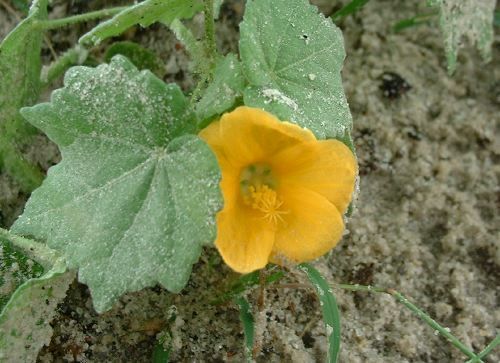
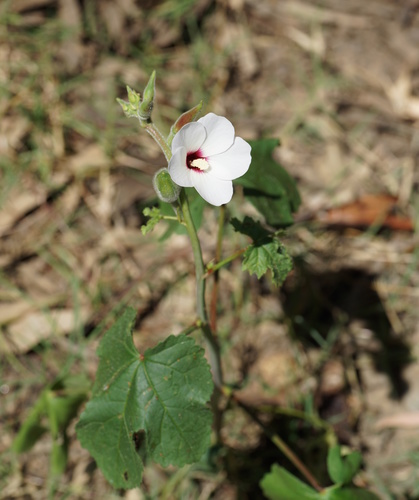
An annual herb. It grows 25-60 cm high. The stem is hairy. The leaves have 5 veins or ribs. The leaves have 3 lobes. The leaves are 5-9 cm long by 4-6 cm wide. The flowers are yellow. The fruit is an oval capsule 6-7 mm long. It has spines and hairs.
How to Grow
Grows best in partial shade. The plant produces seed capsules that are covered in hooked hairs which adhere to fur and clothing. They can be carried for some distance in this manner and the plant can thus easily spread to become a weed. Stems for mucilage are harvested by cutting them just above ground level when they are 75 - 100 cm long. They are prepared by removing all leaves and the terminal part where the stem has a diameter of less than 1cm. The resulting sticks are either taken to the homestead or tied into bundles and brought to the market. The plant is deep-rooted. Closely related to T. Rhomboidea.
Propagation: Seed - When cultivated for the mucilage in the stems, cuttings of 15 - 20cm long are taken from the top end of the harvested stems. Since the crop does not perform well under direct sunlight, the cuttings are usually planted in the shade of a tree. They are planted in a circle with a spacing of 10 - 15cm. If the cutting is not planted straight upward, adventitious roots may develop, causing a reduced capacity to produce slime. Therefore, some farmers tie the cuttings to a taller plant, e.g. plantain, to ensure that they grow upright.
Medicinal Uses
Fresh root scrapings are applied as a poultice on sores and small wounds. The crushed leaf is applied in dressings for treatment of goitre and deformities. In veterinary medicine in Burundi leaf sap is given for treatment of theileriosis.
Other Uses
A fibre obtained from the bark is used for making string and fishing lines. Reports on the quality are variable, it has been said to be of average quality only, but in India it is recorded to be soft, spinnable and nearer to jute in quality than Triumfetta rhomboidea. The presence of this plant is sometimes seen as an indicator of degraded soils. The plant is sometimes cultivated as an intercrop with pearl millet.
Notes
It has also been put in the family Sparmanniaceae. It may eventually be put in the family Malvaceae. These have also been in the family Tiliaceae.
Names & Synonyms
Babani, Borboronguel, Cuecue, Quebem Mascksok, Thiria grande
References (4)
- East African Herbarium records, 1981,
- Grubben, G. J. H. and Denton, O. A. (eds), 2004, Plant Resources of Tropical Africa 2. Vegetables. PROTA, Wageningen, Netherlands. p 536
- Peters, C. R., O'Brien, E. M., and Drummond, R.B., 1992, Edible Wild plants of Sub-saharan Africa. Kew. p 194
- World Checklist of Useful Plant Species 2020. Royal Botanic Gardens, Kew