Abutilon otocarpum
F.Muell.
Lantern flower, Desert Lantern, Desert Chinese Lantern

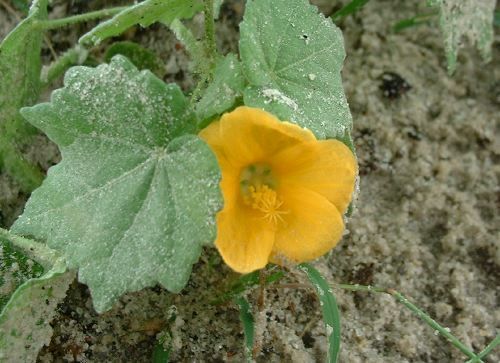
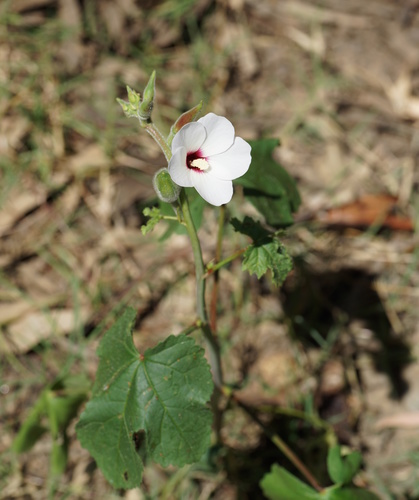
(c) Mark Marathon, some rights reserved (CC BY-SA)

(c) Mark Marathon, some rights reserved (CC BY-SA)

(c) cinclosoma, some rights reserved (CC BY-NC), uploaded by cinclosoma
What to Eat
Edible parts: Seeds
The seeds have a nutty flavour and can be eaten raw without any preparation.
Where to Find It
It grows in tropical and subtropical places. It grows in desert areas often near stream banks and flood plains. It suits a hot dry climate. It needs good drainage and does not do well in humid places. It can grow in slight shade. It can grow in arid places.
Australia*,
How to Identify
A shrub or small tree. It grows 5 m tall. There are prickles along the stem. The leaves are twice divided and there are 8-18 pairs of pinnae. There are up to 50 pairs of pinnules on each pinnae. The flowers are yellow. They are in large clusters at the ends of branches. The pods are flattened.
How to Grow
It is grown from seed. Fire helps the germination and growth of this plant.
Other Uses
A fibre is obtained from the stem bark.
Wikipedia
Source ↗Abutilon otocarpum, the desert lantern, is a small shrub of the family Malvaceae found in most parts of Australia.
Notes
There are about 100-160 Abutilon species.
References (7)
- Cherikoff V. & Isaacs, J., The Bush Food Handbook. How to gather, grow, process and cook Australian Wild Foods. Ti Tree Press, Australia p 188
- Elliot, W.R., & Jones, D.L., 1982, Encyclopedia of Australian Plants suitable for cultivation. Vol 2. Lothian. p 8
- Hunter, J.T., 2017, Is there a relationship between contemporary high Aboriginal plant resource locations and mapped vegetation communities? Cunninghamia 17:27-34. The Royal Botanic Garden Sydney. ISSN 2200 - 405X
- Latz, P., 1996, Bushfires and Bushtucker. IAD. p 84
- Lazarides, M. & Hince, B., 1993, Handbook of Economic Plants of Australia, CSIRO. p 1
- Paczkowska, G. & Chapman, A.R., 2000, The Western Australian Flora. A Descriptive Catalogue. Western Australian Herbarium. p 285
- Wheeler, J.R.(ed.), 1992, Flora of the Kimberley Region. CALM, Western Australian Herbarium, p 206