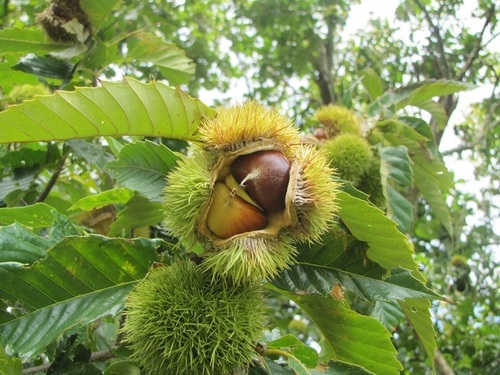
Quercus ithaburensis
Decne
Mt Tabor Oak

Didier Descouens (via Wikimedia Commons)

Offer.s.z (via Wikimedia Commons)

Nemo di Punta Grossa
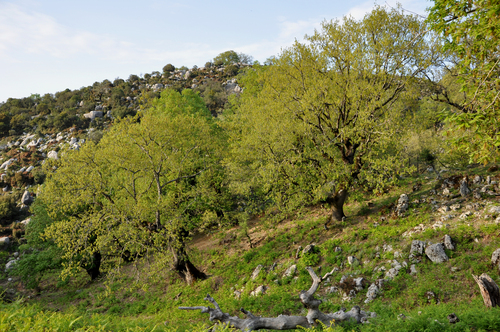
(c) Christian Gilli, some rights reserved (CC BY-NC)
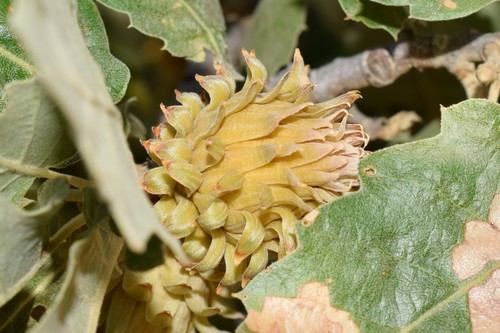
(c) Σάββας Ζαφειρίου (Savvas Zafeiriou), some rights reserved (CC BY-NC)
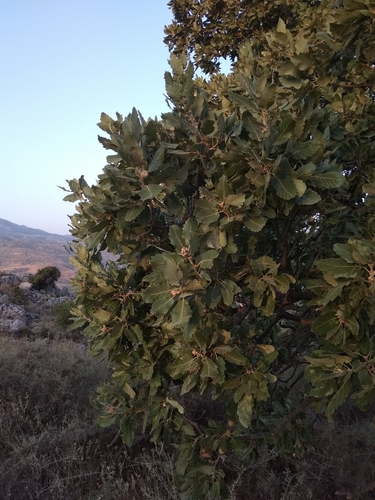
(c) mathias_s, some rights reserved (CC BY-NC)
What to Eat
Edible parts: Nuts, Acorns
The cups of Quercus ithaburensis subsp. macrolepis, known as valonia, are used for tanning and dyeing as are the unripe acorns called camata or camatina. The ripe acorns are eaten raw or boiled.
Where to Find It
It is a Mediterranean climate plant.
Israel, Jordan, Mediterranean, Middle East, Syria, Turkey, Türkiye,
How to Identify
A tree. It can grow 10 m tall. The branches form a round crown. The bark is dark grey-brown. It has deep grooves. The leaves are 5-10 cm long. They have teeth along the edges. The leaves are shiny above and have felt like hairs underneath.
Wikipedia
Source ↗Quercus ithaburensis, the Mount Tabor oak, is a tree in the beech family Fagaceae. It is found from southeastern Italy to the Levant. It is the national tree of Jordan. Two subspecies are accepted, Quercus ithaburensis subsp. ithaburensis and Quercus ithaburensis subsp. macrolepis (syn. Quercus macrolepis, the Valonia oak). Together with Quercus brantii, it forms a clade of distinct, closely related species within the oak section Cerris.
Names & Synonyms
Alon, Balut, Mallul
References (5)
- Al-Qura'n, S. A., 2010, Ethnobotanical and Ecological Studies of Wild Edible Plants in Jordan. Libyan Agriculture Research Center Journal International 1(4):231-243
- Mayer-Chussuck, U & Lev, E., 2014, Wild Edible Plants in Israel Tradition Versus Cultivation. in Z. Yaniv, N. Dudai (eds.), Medicinal and Aromatic Plants of the Middle-East, Springer
- Musselman, L. J., 2007, Figs, Dates, Laurel and Myrrh. Plants of the Bible and the Quran. Timber Press. p 206
- Rivera, D. et al, 2006, Gathered Mediterranean Food Plants - Ethnobotanical Investigations and Historical Development, in Heinrich M, Müller WE, Galli C (eds): Local Mediterranean Food Plants and Nutraceuticals. Forum Nutr. Basel, Karger, 2006, vol 59, pp 18–74
- Tukan, S. K., et al, 1998, The use of wild edible plants in the Jordanian diet. International Journal of Food Sciences and Nutrition. 49:225-235
More from Fagaceae