Cavendishia pubescens
(Kunth) Hemsl.
Pubescent cavendishia
(c) Sebastián Berrío, some rights reserved (CC BY-NC), uploaded by Sebastián Berrío

(c) Juan Manuel de Roux, some rights reserved (CC BY-NC), uploaded by Juan Manuel de Roux

(c) Nicolás Baresch Uribe, some rights reserved (CC BY)
What to Eat
Edible parts: Fruit
The fruit are edible.
Where to Find It
It is a tropical plant. It grows in secondary forests between 1,600-3,000 m above sea level.
Amazon, Andes, Bolivia, Central America, Columbia, Ecuador, Panama, Peru, South America, Venezuela,
How to Identify
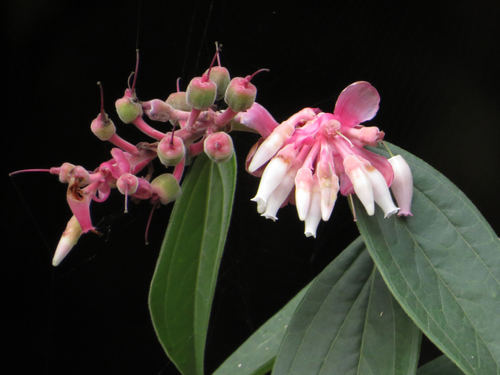
A small tree. It grows 7 m tall. The trunk is 20 cm across. There are many branches. Leaves and new branches are hairy. The leaves are simple and alternate or in spirals. They are oblong to swrord shaped and 12-30 cm long by 3-12 cm wide. They are rounded at the base and taper to the tip. The upper surface is dark green and shiny and they are pale underneath. The flowering shoots are 7.5 cm long and the flowers are in clusters. They are large and tube shaped. The fruit is an oblong berry 1-1.2 cm across. They are dark purple when ripe.
Names & Synonyms
Camaron, Camarona, Manzana, Manzanito, Uva de monte, Uvita, Uvito de monte, Uvito noble
References (9)
- Grandtner, M. M., 2008, World Dictionary of Trees. Wood and Forest Science Department. Laval University, Quebec, Qc Canada. (Internet database http://www.WDT.QC.ca)
- Grandtner, M. M. & Chevrette, J., 2013, Dictionary of Trees, Volume 2: South America: Nomenclature, Taxonomy and Ecology. Academic Press p 111
- Kermath, B. M., et al, 2014, Food Plants in the Americas: A survey of the domesticated, cultivated and wild plants used for Human food in North, Central and South America and the Caribbean. On line draft. p 200
- Kew Plants of the World Online
- Lopez-Diago, D. & Garcia, N., 2021, Wild edible fruits of Colombia. Biota ColomBiana 22 (2) p 35
- Luteyn, J. L., 1983, Ericaceae: Part I. Cavendishia: Flora Neotropica, Vol. 35, Ericaceae: Part I. Cavendishia. pp. 1-289
- Ramirez, D. L. A., 2010, Las Ericaceas Con Frutos Comestibles del Altiplano Cundiboyacense. Pontificia Univerisidad Javeriana, Bogota.
- Reis, S. V. and Lipp, F. L., 1982, New Plant Sources for Drugs and Foods from the New York Botanical Garden herbarium. Harvard. p 227
- Roa, J. A. G. & Boada, D. S. G., 2018, Fundación para el Fortalecimiento de la Fruticultura y Plantas Alimenticias no Convencionales en Colombia.