Acanthus montanus
(Nees) T. Anderson
Mountain thistle
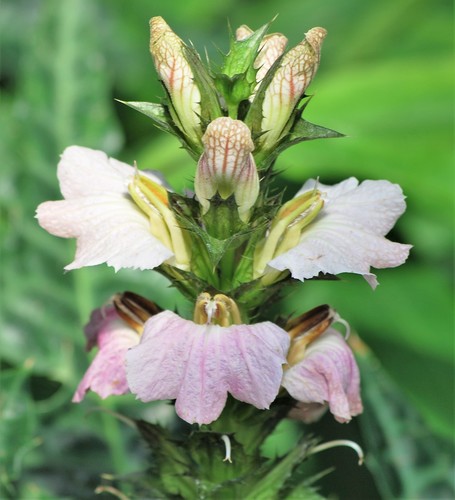
(c) Charles Stirton, some rights reserved (CC BY-SA), uploaded by Charles Stirton

(c) jess00000, some rights reserved (CC BY-NC)

(c) jess00000, some rights reserved (CC BY-NC)
What to Eat
Edible parts: Leaves, Plant - salt
The leaves are eaten, and the plant is used as a salt substitute.
Where to Find It
A tropical plant. It grows naturally in tropical West Africa. It suits hardiness zones 10-11. It needs a fertile well drained soil. It grows in mountain forest in the understorey.
Africa, Angola, Asia, Australia, Balkans, Benin, Central Africa, Central African Republic, CAR, Congo, Congo DR, Dominican Republic, East Africa, Europe, Gabon, Greece, Haiti, Indonesia, Malaysia, Mediterranean, Mozambique, Nigeria, Romania, Sao Tome and Principe, SE Asia, Singapore, Sierra Leone, Tasmania, West Africa, West Indies,
How to Identify
A shrub or small tree. It grows 5 m tall. There are prickles along the stem. The leaves are twice divided and there are 8-18 pairs of pinnae. There are up to 50 pairs of pinnules on each pinnae. The flowers are yellow. They are in large clusters at the ends of branches. The pods are flattened.
How to Grow
Plants can be grown from seeds or by cuttings.
Wikipedia
Source ↗Acanthus montanus, also known as bear's breech or mountain thistle and in Igbo; ogwu_ahga (in Agbani, Enugu State Nigeria) is a species of flowering plant in the genus Acanthus. It is native to tropical Africa, growing in wet and shady places like stream borders in Sierra Leone in West Africa and from Benin to Chad, Zambia, and Angola in central Africa. It is a thinly branched perennial with basal clusters of oblong to lance-shaped glossy, dark green leaves reaching up to 12 inches (30 cm) long. The leaves have silver marks, wavy margins and thorns. It reaches up to 6 feet (1.8 m) tall and about 24 inches (61 cm) wide. Spikes of pale pink flowers appear summer to fall. In cultivation it prefers shady situations and occasional deep watering, but tolerates sunny, dry situations too. Its aggressive roots make this plant well suited to slopes.
Notes
There are about 30-50 Acanthus species. There are about 3,000 Acanthaceae family plants. They are mostly tropical and subtropical. The family are mostly herbs or shrubs.
Names & Synonyms
Bear's breech, Jeruju gunung, Nkeka ngo, Nzundu nzundu
References (11)
- Brickell, C. (Ed.), 1999, The Royal Horticultural Society A-Z Encyclopedia of Garden Plants. Convent Garden Books. p 63
- Burkill, I.H., 1966, A Dictionary of the Economic Products of the Malay Peninsula. Ministry of Agriculture and Cooperatives, Kuala Lumpur, Malaysia. Vol 1 (A-H) p 26
- Cundall, P., (ed.), 2004, Gardening Australia: flora: the gardener's bible. ABC Books. p 82
- Harris, D. J., 2002, The vascular plants of the Dzanga-Sangha Reserve, Central African Republic. National Botanic Garden of Belgium, 2002. – 274 pages p 35
- Jardin, C., 1970, List of Foods Used In Africa, FAO Nutrition Information Document Series No 2.p 51
- Latham, P. & Mbuta, A. K., 2017, Plants of Kongo Central Province, Democratic Republic of Congo. 3rd ed p 17
- Lautenschläger, T., et al, 2018, First large-scale ethnobotanical survey in the province of Uíge, northern Angola. Journal of Ethnobiology and Ethnomedicine (2018) 14:51
- Llamas, K.A., 2003, Tropical Flowering Plants. Timber Press. p 28
- Martin, F.W. & Ruberte, R.M., 1979, Edible Leaves of the Tropics. Antillian College Press, Mayaguez, Puerto Rico. p 171
- Plants of Haiti Smithsonian Institute http://botany.si.edu
- Sukarya, D. G., (Ed.) 2013, 3,500 Plant Species of the Botanic Gardens of Indonesia. LIPI p 577


