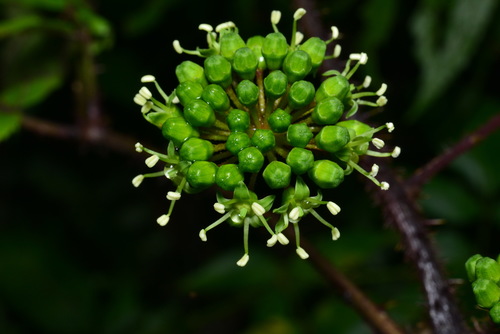
Schefflera pauciflora
R. Viguier
Sankho-ahi

GBIF
What to Eat
Edible parts: Fruit, Caution
The fruit is eaten, though caution is advised.
Known Hazards
Where to Find It
It is a tropical plant. It grows in evergreen broad-leaved forests between 200-1,700 m above sea level in south China.
Asia, China, India, Laos, Northeastern India, SE Asia, Vietnam,
How to Identify
A small tree. It grows about 9 m tall. It can have climbing stems 15 m long. The leaf stalks are 10-20 cm long. The leaves are compound and have leaflets spread out like fingers on a hand. The leaflets are oval and taper to both ends. There are 5-7 leaflets. They are 8-20 cm long by 3-9 cm wide. The veins are raised on both surfaces. The flowers are in a group of heads at the ends of the branches. There are 5-8 flowers in each head. The fruit is oval and 3-5 mm across. They have 5 ribs.
Medicinal Uses
It is used in medicine.
Notes
It is used in medicine.
Names & Synonyms
Qiu xu e zhang chai
References (1)
- Gangwar, A. K. & Ramakrishnan, P. S., 1990, Ethnobotanical Notes on Some Tribes of Arunachal Pradesh, Northeastern India. Economic Botany, Vol. 44, No. 1 pp. 94-105 (As Schefflera glomerulata)