Byttneria herbacea
Roxb.
Common hog weed
MalvaceaeLeaves
iNaturalist · cc-by-nc
(c) Mayuresh Kulkarni, some rights reserved (CC BY-NC)
(c) Mayuresh Kulkarni, some rights reserved (CC BY-NC)

iNaturalist · cc-by-nc
(c) Aditya Bari, some rights reserved (CC BY-NC)
(c) Aditya Bari, some rights reserved (CC BY-NC)
iNaturalist · cc-by-nc
(c) Subbu Ramanathan, some rights reserved (CC BY-NC)
(c) Subbu Ramanathan, some rights reserved (CC BY-NC)
What to Eat
Edible parts: Leaves
The leaves are eaten as a green.
Where to Find It
A tropical plant. It grows near Chennai. It grows on bare slopes between 800-1,100 m above sea level.
Asia, India,
Countries: United Arab Emirates, Afghanistan, Armenia, Azerbaijan, Bangladesh, Bahrain, Brunei, Bhutan, China, Georgia, Indonesia, Israel, India, Iraq, Iran, Jordan, Japan, Kyrgyzstan, Cambodia, North Korea, South Korea, Kuwait, Kazakhstan, Laos, Lebanon, Sri Lanka, Myanmar, Mongolia, Maldives, Malaysia, Nepal, Oman, Philippines, Pakistan, Qatar, Saudi Arabia, Singapore, Syria, Thailand, Tajikistan, Timor-Leste, Turkmenistan, Turkey, Taiwan, Uzbekistan, Vietnam, Yemen
How to Identify
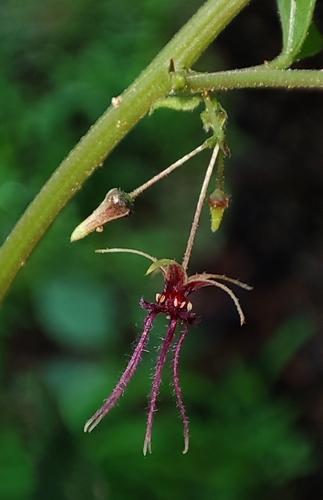
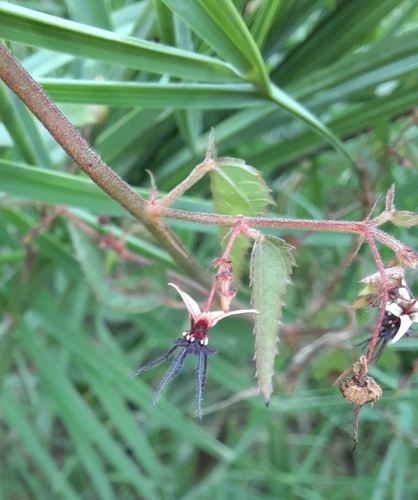
A herb. It lies along the ground. It can be 30 cm long. It has many branches. The stems are hairy. The leaves are simple and alternate. They are 2-3 cm long by 1.5-2.5 cm wide. The base is heart shaped and hairy. There are teeth along the edge. The flowers are red. They are in the axils of leaves. The fruit is a round prickly capsule.
Other Information
Famine food
Notes
Also put in the family Sterculiaceae. It has anti-oxidant potential.
Names & Synonyms
Aree keeray, Aree kura, Vipuri chedi
Buettneria herbaceaByttneria cordata Willd. ex Roxb.
References (4)
- GAMMIE, (As Buettneria herbacea)
- SHORTT, (As Buettneria herbacea)
- Singh, H.B., Arora R.K.,1978, Wild edible Plants of India. Indian Council of Agricultural Research, New Delhi. p 39 (As Buettneria herbacea)
- WATT, (As Buettneria herbacea)