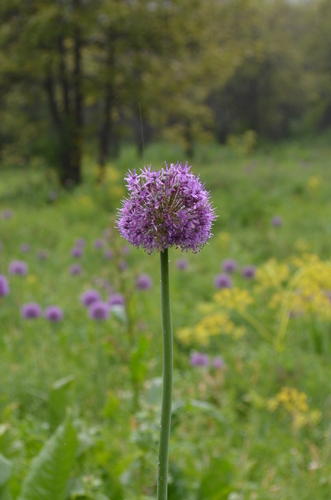
Allium ochotense
Prokh.
Siberian onion

(c) Boris Bolshakov, some rights reserved (CC BY-NC), uploaded by Boris Bolshakov

(c) 红梅, some rights reserved (CC BY-NC)
What to Eat
Edible parts: Leaves, Stalk
The leaves and stalks are used for flavouring and can be boiled to make tea, pickled, or added to soups.
Where to Find It
It is a temperate plant.
Alaska, Asia, China, Japan, Korea, Russia, Siberia,
How to Identify
An onion family herb. It grows 20-30 cm tall. It has a strong garlic like odour. The bulb is surrounded by a net like coating. The flowers are white.
Medicinal Uses
The leaves are boiled and used as a tea drink.
Wikipedia
Source ↗Allium ochotense, or the Siberian onion, is a primarily East Asian species of wild onion native to northern Japan, Korea, China, and the Russian Far East, as well as on Attu Island in Alaska. Some authors have considered A. ochotense as belonging to the same species as A. victorialis, but more recent authorities have treated it as a distinct species.
Other Information
It is culitvated. It is popular.
Notes
They have also been put in the family Alliaceae.
Names & Synonyms
Haengjacho, Meng-i, Myeong-i, Sanmanul
References (5)
- Chen, B. & Qiu, Z., Consumer's Attitudes towards Edible Wild Plants, Ishikawa Prefecture, Japan. p 22 www.hindawi.com/journals/ijfr/aip/872413.pdf (As Allium victorialis var. platyphyllum)
- Lee, Y. M., 2014, Important Plants of East Asia II: Endemic Plant Stories. East Asia Biodiversity Conservation Network p 10
- Ong, H. G., et al, 2015, Ethnobotany of the wild edible plants gathered in Ulleung Island, South Korea. Genet Resourc Crop Evol. Springer
- Pemberton, R. W. & Lee, N. S., 1996, Wild Food Plants in South Korea: Market Presence, New Crops, and Exports to the United States. Economic Botany, Vol. 50, No. 1, pp. 57-70 (As Allium victorialis var. platyphyllum)
- Seidemann J., 2005, World Spice Plants. Economic Usage, Botany, Taxonomy. Springer. p 27 (As Allium victorialis var. platyphyllum)