Allium neriniflorum
(Herb.) G. Don
Senghus, Togtulai

(c) Nan Yang, some rights reserved (CC BY-NC), uploaded by Nan Yang

(c) Nan Yang, some rights reserved (CC BY-NC), uploaded by Nan Yang
(c) 红梅, some rights reserved (CC BY-NC)
What to Eat
Edible parts: Bulbs, Vegetable
The bulbs are cooked and eaten as a vegetable.
Where to Find It
It is a temperate plant. It grows in damp places and sandy places along coasts. It grows from near sea level to 2,000 m above sea level in north China.
Asia, China, Mongolia, Russia,
How to Identify
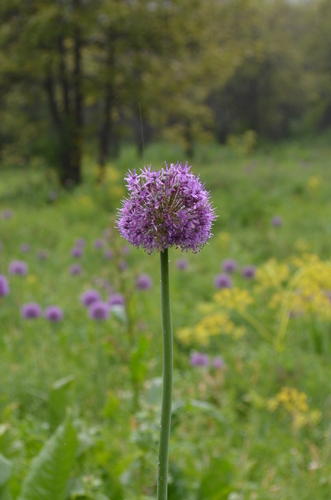
An onion herb. It has one bulb. It is 1-2 cm across. The leaves are 1-3 mm wide. The stalk is 20-50 cm long. It has leaf sheaths at the base.
Wikipedia
Source ↗Allium neriniflorum is a species of wild onion in the family Amaryllidaceae. It is native to Mongolia, the Zabaykalsky Krai region of Siberia, and northern China (Inner Mongolia, Hebei, Heilongjiang, Jilin, Liaoning). It grows on coastal sand dunes, wet meadows, hillsides, etc., at elevations up to 2000 m. Allium neriniflorum produces one round or egg-shaped bulb up to 2 cm (2⁄3 in) in diameter. Scape is up to 50 cm (20 in) tall. Leaves are round in cross-section, hollow, about the same length as the scape. Umbels contain only a few flowers, usually red or red-violet but sometimes white.
Notes
They have also been put in the family Alliaceae.
Names & Synonyms
References (2)
- Khasbagan, Hu-Yin Huai, and Sheng-Ji pei, 2000, Wild Plants in the Diet of Athorchin Mongol Herdsmen in Inner Mongolia. Economic Botany 54(4): 528-536
- Urgamal, M., et al, 2014, Conspectus of the Vascular Plants of Mongolia. Mongolia Academy of Sciences Institute of Botany and National University of Mongolia Department of Biology. p 47