Quercus obtusata
Humb. et Bonpl.
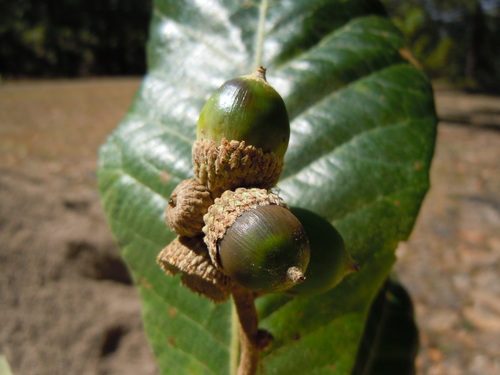
(c) Victor Quintero F., some rights reserved (CC BY-NC), uploaded by Victor Quintero F.

(c) Raymundo Omar, some rights reserved (CC BY-NC), uploaded by Raymundo Omar

(c) Pedro Nájera Quezada, some rights reserved (CC BY-NC), uploaded by Pedro Nájera Quezada
What to Eat
Edible parts: Seeds, Nuts
Where to Find It
It is a tropical plant.
Mexico, North America,
How to Identify
A tropical oak tree in the Fagaceae family with edible seeds and nuts.
Wikipedia
Source ↗Quercus obtusata is an oak in the white oak group (Quercus sect. Quercus) endemic to Mexico, with a distribution ranging from San Luis Potosí and Nayarit south to Oaxaca, from 620 to 2800 MSL. Quercus obtusata is a tree up to 20 metres (66 feet) tall with a trunk sometimes more than 60 centimetres (24 inches) in diameter. The leaves are thick and leathery, up to 22 cm (8+3⁄4 in) long, widely egg-shaped with 3–9 pairs of shallow rounded lobes or undulations. Resembles Q. potosina, which has smaller leaves (3–10 x 2–6 cm); also resembles Q. rugosa, this one has a convex leaf strongly coriaceous, a revolute margin, the epidermis bullate; at least, one can differentiate Q. obtusata from Q. laeta, which has foliar underside glaucous, without masses of glandular secretions, none or rare glandular trichomes, a leaf more oblong than oboval with a margin sometimes entire.
References (1)
- Casas, A., et al, 1996, Plant Management Among the Nahua and the Mixtec in the Balsas River Basin, Mexico: An Ethnobotanical Approach to the Study of Plant Domestication. Human Ecology, Vol. 24, No. 4 pp. 455-478
More from Fagaceae