Calamus deerratus
Mann. & H. A. Wendl.

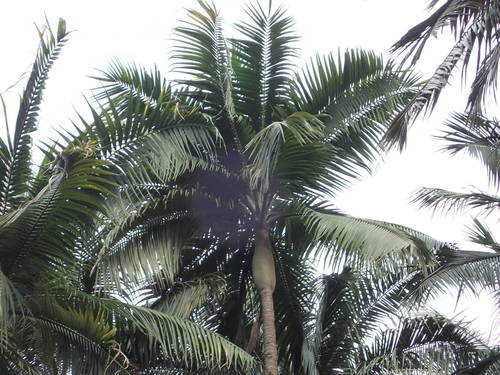
(c) Marco Schmidt, some rights reserved (CC BY-NC-SA), uploaded by Marco Schmidt

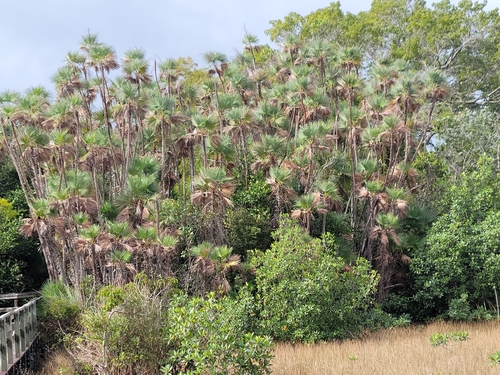
(c) Marco Schmidt, some rights reserved (CC BY-NC-SA), uploaded by Marco Schmidt
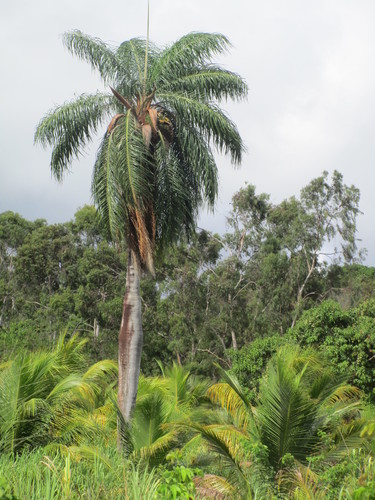
(c) Jurga Motiejūnaitė, some rights reserved (CC BY-NC)
What to Eat
Edible parts: Shoots, Vegetable, Bud
The stem tips are eaten raw or roasted as a vegetable, and the buds and young shoots are consumed as vegetables.
Where to Find It
A tropical plant. It grows to the top of forest trees in wet forest in West Africa. It grows along river banks. It suits hardiness zone 10a.
Africa, Angola, Burkina Faso, Central Africa, Central African Republic, CAR, Congo DR, East Africa, Gambia, Ghana, Guinea, Guinée, Guinea-Bissau, Nigeria, Senegal, Sierra Leone, Sudan, Uganda, West Africa, Zambia,
How to Identify
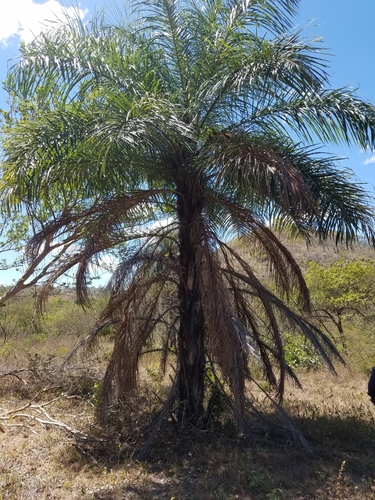
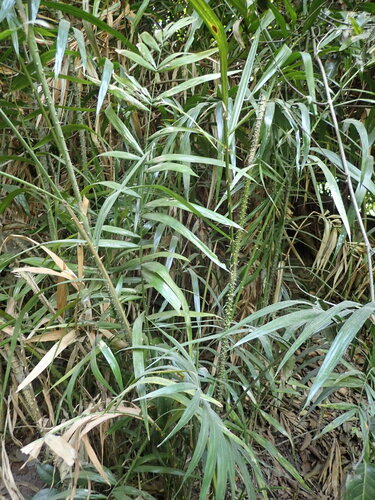
A palm or rattan. It is spiny and climbs 30 m high. The internodes are 15-20 cm long. The leaves have spines 1-5 cm long. The stem has long threads 2 m long with hooks.
Nutrition Score: 34/100
| Part | Moisture | kJ | kcal | Protein | Vit A | Vit C | Iron | Zinc |
|---|---|---|---|---|---|---|---|---|
| Shoots | 85 | 245 | 59 | 6 | — | — | — | — |
How to Grow
It can be grown from seeds. The fleshy layer should be removed. Sections of the rhizome can be used.
Propagation: Seed - it has a fairly short viability and is best sown as soon as it is ripe.
Other Uses
The stems are split and used to make a wide range of articles including rope, baskets, furniture, thatch and fences. Unsplit stems are traditionally used to make suspension bridges. The long and slender stems of Calamus species are put to various uses according to their size, length, flexibility, elasticity and toughness. The most slender canes are employed entire for binding purposes, and in making chairs, blinds, mats, wicker or basketwork, fishing implements, etc. Twisted together, they make very strong cables. The largest and more resistent canes are used entire as cables, the framework of wicker chairs etc. Usually, however, for many purposes the stems are split throughout their length into 2 - 4 or more strips from which the inner soft brittle and spongy portion is removed by means of a knife or same other instrument, so as to leave the external portion, which is hard, tough, flexible, elastic and has its outer surface very clean and smooth as if it had been varnished. Strips vary in width according to the use to which they are to be put. Those for delicate work, such as the network of furniture, small bags, hats, etc, are from 1 - 3mm wide; those employed as lashings in native housebuilding or in fastening the removable head of the Malay axe to its handle are from 5-6 mm wide. Collecting and preparing the stems is very simple. The stem is cut near the ground and detached from the trees by taking a strong hold of its base and thus pulling down the entire plant with its leaves. The most recent growth at the top of the plant is removed and then, handling it from the upper end, the stem is forcibly drawn in the opposite direction between two pieces of wood, thus removing the spiny coverings. It is then cut into lengths of about 5 metres, each piece is bent into two equal parts and the stems are fastened into bundles ready for market. The most valued stems are not thicker than a man's little finger and have a fine polished straw-yellow glassy surface.
Wikipedia
Source ↗Calamus deerratus is a dioecious rattan species within the family Arecaceae, it is widespread in Tropical Africa and it is the only species within the genus Calamus that is native to Tropical Africa.
Notes
There are 375-400 Calamus species. There are 175 species in tropical Asia.
Names & Synonyms
Batanor, Bu ketao, Bugal, Ecapate, Ki tid, Kintem, Kitinga, Lububi, Mam-tampa-de-sera, Quitite, Quito, Si utem, Tambin, Tambo
References (14)
- Abbiw, D.K., 1990, Useful Plants of Ghana. West African uses of wild and cultivated plants. Intermediate Technology Publications and the Royal Botanic Gardens, Kew. p 41
- Burkill, H. M., 1985, The useful plants of west tropical Africa, Vol. 4. Kew.
- Chapman, J. D. & Chapman, H. M., 2001, The Forest Flora of Taraba and Andamawa States, Nigeria. WWF & University of Canterbury. p 210
- Dalziel, J. M., 1937, The Useful plants of west tropical Africa. Crown Agents for the Colonies London.
- Djihounouck, Y., et al, 2018, Diversité Et Importance Socio-Economique Des Espèces Fruitières Sauvages Comestibles En Zone Kasa (Sud-Ouest Du Sénégal). European Scientific Journal December 2018 edition Vol.14, No.36 ISSN: 1857 – 7881
- Grivetti, L. E., 1980, Agricultural development: present and potential role of edible wild plants. Part 2: Sub-Saharan Africa, Report to the Department of State Agency for International Development. p 24
- Grubben, G. J. H. and Denton, O. A. (eds), 2004, Plant Resources of Tropical Africa 2. Vegetables. PROTA, Wageningen, Netherlands. p 560
- Latham, P. & Mbuta, A. K., 2014, Useful Plants of Bas-Congo Province, Democratic Republic of Congo. Volume 1. Salvation Army. p 95
- Malaisse, F., 1997, Se nourrir en floret claire africaine. Approche ecologique et nutritionnelle. CTA., p 59
- Malaisse, F., 2010, How to live and survive in Zambezian open forest (Miombo Ecoregion). Les Presses Agronomiques de Gembloux.
- Peters, C. R., O'Brien, E. M., and Drummond, R.B., 1992, Edible Wild plants of Sub-saharan Africa. Kew. p 37
- Terashima, H., et al, 1991, Ethnobotany of the Lega in the tropical rainforest of eastern Zaire: part 1, Zone de Mwenga. African Study Monographs. Suppl. 15:1-61
- Trans. Linn. Soc. London 24:429, t. 41. 1864
- World Checklist of Useful Plant Species 2020. Royal Botanic Gardens, Kew