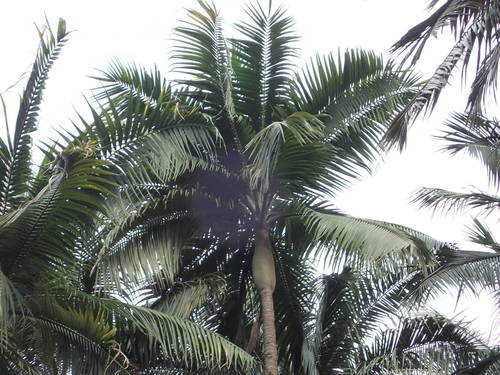
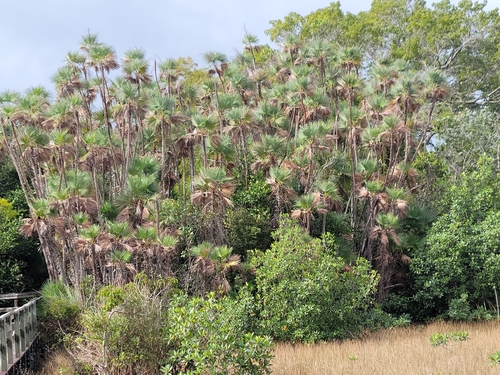
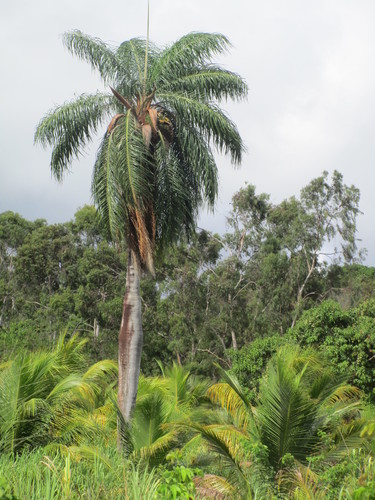
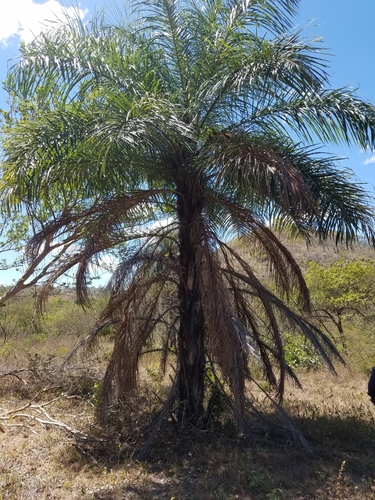
Calamus sp.

Wikimedia Commons - Nativeplants garden

Wikimedia Commons - Jyotsna Nag
What to Eat
Edible parts: Fruit
In forests where rattan grows, its economic value can play a crucial role in conservation efforts. By offering an alternative source of income, rattan harvesting can deter loggers from engaging in timber logging. Harvesting rattan canes is simpler and requires less sophisticated tools compared to logging operations. Furthermore, rattan grows rapidly, which facilitates quicker replenishment compared to tropical wood species.This economic incentive supports forest maintenance by providing a profitable crop that complements rather than competes with trees. However, the long-term profitability and utility of rattan compared to other alternatives remain subjects of ongoing evaluation and study. Cleaned rattan stems with the leaf sheaths removed are superficially similar to bamboo. Unlike bamboo, rattan stems are not hollow. Most (70%) of the world's rattan population exists in Indonesia, distributed among the islands Borneo, Sulawesi, and Sumbawa. The rest of the world's supply comes from the Philippines, Sri Lanka, Malaysia, Bangladesh and Assam, India.
Where to Find It
A tropical plant. It occurs in lowland areas.
Pacific, Papua New Guinea, PNG,
How to Identify
A thorny rattan with parallel veined leaves. The fruit hangs in clusters from fruiting branches. Fruit are 1 cm across and pale greenish white with a scaly surface.
How to Grow
Plants are grown from seed.
Medicinal Uses
In early 2010, scientists in Italy announced that rattan wood would be used in a new "wood to bone" process for the production of artificial bone. The process takes small pieces of rattan and places them in a furnace. Calcium and carbon are added. The wood is then further heated under intense pressure in another oven-like machine, and a phosphate solution is introduced. This process produces almost an exact replica of bone material. The process takes about 10 days. At the time of the announcement the bone was being tested in sheep, and there had been no signs of rejection. Particles from the sheep's bodies have migrated to the "wood bone" and formed long, continuous bones. The new bone-from-wood programme is being funded by the European Union. By 2023, experimental implants into humans were taking place.
Production
Fruiting is seasonal.
Notes
There are 375-400 Calamus species. There are 175 species in tropical Asia.
References (2)
- French, B.R., 1986, Food Plants of Papua New Guinea, A Compendium. Asia Pacific Science Foundation p 323
- Williams, C.N., Chew, W.Y., and Rajaratnam, J.A., 1989, Tree and Field Crops of the Wetter Regions of the Tropics. Longman, p 181