Brassaiopsis glomerulata
(Blume) Regel
Hoblaiso

(c) John P, some rights reserved (CC BY-NC), uploaded by John P
(c) John P, some rights reserved (CC BY-NC), uploaded by John P

(c) equisetalean, some rights reserved (CC BY-NC)
What to Eat
Edible parts: Leaves
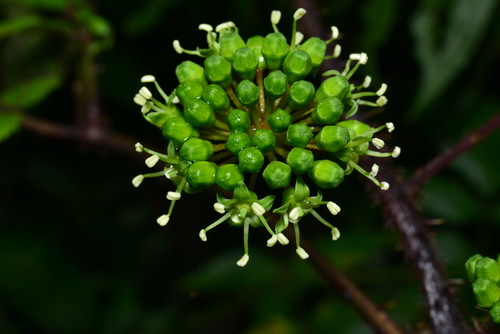
The fruits are eaten as chutney, and young leaves are also made into chutney.
Where to Find It
It is a tropical plant. It grows on mountain slopes and in valleys between 400-2,400 m above sea level. In Sichuan and Yunnan.
Asia, Bhutan, Cambodia, China, Himalayas, India, Indochina, Indonesia, Laos, Myanmar, Nepal, Northeastern India, SE Asia, Thailand, Vietnam,
How to Identify
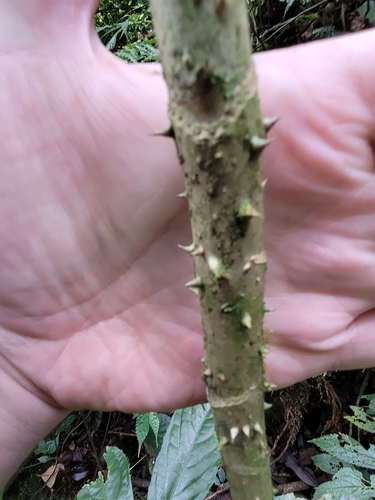
A tree. It grows 20 m tall. The branches have prickles. They have a rusty red coating when young. The leaves are compound and have leaflets arranged like fingers on a hand. There are 5-9 leaflets. The leaflets are 15-35 cm long by 6-15 cm wide. The fruit are round and 7-10 mm across.
Wikipedia
Source ↗Brassaiopsis glomerulata is a species of shrub in the family Araliaceae. Extracts are sold as bodybuilding supplements based on the assumption that aromatase inhibitors present in the plant might have effects in humans.
Names & Synonyms
Baw, Dong gong lu, Guo dan, Ta bi ta la, Tago
References (5)
- Cao, Y., et al, 2020, Ethnobotanical study on wild edible plants used by three trans-boundary ethnic groups in Jiangcheng County, Pu’er, Southwest China. Journal of Ethnobiology and Ethnomedicine (2020) 16:66
- Johnson, N., 2002, Environmental Change in northern Thailand: Impact on Wild Edible Plant Availability. Ecology of Food and Nutrition, 41: 5, 373-399
- Murtem, G. & Chaudhrey, P., 2016, An ethnobotanical note on wild edible plants of Upper Eastern Himalaya, India. Brazilian Journal of Biological Sciences, 2016, v. 3, no. 5, p. 63-81 (As Brassiopsis)
- Priyadi, H., et al, Five hundred plant species in Gunung Halimun Salak National Park West Java. A checklist including Sundanese names, distribution and use. CIFOR, FFPRI, SLU p 137
- Srivastava, R. C., 2010, Traditional knowledge of Nyishi (Daffla) tribe of Arunachal Pradesh. Indian Journal of Traditional Knowledge. 9(1):26-37 (Also as Brassaiopsis speciosa)