Allium prattii
C.H. Wright ex Forbes & Hemsl.
Chhaphi

(c) Jinmin Li, some rights reserved (CC BY-NC-SA), uploaded by Jinmin Li

(c) 桃子, some rights reserved (CC BY-NC), uploaded by 桃子

(c) Panayoti Kelaidis, some rights reserved (CC BY-NC), uploaded by Panayoti Kelaidis
What to Eat
Edible parts: Leaves, Bulb, Flowers
The bulbs are eaten fresh or used as a flavouring. The leaves are used for flavouring curries. The flowers are also edible.
Where to Find It
It is a subtropical plant. It grows in shady and damp places and along stream banks between 2,000-4,900 m above sea level. In Yunnan. In Sichuan.
Asia, Bhutan, China, Himalayas, India, Nepal, Northeastern India, Sikkim, Tibet,
How to Identify
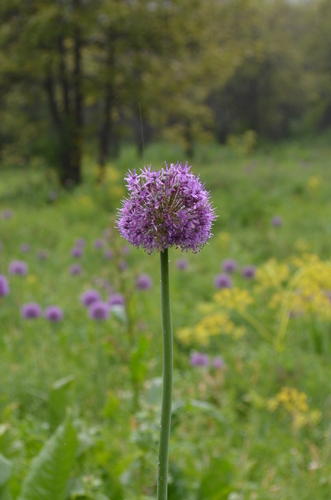
An onion family herb. There can be one bulb or a cluster. There are 2 leaves. They are sword shaped and 1-4 cm wide. The stalk is 10-60 cm long. The flowers are purple red or pale red.
Wikipedia
Source ↗Allium prattii is an Asian species of wild onion native to Assam, Nepal, Sikkim, Bhutan, and China (Anhui, Gansu, Henan, Qinghai, Shaanxi, Sichuan, Tibet, Yunnan). It is found at elevations of 2000–4900 m. Allium prattii has a scape up to 60 cm tall, round in cross-section. Leaves are flat, linear or very narrowly elliptic, usually a bit shorter than the scape. Umbel is hemispheric with many red or purple flowers.
Notes
They have also been put in the family Alliaceae.